
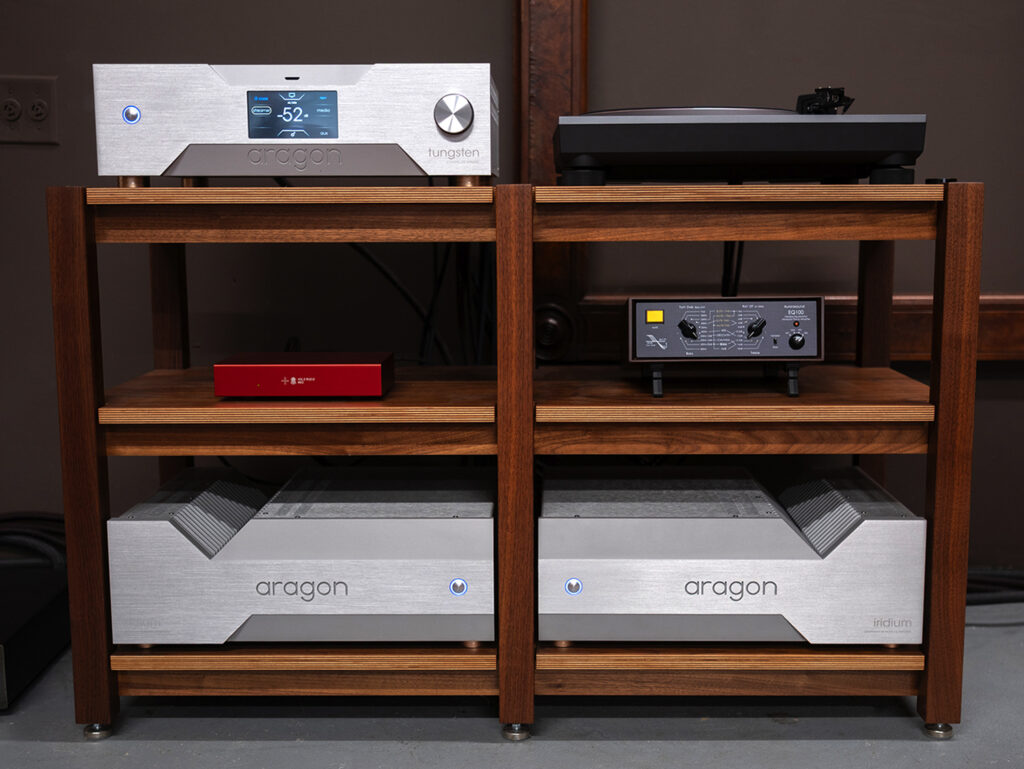
Reviving a classic brand comes with perceived pluses and minuses.
On the plus side, a well respected brand like Aragon comes with certain expectations including solid engineering and exceptional build quality while on the minus side, and this holds for any re-vamped brand, people wonder if they’re looking at an old design best left in the past.
But lets begin at the beginning. Mondial Designs was founded in 1986 by Paul Rosenberg and Anthony Federici who manufactured hifi components under the Aragon and Acurus brands. The dual-mono 4004 was their first amplifier, with circuit design by none other than Dan D’Agostino, under the Aragon brand followed by the MK II version, the 8008 in 1986, and the Palladium monoblock powerhouses. Each one of these amplifiers were and still are viewed by many as classics when it comes to bang for the buck—high performance high value bullet proof design with many older Aragon amps still out there playing away with raw musical power. It wasn’t uncommon back in the day to find an Aragon amp paired with a pair of Apogees, panel speakers known for their ability to suck the life out of most accompanying amplifiers.
Rick Santiago, an engineer, audio product designer and musician, and Ted Moore, a physicist and specialist in manufacturing precision semiconductors and instrumentation, co-founded Indy Audio Labs (IAL) in 2008 and purchased Aragon and Acurus a year later from Klipsch who bought and basically shelved the brands in 2001.
From IAL:
Indy Audio Labs develops and manufactures all of its products in the US using proprietary hardware, software and manufacturing techniques. The same Indianapolis facility that produces Aragon and Acurus circuit boards also manufactures devices for demanding customers in other industries such as medical, aerospace and military. Indy Audio Labs prides itself on remaining true to both its made in America brand heritage and to the high-value, high-performance promise that made Aragon and Acurus famous.
The Tungsten Preamp and Iridium Monoblocks, both part of the Aragon Elements Collection, made their first public appearance at Cedia in 2021.

I asked my contact at IAL, Richard Henthorne, Senior Director of Sales, for a few words explaining how the new Aragon Iridium monoblocks differ from the old Aragon Palladium mono amps:
Imagine if you tasked yourself with looking at a legendary product with fresh eyes. The team at Aragon has taken the Palladium mono black amplifiers and left no stone unturned in regards to:
Larger higher quality toroid. Virgin cores with proprietary winding techniques. Made in Canada.
Optimizing the power supply. Four 37000 uF, European made premium filter caps are used. The size of soda cans and bolted to the rectifier board.
Speaking of rectifiers, the competition uses a single 35 amp rectifier for up to a 1-2kw mono.
We use a set of four …..
The channel cards use a total of 24 hand matched ultra high bandwidth power transistors. Packing a slew rate exceeding 240 volts per microsecond make these the fastest amplifiers in the real world.
Every component on the channel card has been scrutinized to be the highest quality part for its purpose, surface mount design is used where possible to minimize circuit lengths. And speaking of that, each channel card is a perfect mirror image. And each Iridium is a mirrored pair.
I think it’s safe to say the Iridium monoblocks have been re-engineered from the ground up.
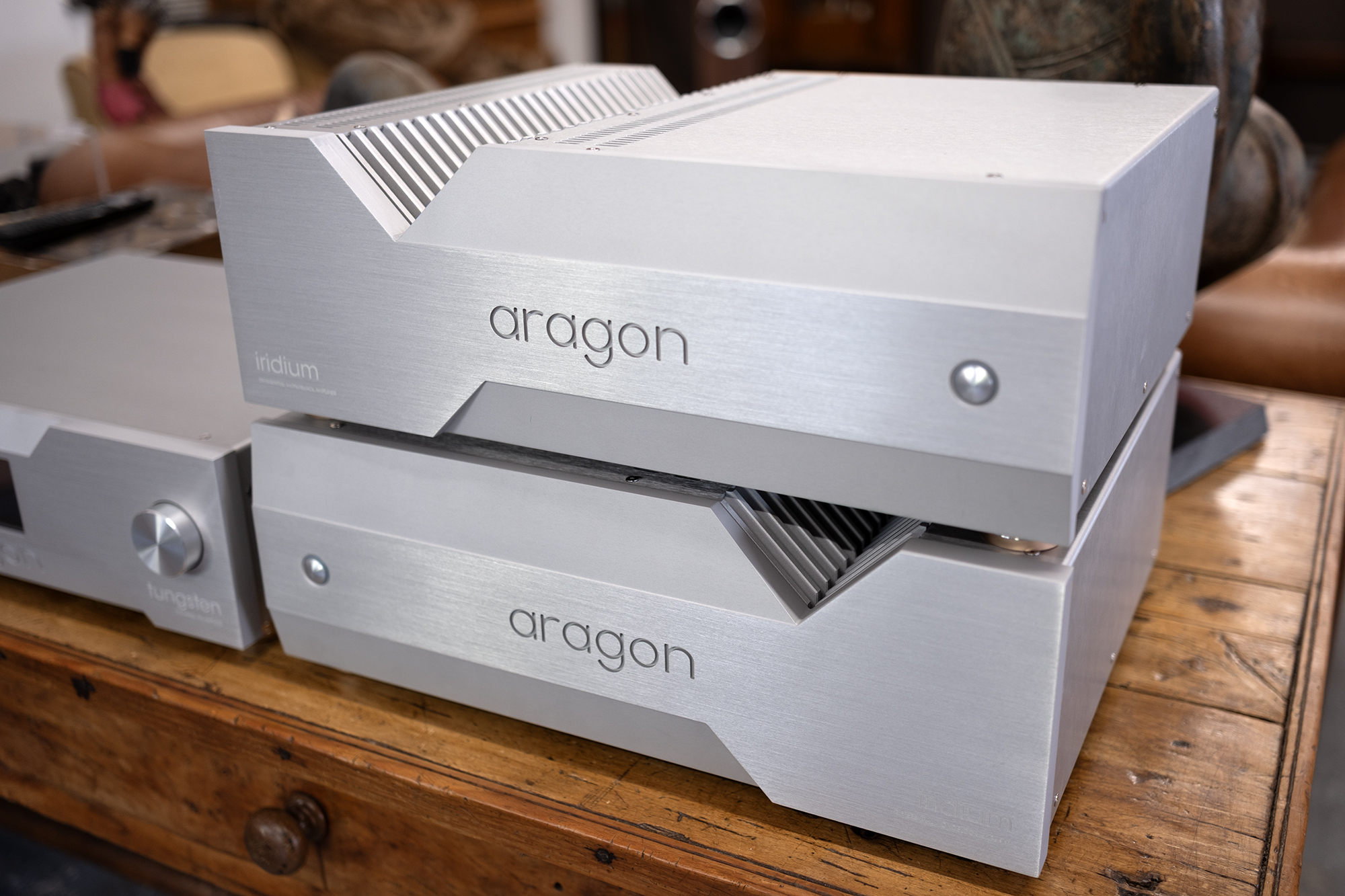
The Iridium operate in high-biased Class A/B offering 400 Watts of output power into 8 Ohms, 600 Watts into 4, and > 1000W into 2 with the first 24 Watts (or so) delivered in Class A.
From the User Manual:
The new TITANIUM circuitry consists internally of two in-dependent power supplies; two massive 0.5kVA toroidal transformers feed pairs of 35A bridge diode rectifiers. These supply signals are then filtered by more than 140,000uF of capacitance to deliver clean +/-70-volt power rails to each channel. The IRIDIUM power supply is more than twice that of the TITANIUM on a per-channel basis because it’s built around a single massive 1.2kVA toroidal transformer feeding all four 35A bridge rectifiers and 140,000uF of capacitance.
Both the TITANIUM and IRIDIUM use a discrete symmetrical amplifier circuit topology. No ICs are used in the signal path. Instead, some of the latest low-noise, high-voltage discrete semiconductors are used throughout. Both Aragon models are DC-coupled input-to-output. Zero-offset is maintained by a newly designed servo circuit. The control and monitoring sub-system integrated this latest generation Aragon amplifier features several advancements in thermal management and fault protection over prior designs.
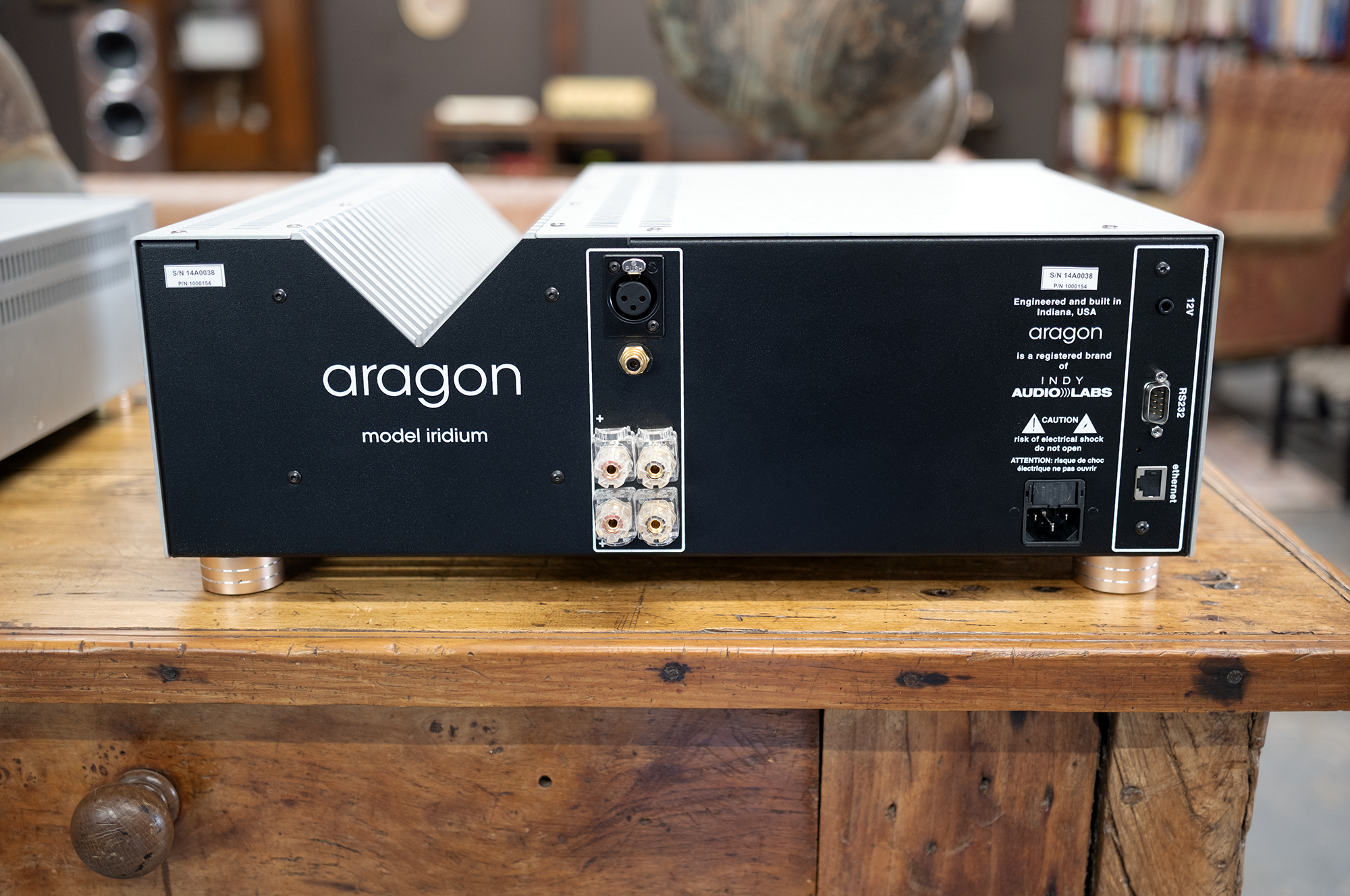
A single single-ended RCA and XLR input join 2 sets of gold-plated, 60-amp insulated 5-way speaker binding posts for bi-wiring. The Network Module houses an RS-232 input for system control with support for home automation systems, Ethernet for factory programming, and a 3.5mm external 12V trigger input.
Each monoblock weighs in at >60 lbs which is about the limit of back-friendly in my aging book. The thick sculpted aluminum front panel sports a laser-etched model name, a precision-machined brand logo, and a single power button that’s surrounded by a blue light when powered on and red when off for a clean understated look. Overall the Iridium monoblocks look the part of very well built power amplifiers more than ready to do the all-important job of making speakers sing (and you dance).

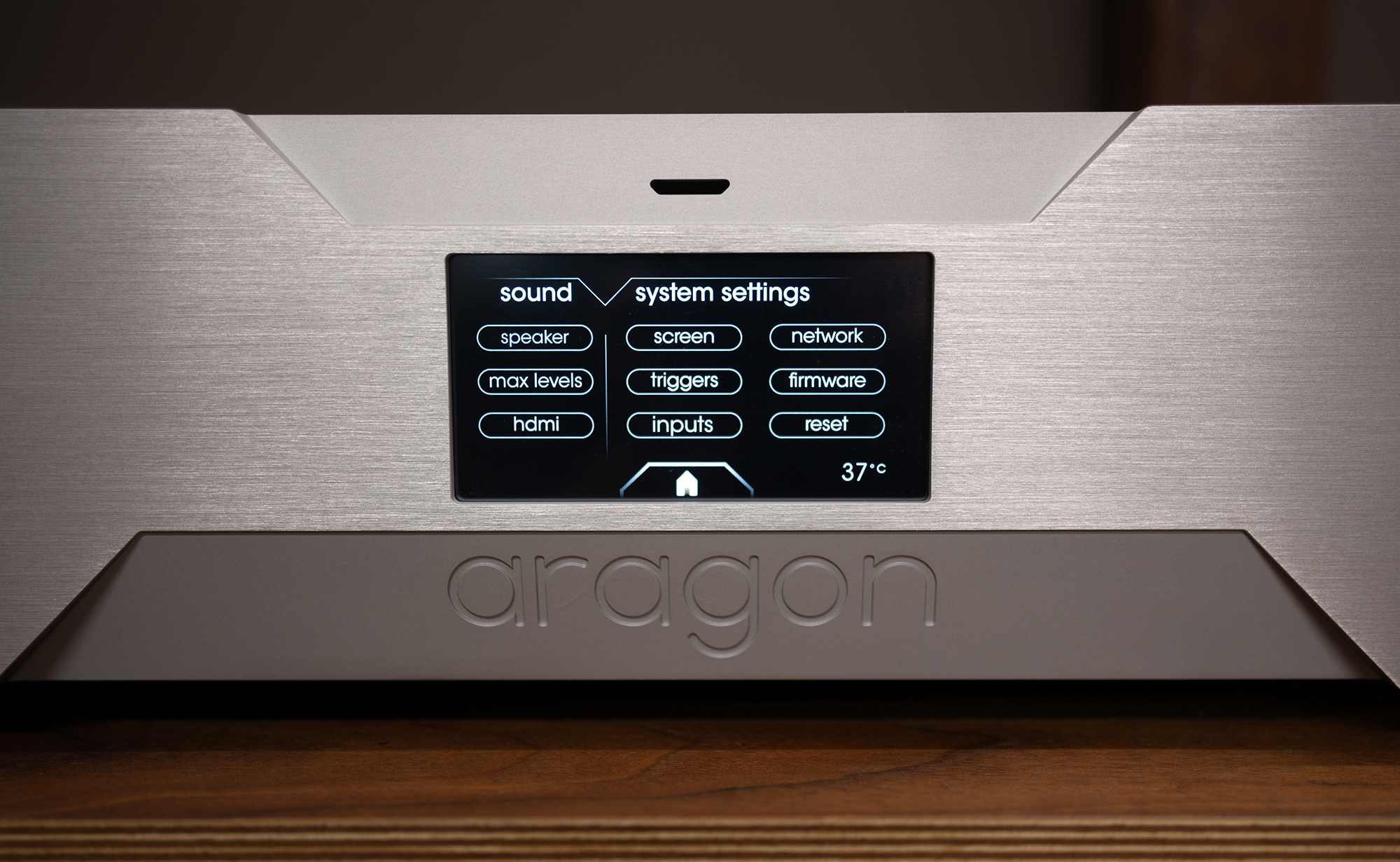
The Tungsten Preamplifier carries on the clean chunky sculpted understated look of the Iridium monoblocks but that centered 5” LCD touch panel display hints at the complexities inside that include a 24-bit/192kHz capable DAC, MM phono stage, and a DSP-based parametric EQ with five bands per channel.
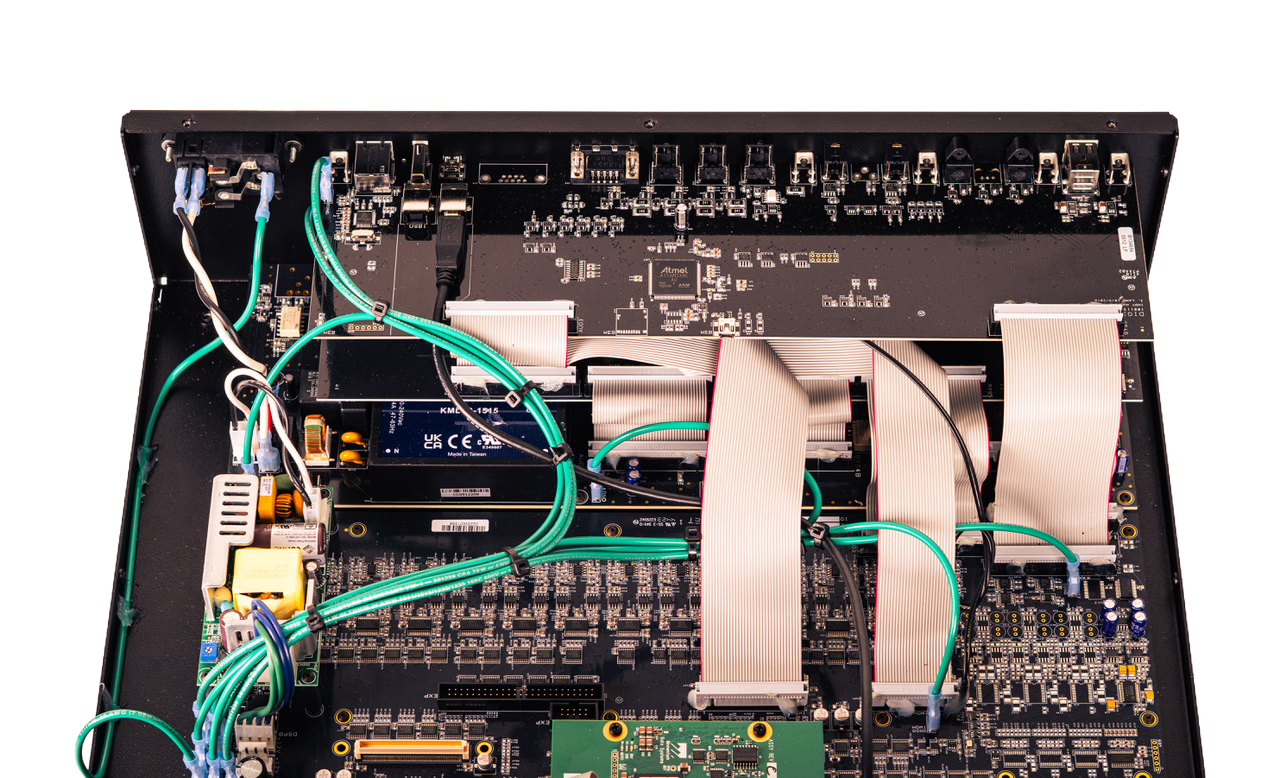
The Aragon website is slim when it comes to details about the Tungsten and the user manual is in the works.
Here are the Tungsten’s bullet points from the company:
- world-class performance for high resolution audio playback
- meticulous attention to signal path integrity
- wide range of analog and digital inputs
- DSP supports a host of EQ options
- Ethernet-based control and status monitoring
- software upgradeable
- solid American engineering and construction
- 5-year warranty
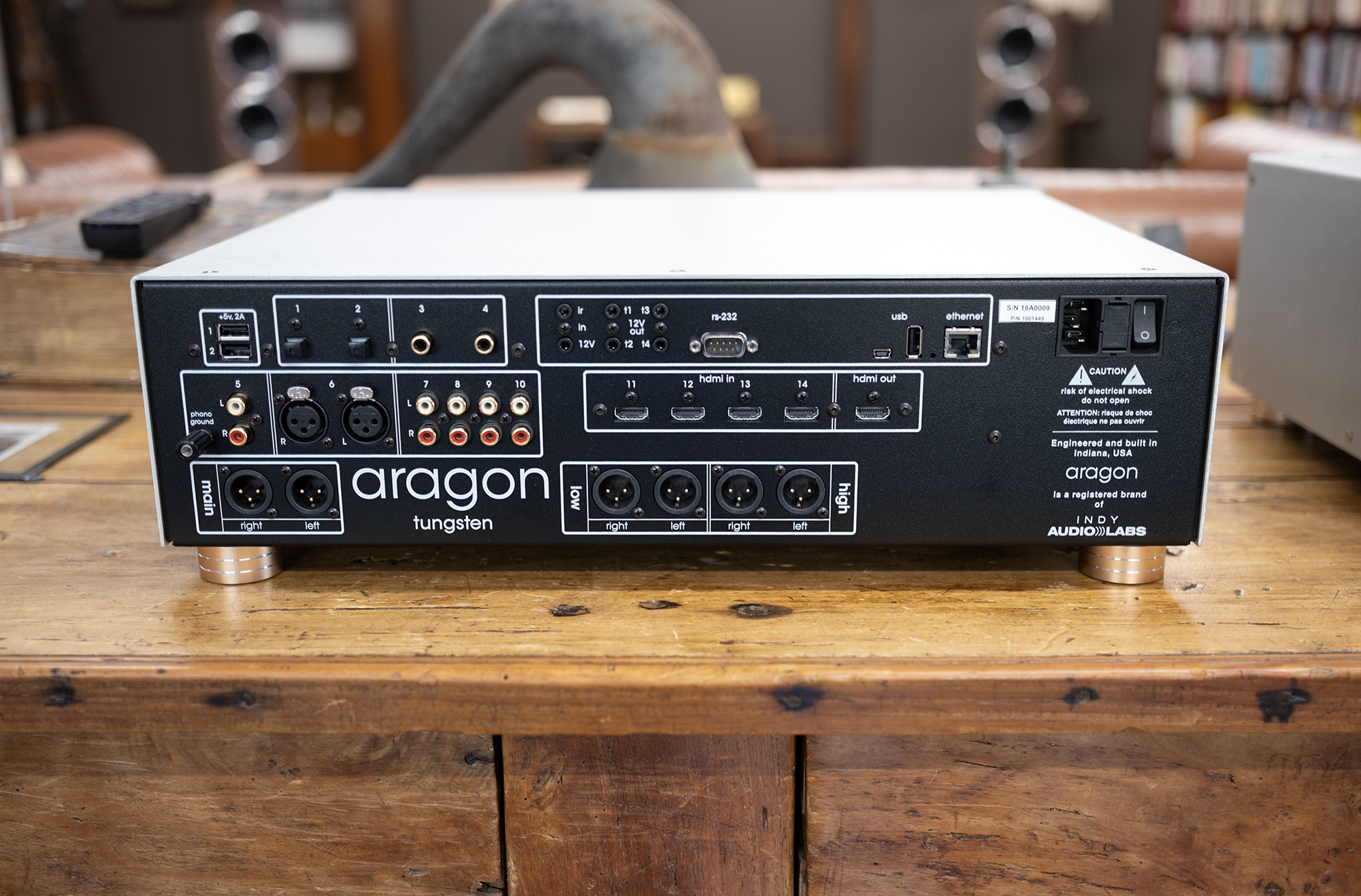
The Tungsten preamplifier offers a number of digital inputs (2x coax RCA, 2x optical, 4x HDMI 2.0 with pass-through) in addition to 4x RCA and 1x XLR inputs and a single pair of XLR outputs. The additional XLR outputs (marked High and Low) are for future 2 and 3 way crossover functionality that will come with a firmware upgrade. The Tungsten can be run analog all the way if you so desire. It’s also worth noting that the Tungsten is built to be easily upgradeable via firmware in addition to its modular design when it comes to the in-built DAC. Future proof.
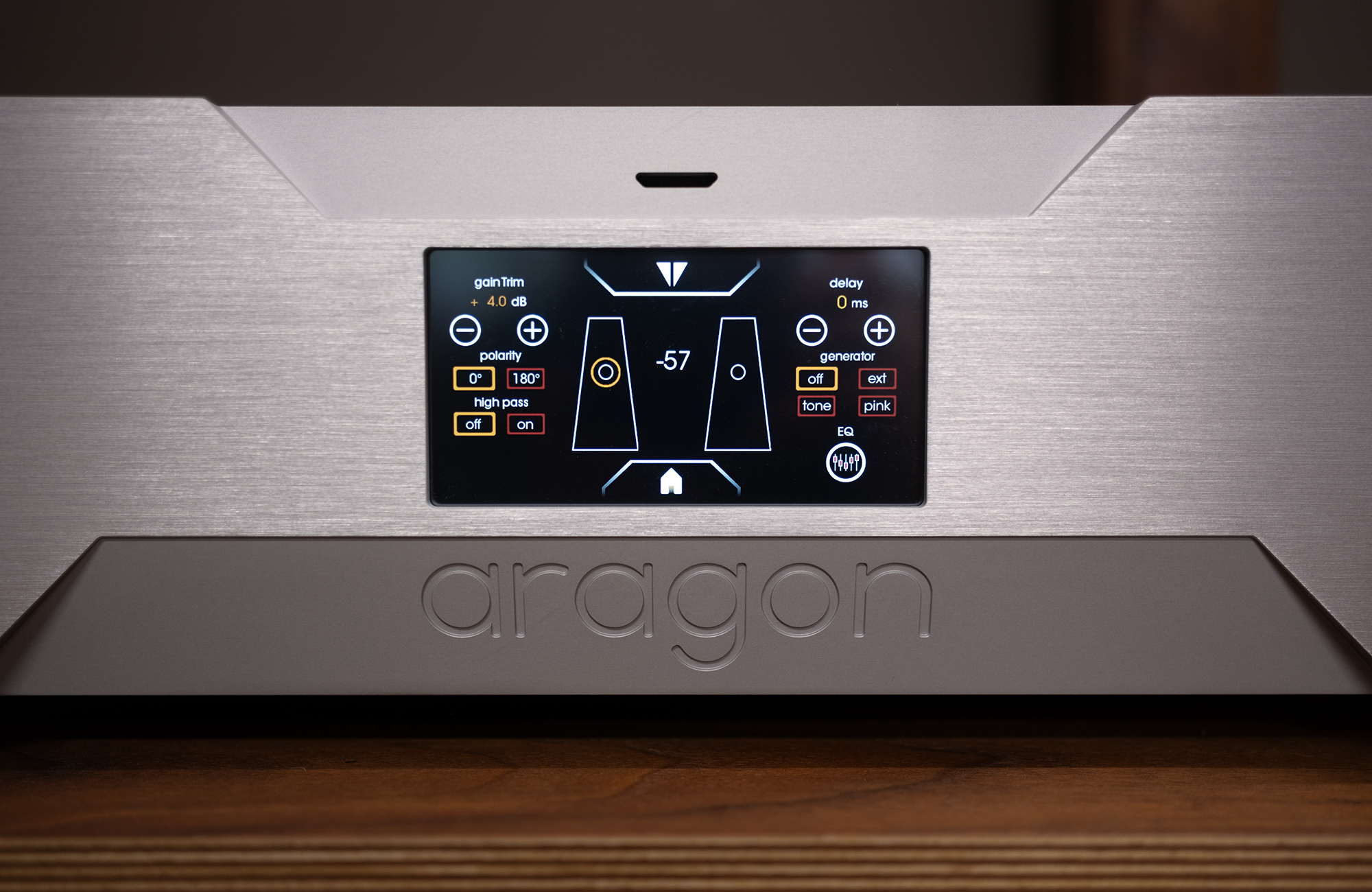
Even without help from a manual I was able to suss out the Tungsten’s functionality to meet my needs which included using its DAC paired with the over-achieving Barn resident HoloAudio Red DDC & Network Streamer (review) via an AudioQuest Coffee Coax cable as well as its MM phono input paired with the newly Barn resident Aurorasound AFE-12 MC Step-Up Transformer to step up my Zu/DL103 Mk.II cartridge mounted on the review Technics SL-1500CS Direct Drive Turntable (more info). I did not EQ.
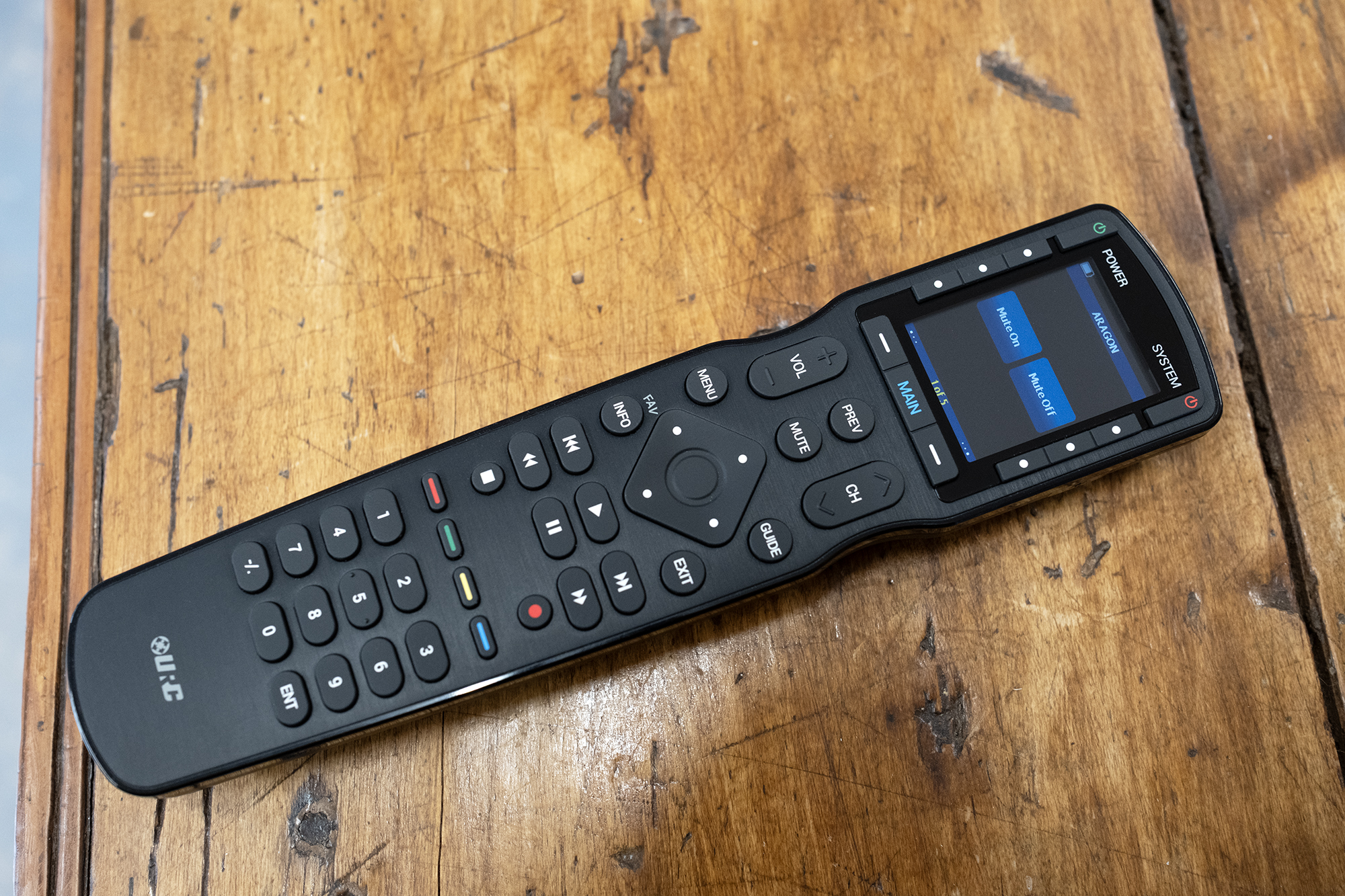
The included generic remote has a nice-sized screen of its own and I understand the company is working on a matching remote.
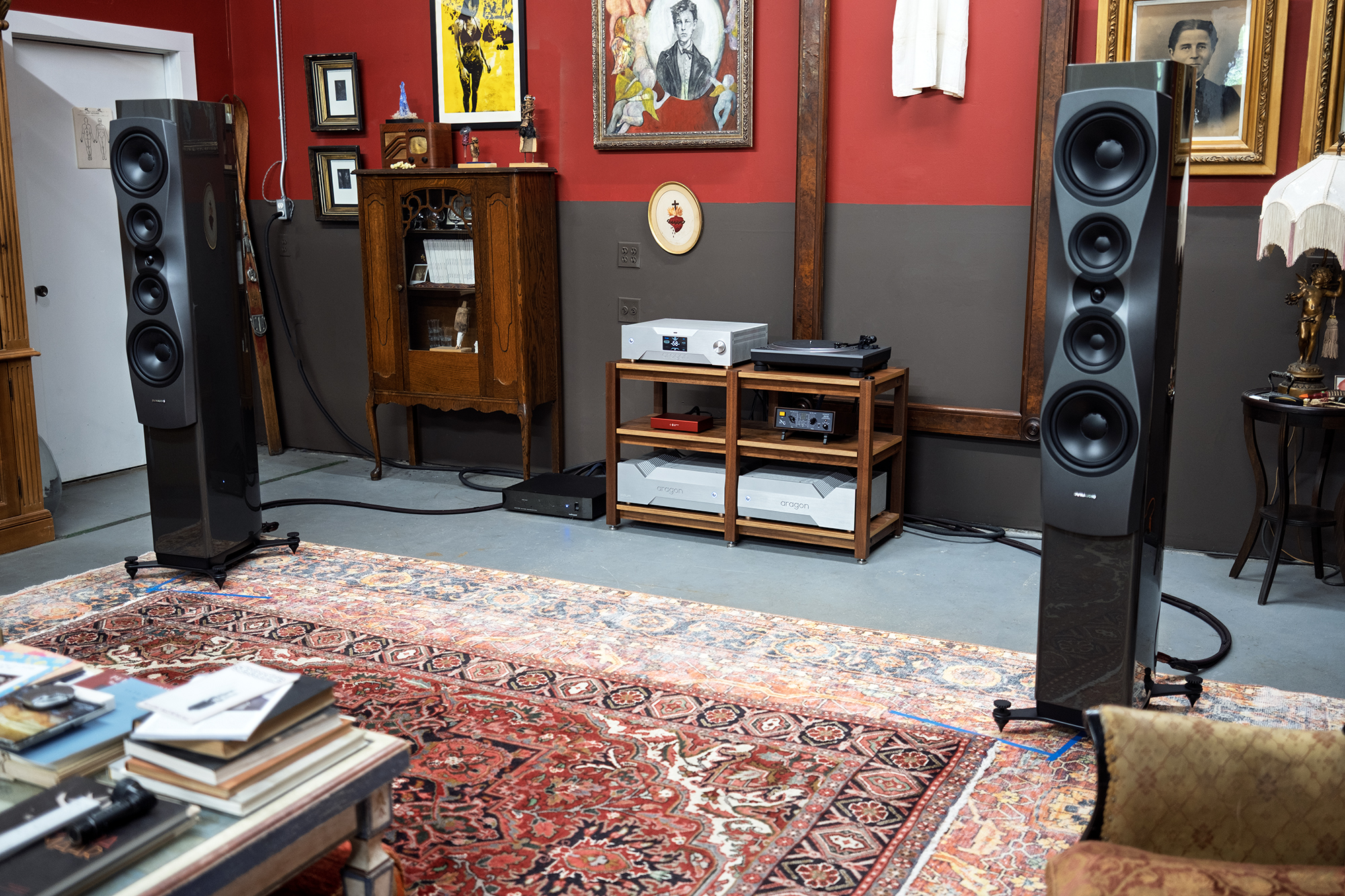
The Aragon stack got to play with two pair of speakers including the recently reviewed Dynaudio Confidence 60 (review) and the in for review Peak Consult Sinfonia (more info) all wired with cables from AudioQuest (see full Barn and system details).
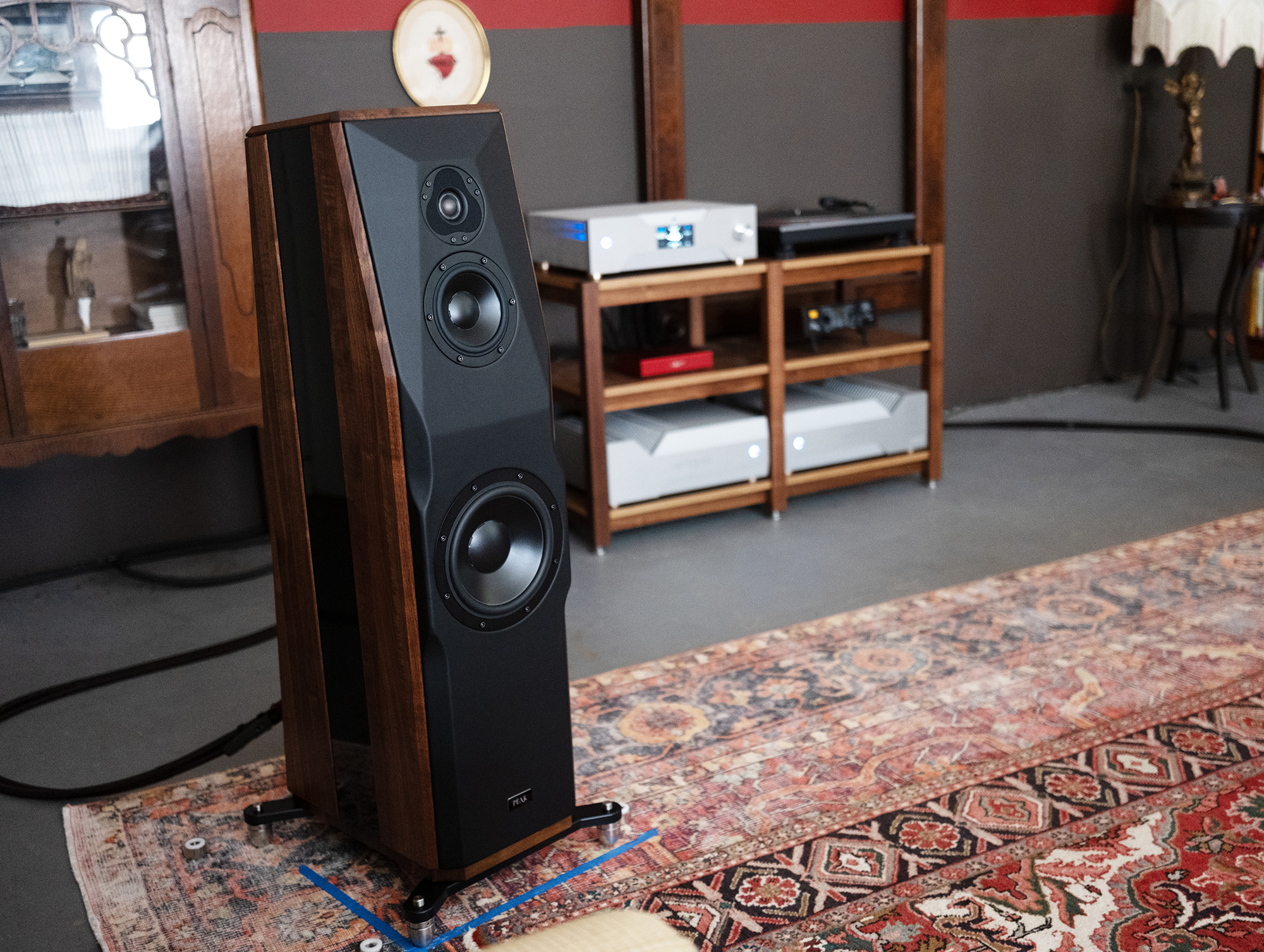
As you can read in my review, the Dynaudio Confidence 60 offer room-friendly full-range performance and the Aragon stack drove the heck out ‘em from 1Hz on up. What? How many Hertz? Richard Henthorn introduced me to Bass From Hell, Vol. 1 by Senhor De Baixo that includes, well, bass from hell dipping well below audible levels but when played through the big Dynaudios you could see that sub-bass energy moving cones and air. Woof!
While Bass From Hell is a novelty for me, the Aragon stack’s ability to offer controlled and fully formed bass response as low as your hearing and speakers can go proved thrilling on music I enjoy including Carrier’s 2025 stunner Rhythm Immortal. In addition to some nice deep bass, this album is a great test for other important aspects of reproduction including dynamics, resolution, clarity, and speed. And timbre. A full workout test that the Aragon stack passed with Mensa-level acuity. In terms of creating a believable, vast, and highly defined sound image, the Aragon gear was extremely impressive and I’m not so sure I’ve heard better in this regard. Of course in order for these qualities to be the case the amplification chain has to have nearly non-existent levels of self noise as these sonic things can get buried in the noise floor. Or so I’ve heard from other amps.
All to say the Aragon stack offered exceptional clarity in every regard coupled with effortless control no matter the music or frequency. Impressive.
Sally Anne Morgan’s Second Circle The Horizon also released in 2025 is another album I go back to albeit for different reasons. Fiddle, banjo, electric and acoustic guitar, piano, various percussion, hurdy gurdy, bass, and synthesizers are the basis of these meditative meanderings.
From the liner notes:
Raised on old time and Appalachian folk traditions, Morgan’s artistry embodies the rich life of the communities and natural world she surrounds herself with. Based in Alexander, NC in the thick of Appalachia, and edge of the Pisgah National Forest, Morgan’s blend of traditional technique and distinctly modern compositional approach are infused with the sounds of her garden, surrounding pastures, forests and mountains. The rhythms of nature, its flora and fauna, are inseparable from her work which is in constant conversation with the people and places around her. Second Circle The Horizon is a meditation on returning, uncovering the new within the familiar and recognizing the familiar within the new.
Regular readers know I have a very strong attachment to tone or timbre or simply the way things sound and the more natural the better. It can be the case that some powerful solid state amps can lean things out, making the sound of things like banjo and fiddle feel underdeveloped, short on their full harmonic potential and I am very happy to report that the Aragon gear suffered no such loss. While you wouldn’t mistake the Tungsten / Iridium combo for a 300B-based single-ended amp, there was indeed a harmonic rightness to music and the pair pushing the Peak Sinfonia sounded rich and right.
In terms of overall balance, I would say the Aragon gear sounds rounder than other solid state amps I’ve had in for review. In this regard I’ll point to the much more expensive JMF Audio PRS 1.5 Preamplifier/HQS 6002 Amplifier combo (review) which offered an even greater sense of transparency and the much less expensive Musical Fidelity M8xi Integrated Amplifier (review) that sounds comparatively a bit flat and bleached. To put a finer point on it, the Aragon gear has a full-bodied richness that I found very inviting.
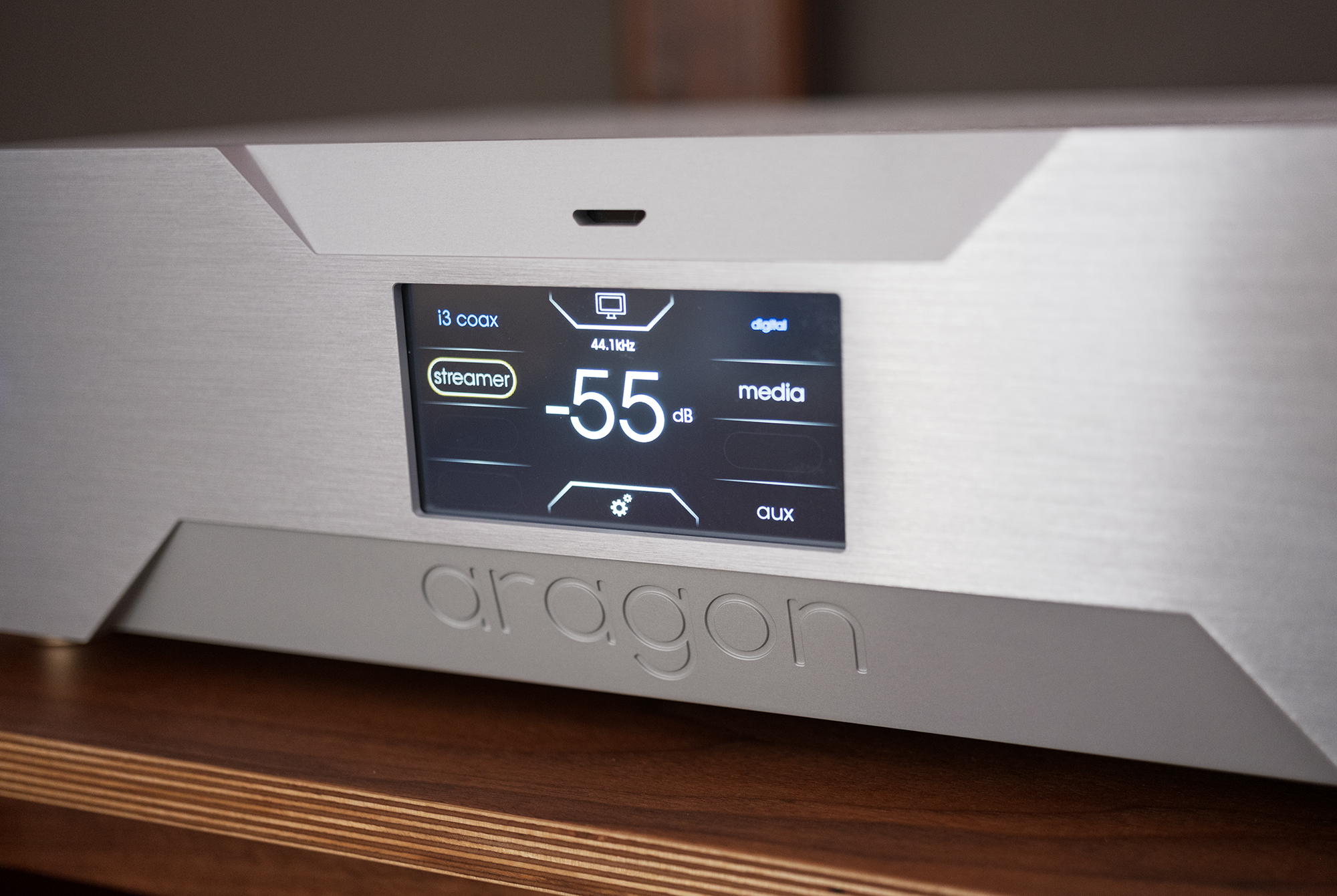
I’ll admit that integrated amplifiers and preamplifiers that come with a DAC rarely excite me. When offered as an option I usually recommend a pass the higher the price goes. So when I first had the Aragon stack setup and ready to roll, I employed the exceptional Imersiv D-1 DAC (review), a D to A converter that in many ways is the best stand alone DAC I’ve heard. And by stand alone DAC I mean just a DAC without streaming capabilities.
But then I switched to the DAC inside the Tungsten, with the Holo Red doing the streaming bit, and was shocked. No, make that shocked! at what I heard. And what I heard was immediately obvious and included an opening up of the sound image to a greater degree, greater refinement, and a slightly richer sound. What the heck? I spoke to Richard Henthorne about this phenomena and he explained that they had spent real time tweaking their digital filter, using measurements and ears, to get the sound they were looking for. I’m glad they found it.
All to say I’m going to say something I’ve never said about a DAC inside a preamp or integrated amp–don’t even think about ignoring the Tungsten’s DAC unless you like wasting money. It is that good.
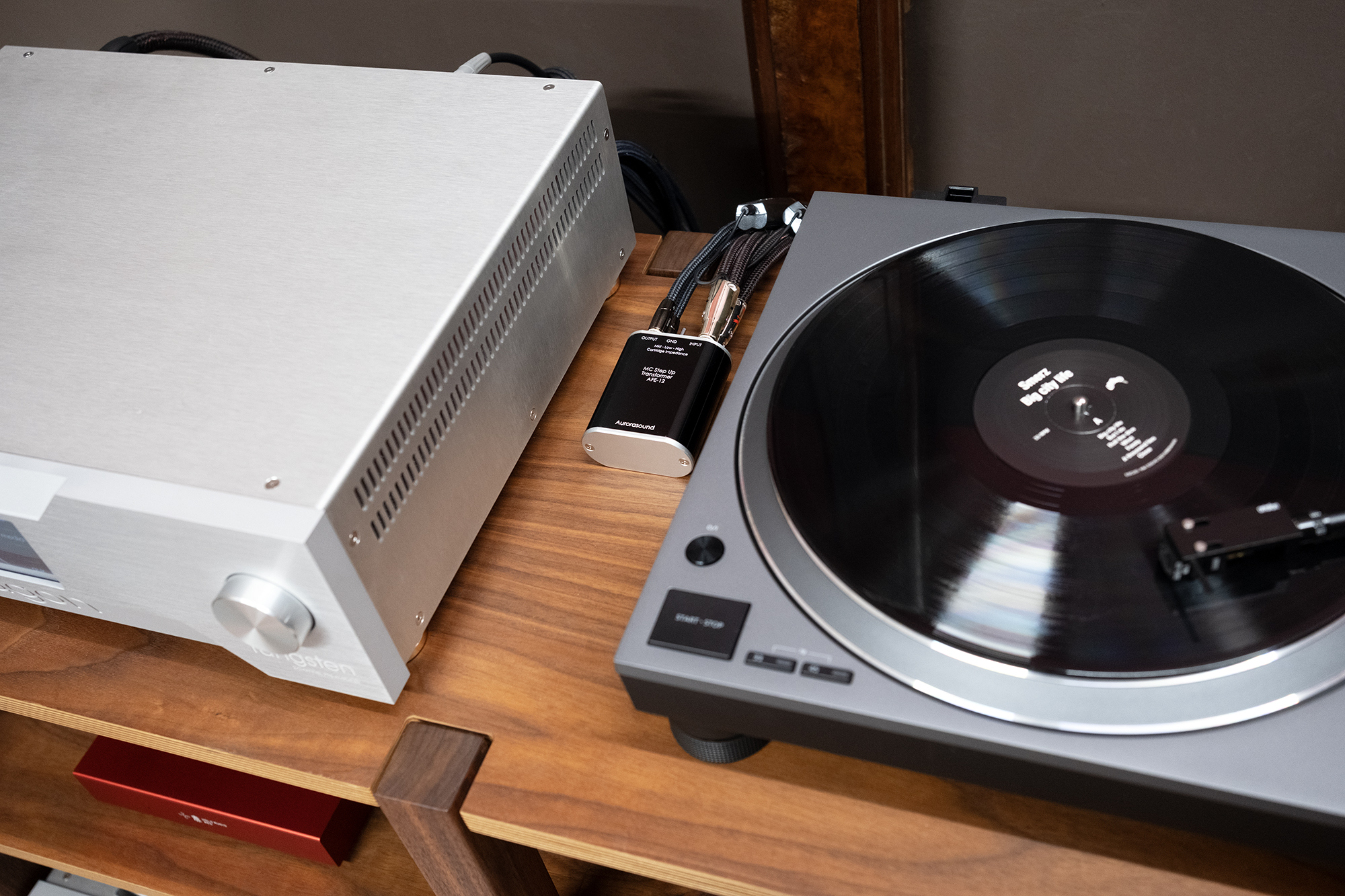
There’s nothing like some Smerz, specifically Big City Life from 2025, to put a smile on your face and some pep in your step. I know you know this but the Denon DL-103, even in stock form but even more so in the Zu version, is a great cartridge. Great if you enjoy rich full figured sound and with the right step up transformer it can be all the cartridge you need. Here with the Technics SL-1500CS and Aurorasound AFE-12 stepping things up into the Tungsten’s MM input, Smerz sounded big, bouncy, punchy and bold just as they should. Smile- and dance-inducing pure pleasure.
Relatively speaking, this is a modest analog rig and the Tungsten’s built in MM phono stage served it very well. I ran through a bunch of records and enjoyed every single one of ‘em. But unlike the Tungsten’s DAC, some buyers may want to roll their own when it comes to a phono stage and my best guess is you know who you are and you probably already own one you’d prefer for sound, features, and flexibility. I know I do.
With the Aragon stack’s combined set of strengths, features, and all that raw power, I don’t really have a direct comparison to offer. The Audia Flight Strumento Series N°1 evo Stereo Preamplifier & N°8 Monoblock Power Amplifiers (review) come to mind but costs about $21k more without a DAC or phono option. Nonetheless, the Audia Flight gear, every piece I’ve reviewed, has a lovely rich nearly silken sound while offering plenty of power but without the benefit of a direct A/B I can’t really dig into comparative differences with the Aragon stack. My sense is the Aragon gear digs deeper into the mix so to speak and the DAC inside the Tungsten adds a boatload of value by bettering DACs in the $12k range (and up).
Both the Dynaudio Confidence 60 and Peak Consult Sinfonia are capable of loud, louder than I normally listen and paired with the Aragon gear music damn near dared me to turn things up. And up again which led me to some of my favorite Barn burners including “Skeleton Key” from Circuit des Yeux, “Midost” from Marc Ribot’s Ceramic Dog, “Since I’ve Been Loving You” from Led Zeppelin III, “Figure 8” from FKA twigs M3LL155X, and “Voodoo Chile” from Jimi. To name but a few and I could on, I did go on, but I don’t want to belabor the point—the Aragon stack lets you hear right through, deep into the beating heart of whatever music you send its way—unfettered and unadorned.
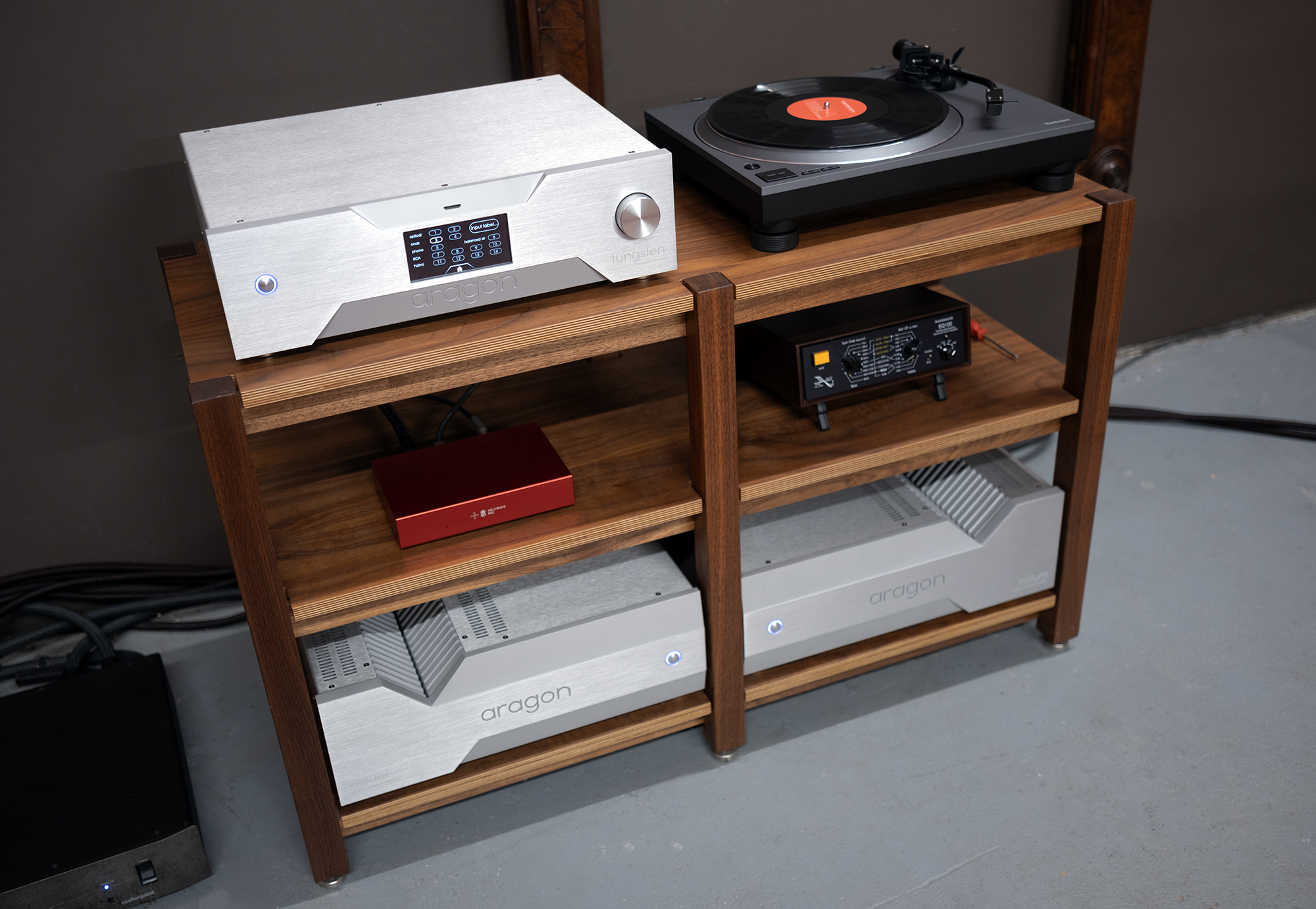
After spending about two and a half months of quality time with the Aragon Tungsten preamplifier and Iridium monoblocks driving two different pair of speakers I have nothing but compliments to share. With an overall sound that is at once rich and highly resolving with exceptional speed, clarity, and control no matter how low your music goes, the Aragon stack offers the best of both worlds with its rich heritage and exceptional re-imagining of the company’s classics. Add to all that the Tungsten’s superb DAC and the ability to drive any speaker on the planet and I have no reservations in giving the Aragon gear my highest recommendation.

Aragon Tungsten Preamplifier: $19,999
Aragon Iridium Monoblock Amplifiers: $25,998/pair
Company Website: Aragon
Tungsten Preamplifier Specifications
Frequency Response: 20-20kHz +-0.03dB
THD: <.015% (20-20kHz)
SNR: >110dB (A-wt)
Max Output: 7V RMS
Power Consumption: 70W (max), <1W (standby)
Analog Inputs: 4x gold-plated RCA L/R unbalanced, 1x XLR R/L balanced
Phono Input: 1x gold-plated RCA L/R (supports MM cartridges)
Digital Inputs: 2x coax RCA, 2x optical, 4x HDMI 2.0 with pass-through (1x HDMI output)
Analog Outputs: 2-channel, 3x XLR per channel for future 2&3 way crossover functionality via firmware upgrade
Operating Modes: digital and analog pass-through
Max Sample Rate: 192kHz
Max Bit Depth: 24-bits
Parametric EQ: 5 bands per channel
Front Panel Display: 5” LCD touch panel
Serial: 1x DB9, 2-way control, mini USB programming port
Ethernet: 1x Ethernet, web interface + 2-way TCP/IP control
12V Trigger & IR: 1x 3.5mm IN, 4x 3.5mm OUT, IR remote
Charging Port: 2x USB 5V, 2A
Product Dimensions: 5.25” x 19” x 15” (13.3cm x 48.3cm x 38.1cm) | 30lbs. (13.6kg)
Finishes: black or silver with satin anodized laser-etched logo
Iridium Monoblock Amplifiers Specifications
Power Output: 400W into 8Ω | 600W into 4Ω
Peak Power: 545W (1%THD, 8 ohms, per CEA-2006) | 800W (<1% THD, 4 ohms, per CEA-2006)
THD: 0.02% | .05%
Frequency Response: 5Hz to 20kHz +0/-1dB | 5Hz to 20kHz +0/-2.0dB
TIM DIM Distortion: 0.010% | <1Hz to>170kHz +0-6db (overall bandwidth)
S/N: 112dB, A-weighted
Damping Factor: 200, 8Ω @50Hz
Input Sensitivity: 1W: 60mV (single-ended&balanced) | 400W: 1.2V (single-ended&balanced)
Input Independence: 45kΩ (balanced) | 15kΩ (single-ended)
Inputs: 1 XLR jack | 1 gold-plated RCA jack
Outputs: 2 sets gold-plated, 60-amp insulated 5-way speaker binding posts
12V Trigger: controls RS-232: full status and control of standby/on
Power Consumption: standby:<1W; idle:120W; max:1500W
Colors: black or silver with satin anodized laser-etched logo
Dimensions: 7”(17.8cm) x 16”(40.6cm) x 19”(48.3cm) | 63lbs (28.6kg)