
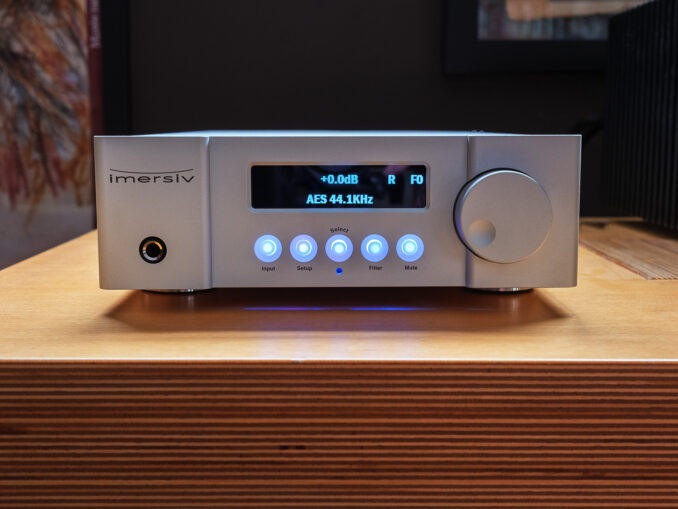
There’s been a steady buzz surrounding the D-1 DAC from Imersiv coming from a number of sources all of whom are serious about digital and DACs. Based on what I’ve been hearing in Barn, that buzz is very well deserved.
As we all know by now, hearing is key for me when it comes time to sit and listen. Here, when it’s just me and music, everything else falls by the wayside, even claims of the most cutting edge tech, the marketing, and the cost. Of course that’s in an ideal world as some hifi gear fails to get out of its own way and digital may be guilty of calling undue attention to itself most often.
Here’s my addition to the Imersiv D-1 DAC buzz—I reviewed nothing but digital gear for over six years as Editor of the now defunct AudioStream and I’ve continued this digital quest here at Twittering Machines over the last seven or so years and there have been but a few real standout digital products. The totaldacs (every one), the dCS Network Bridge, and the Grimm MU1 and MU2 come most immediately to mind. When it comes to sheer excitement at the sound of music, this is the shortest of short lists of digital gear that made me sit up and say “Wow!” And I’ll add the Imersiv D-1 DAC to that “Wow” list.

With digital gear—and I would say most not some—it feels as if there’s something in between me and the music. Some kind of sonic distraction or obstruction that prevents real and complete connection. A layer of haze, unnaturally sharp edges, foreshortened sounds seemingly getting lost in self noise, bulbous bass, undue tube bloom, and so on. These impediments to complete connection result in a kind of lax listening or fatigue from the work involved in trying to listen through the distractions or obstructions.
Restless listening typically ensues—switching from track to track before any reach the end and getting easily distracted by just about anything can all be symptoms of less than ideal hifi. But when a system cuts through all that noise with sound so transparent it simply cannot be ignored, you know it’s a keeper. Something special.
The Imersiv D-1 DAC mainly got to play in two systems during its 2-month Barn stay. These included one of the most exciting and engaging systems I’ve had the great pleasure of living with comprised of the recently reviewed Gauder Akustik Elargo 200 (review), Gryphon Diablo 333 (review), and the Barn resident Grimm MU1 (review) feeding the D-1 DAC via an AudioQuest AES cable and the Musical Fidelity M8xi Integrated (more info) paired with the Perlisten S7t Black Edition Loudspeakers (more info). One reason the D-1 DAC did not get to play with other integrated amps on hand for longer stretches, like the Barn resident Leben CS600x, is Imersiv does not recommend using the D-1 DAC’s RCA outputs, which the manual refers to as “utility only”. I’ll get into the why’s shortly.
Regardless of the system setting, the d-1 DAC’s stand out qualities stood out. Chief among these qualities are an unshakable sense of completely unobstructed transparency, endless resolution, unrestrained dynamics, and a completely natural voice. Of course the more resolving the system the more of all that goodness comes through which is why I highlighted the Gauder/Gryphon rig but considering the Imersiv’s $12,000 asking price, it will likely also find itself living in less costly systems. So much the better.

But how? How does the half-width Imersiv D-1 DAC do what it does so well? We can easily, too easily imo, fall back on the grossest of DAC generalizations and look to conversion technology employed—R2R, chip, FPGA, NOS, OS, etc.—or any number of other technical tidbits that amount to playing pin the tail on the donkey seeing as those of us who only listen to results have no real idea of the importance of every single thing that goes into making a piece of hifi kit sound the way it sounds.
Let’s begin by stating some facts—Imersiv is a subsidiary of Millennia Media which was founded in 1990 “as a classical music production company.” Today, it’s safe to say the company serves the “Pro Audio” market.
From the company website:
With over 50,000 recording channels in-use, Millennia is the leading microphone preamplifier for Hollywood film scores (1,000+), classical music recordings (10,000+), acoustic jazz, Foley, and ADR. If you listened to music today, or watched a movie, chances are you heard a Millennia recording (Juilliard 48ch, Andrea Bocelli 40ch, Eastman 192ch, Carnagie Hall 24ch, Los Angeles Opera 32ch, Lincoln Center 96ch, Berlin Phil 16ch, M. Tabernacle 192ch, etc.)
Other company highlights include their LOCi phono preamplifier which was “designed under contract specification for the U.S. Library of Congress, who use LOCi preamps in every archiving room at the U.S. Audio Archives in Culpeper VA.” All to say the people behind the Imersiv D1-DAC have a long and storied story in and around recording and reproduction.
I hope you’ll forgive the inclusion of the following long quote from Imersiv related to their HDR-A (High Dynamic Range) multi-path processing but I feel it’s the best way to convey the gist of the tech inside the D1-DAC.
From Imersiv:
Perfecting HDR-A took over 10 years of continuous research and development. The graph shows how it works.
Path 1 is an audio signal with 90dB of dynamic range, from 0dB to 90dB. Path 2 is an audio signal with 100dB of dynamic range, from 80dB to 180dB. When paths 1 & 2 are combined, the resulting dynamic range is 180dB, from 0dB to 180dB. That’s multi-path high dynamic range audio.
Multi-path HDR-A offers two major advantages over traditional single-path methods. First, it significantly reduces noise and distortion (THD+N). The imersiv D-1 achieves a remarkable 40 nanovolts of broadband noise, which is around 40 dB lower — 100 times quieter — than today’s best DAC designs. In fact, the D-1’s self-noise is 25dB below the measurement capability of today’s leading test equipment, such as the APx555B (see FAQ).
The second advantage is untethered headroom. HDR-A technology allows us to boost high-path headroom to any level without affecting our quiescent self-noise. The D-1 provides +22dBu (10 volts) of ISO-free* headroom while maintaining its profoundly low 40nV self-noise floor. This results in a true broadband, unweighted linearity and dynamic range of 28 bits or 168dB. (*inter-sample overs or inter-sample peaks)
Multi-path is the next design standard of audio architecture, from microphone to power amp, and everything in between.
This last sentence grounds us back in Millenia’s pro roots as they view HDR-A technology as a kind of end-to-end recording and replay solution–“from microphone to power amplifier”—not just as a means to make a very good sounding DAC. It’s worth noting that each of the two ‘Paths’ is sent through its own unspecified DAC chip with DSP controlling the flow so to speak.
Stepping back and away from the nitty gritty, reducing noise/distortion and increasing dynamic range and headroom are common enough goals for any DAC design, the difference with Imersiv is their claims regarding the D-1’s measured performance—dynamic range greater than 160dB for example (see full specs below)—and their related marketing claims which you can read about on the Imersiv website.

There’s nothing about the looks of the Imersiv D-1 DAC that screams—extraordinary. Its half-width size, LCD centered display, headphone jack, backlit function buttons, and volume knob are standard fare but I appreciate the soft purple glow as a nice deviation from the norm. But looks can be deceiving as is the case here because there are a number of functions, some DSP-based, inside the D1-DAC that are not ordinary.
Notably one function found in the Setup menu is “Calibrate” which I’ll let the D-1’s manual describe:
Run Calibrate (line outputs) and Calibrate HP (headphones) upon initial installation. Calibrate optimizes the sensitive output stages of the D-1 to the electrical characteristics of the device it is connected to. If your destination device, headphones or cables are changed, run a new Calibrate cycle.
You can find a more detailed explanation on the Imersiv website’s FAQ page which I recommend reading. Running the calibration is as easy as pushing a button and waiting a minute or so for the process to run its course. Other Setup options include Polarity Invert, Low Latency (see FAQ), Resample (“all incoming signals between 32kHz and 176.4kHz are immediately up-sampled to 192kHz sample rate and all signal processing/conversion is done at 192kHz”), and Headphone Exclusive (deactivates XLR outputs). I recommend reading the D-1 manual for the full story.
The D-1 DAC also includes a number of digital filter options easily accessed by pressing the front panel Filter button, These filter options include:
F0 – Fast Lin – Fast Roll-off Linear Phase (default)
F1 – Slow Lin – Slow Roll-off Linear Phase
F2 – Apod Fast Lin – Apodizing Fast Roll-off Linear Phase
F3 – Fast Min – Fast Roll-off Minimum Phase
F4 – Slow Min – Slow Roll-off Minimum Phase
F5 – Hybrid Min – Hybrid Fast Roll-off Minimum Phase
I view filter options the same as condiments—feel free to use what you like.
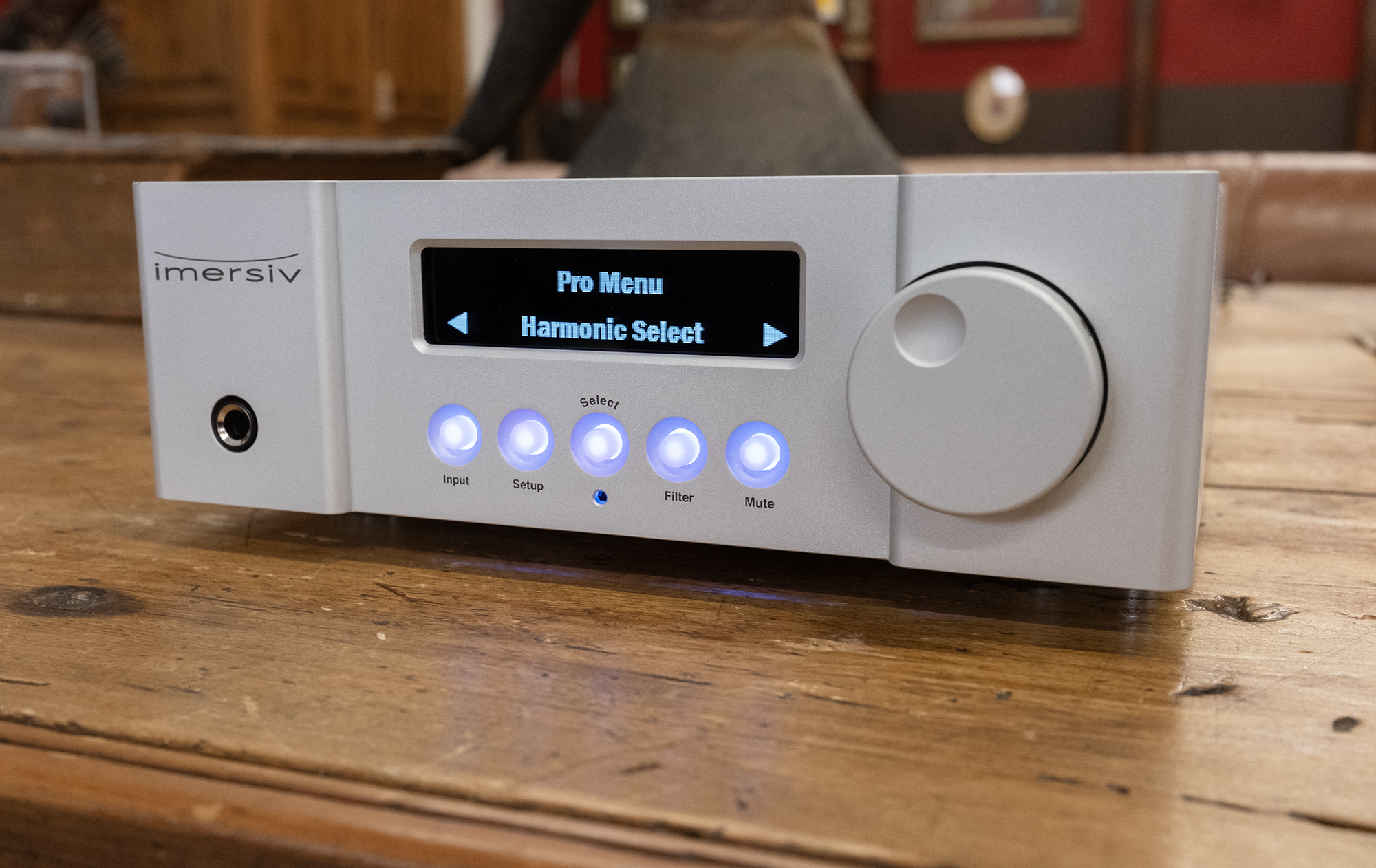
There’s also a kinda hidden “Pro” menu, accessed by pressing the Setup and Select buttons simultaneously which comes with a number of interesting options. Once again I’ll point you to the D-1 manual for the full story but these include L/R Balance. Mid Balance (“adjusts ‘mid’ level in 0.1dB/step increments, up to +/-12dB”), and perhaps the most interesting of all–Harmonic Distortion.
From the manual:
Various “flavors” of harmonic coloration, for adding “warmth” and “richness” and “body” to pop music program. Select a harmonic pre-set (“A”, “B”, etc.) then use the front-panel encoder knob to dial-in the effect amount desired (0-10). See FAQ for a lengthy discussion on harmonic coloration setup and use.
Use at your own discretion (and pleasure). In general I do not spend many words on included options like filter settings and upsampling because they are user and system specific in terms of preference and the same goes for Harmonic Distortion. I will say I spent some time, not much mind you, clicking through these options and they offer subtle sound shaping that may or may not appeal. I preferred running straight, without the extra flavoring.
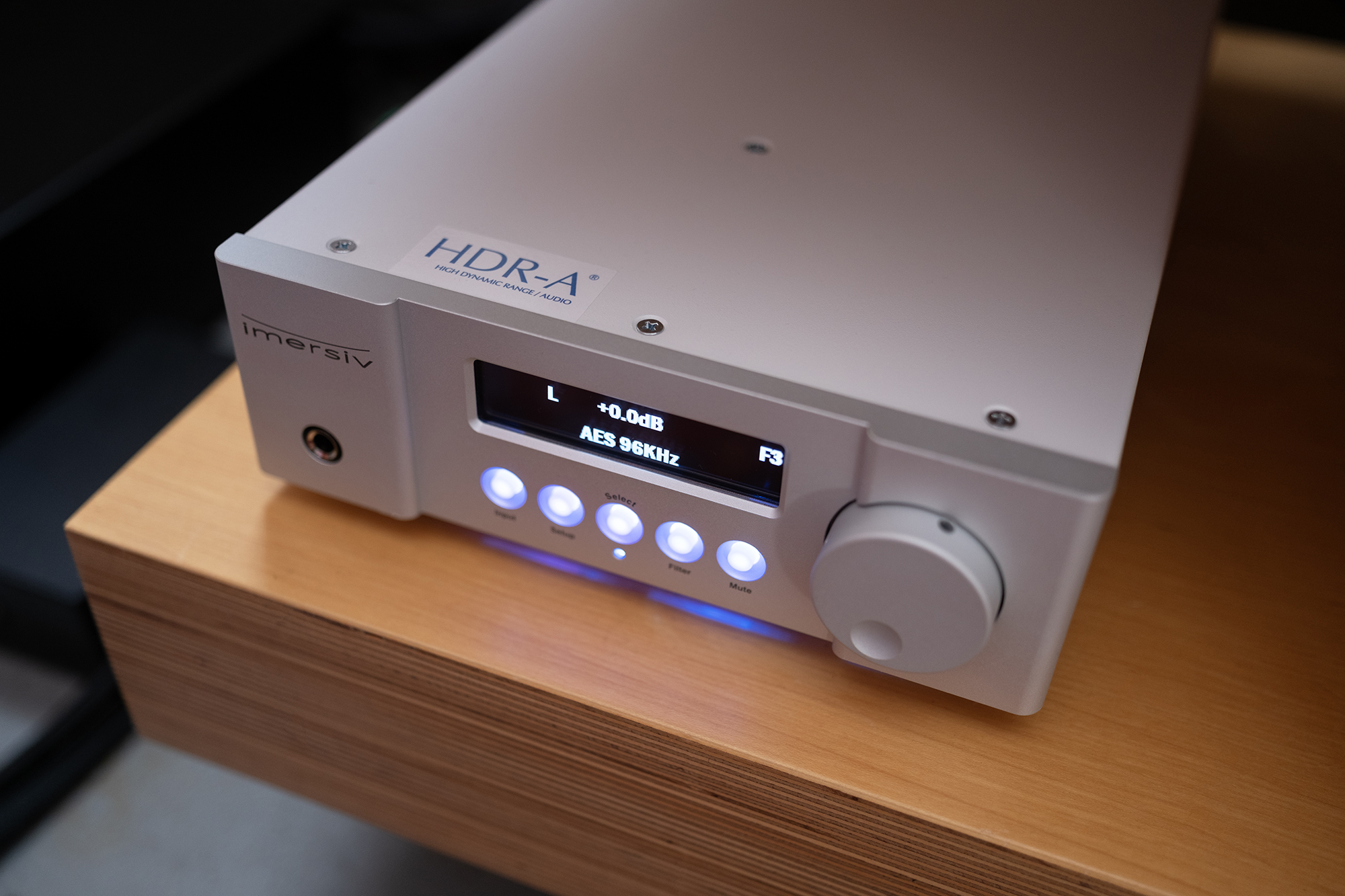
Last but not least, there’s a nice chunky volume knob up front which Imersiv recommends using instead of a preamplifier. Seeing as I only have integrated amplifiers in Barn at present, and my Leben CS600x is also of the integrated variety, I cannot offer any amp-direct listening notes.
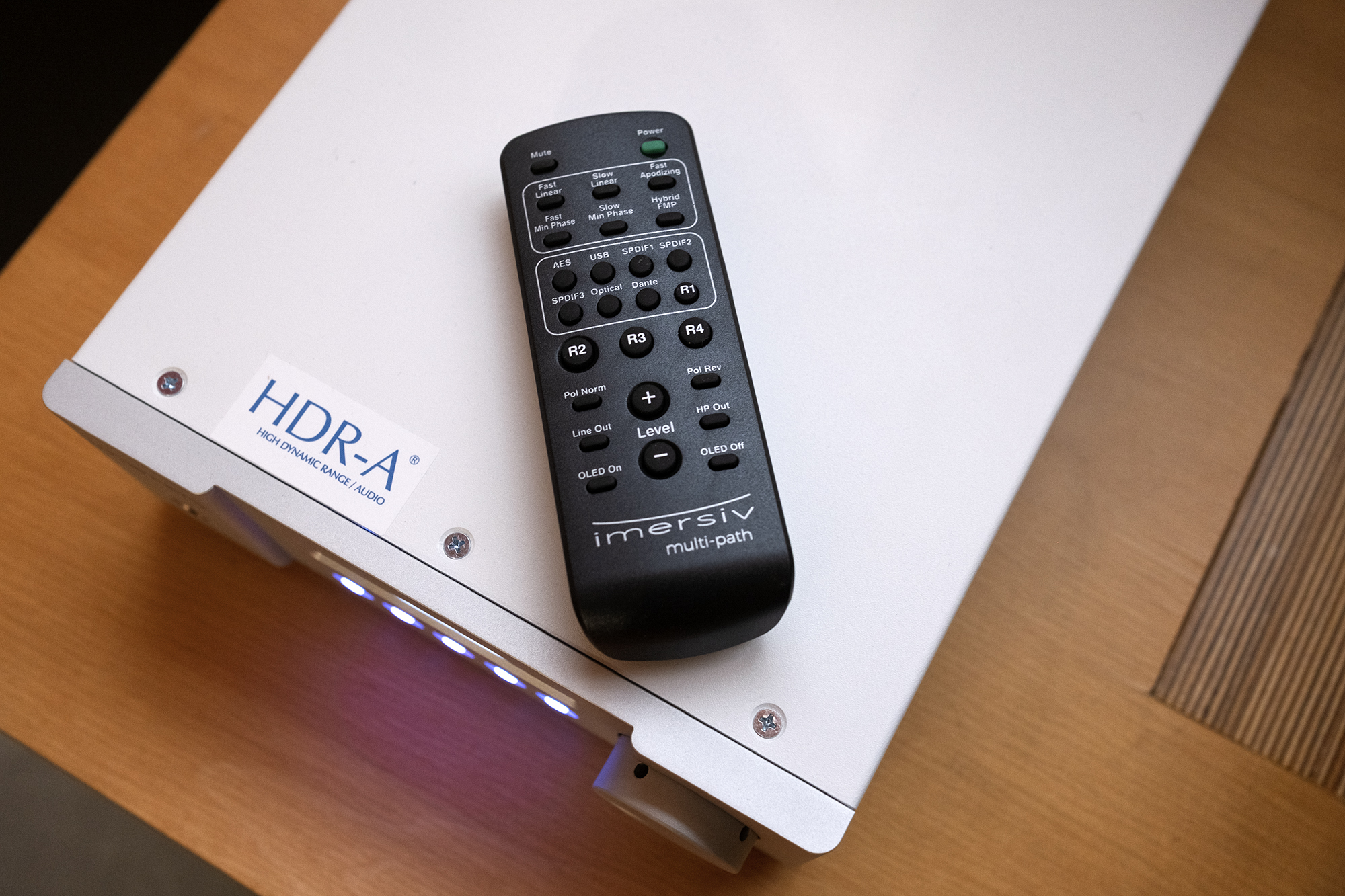
The included remote offers direct access to the various filter settings, input selection, volume control, polarity, and line out or headphone out (the “R” buttons are reserved for future uses).
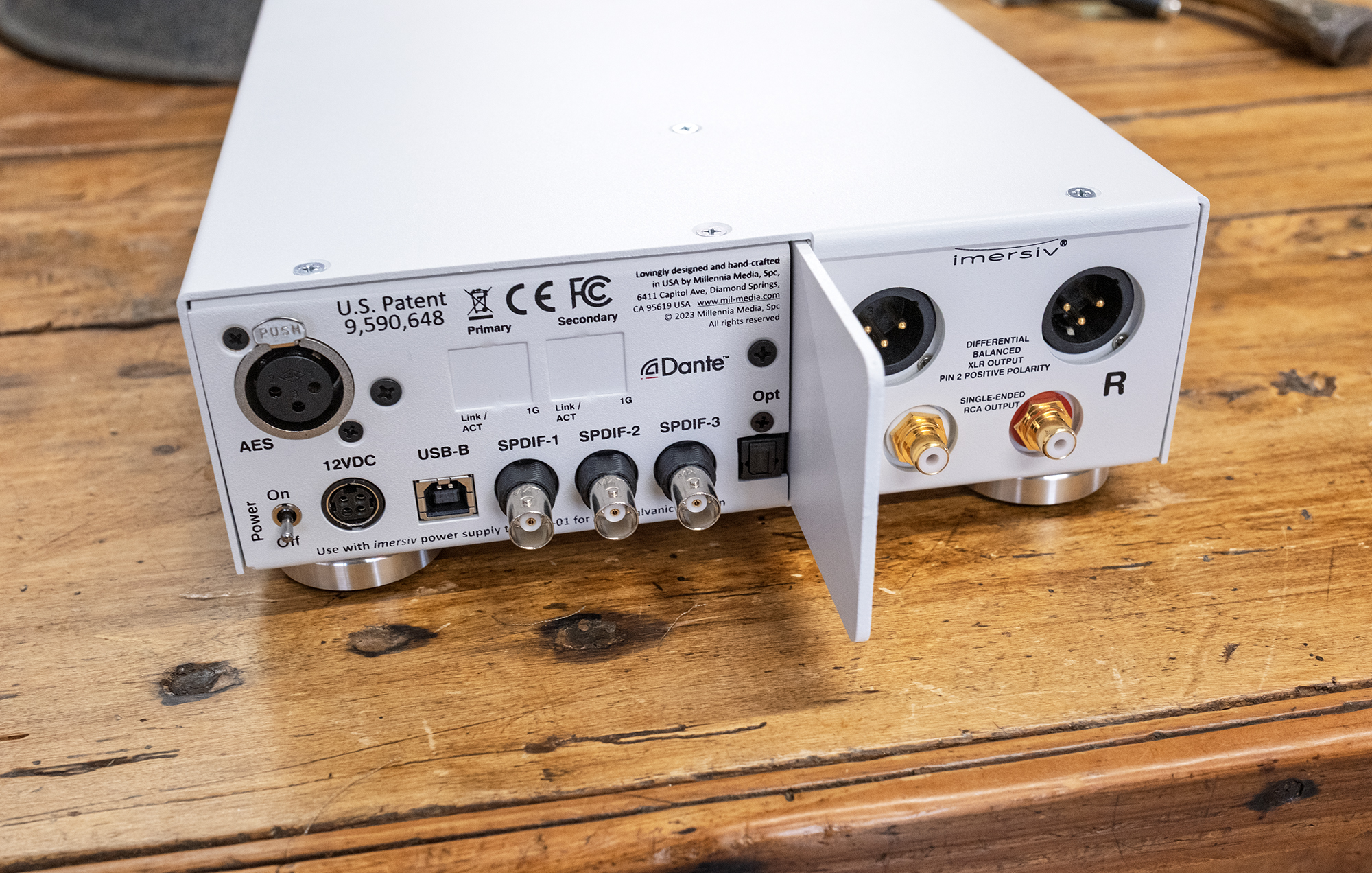
Things are mostly familiar around the D-1 DACs backside that includes a number of digital inputs, power toggle switch, and both single-ended RCA and balanced XLR outputs. But—and this is a very important but—the company stresses that you must use the XLR outputs to get the benefits of the HDR-A technology and related performance.
From the manual:
Published specifications are achieved at the differential-balanced 3-pin XLR outputs. The XLR outputs must be terminated with a true differential- balanced 3-pin receiver (power amp, ideally). The RCA unbalanced outputs are not performance-specified.
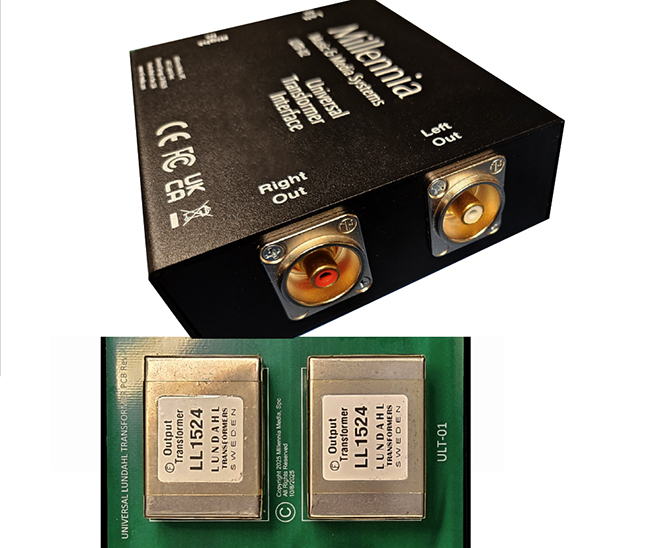
Imersiv does offer a workaround of sorts in the form of their UTB—Universal Transformer Interface ($500) that “will properly convert the D-1’s diff-bal XLR signals to an unbalanced RCA format while preserving full HDR-A dynamic range performance.” But to get the best performance from the Imersiv D1-DAC, XLR is the way to go and the company stresses their preference to run it directly into a power amp “with at least 20dB of self-gain and true XLR diff-bal inputs.”
One other oddity is the ‘tail’ sticking out of the D-1’s rear panel, which is one end of a 10-gauge aluminum plate that “runs the entire inside length of the D-1 chassis (14in/35cm)…Its main purpose provides RF shielding between the digital and analog PCBs.” Lastly, there’s a connector for the included external switch mode power supply (I can hear the audiophile gasps) but there’s also a reason for this choice.
I’ll let Imersiv explain:
For the D-1, we opted for a superior audio-grade external SMPS – not just for ideal sonic and noise performance, but also because it provides 100% galvanic/earth isolation to the sensitive USB and Dante interfaces. Moreover, this main power source is double downstream regulated by ultra-low-noise linear circuits, along with amplifier stages that provide further extraordinary levels of PSRR. The D-1 is a master class in state-of-art power and ground design.
Double downstream isolated. But I bet there any number of D1-DAC owners out there trying linear power supplies which is more than likely a hit or miss proposition.
I admit that was a lot of words spent on things other than listening but seeing as the Imersiv D-1 DAC represents a unique design and offers a number of unusual functions and requirements, I felt they were words well spent.
Have you ever gone car shopping at a dealer or used car lot? If you have, think about those moments before you even sat in the car of your dreams listening to the salesperson go on and on about all the special features, the performance, reliability, and options until their words started to sound like angry bees buzzing around inside your head, ready to fill it to explosive levels of who cares?
“I just want to drive the damn thing! Dammit!”
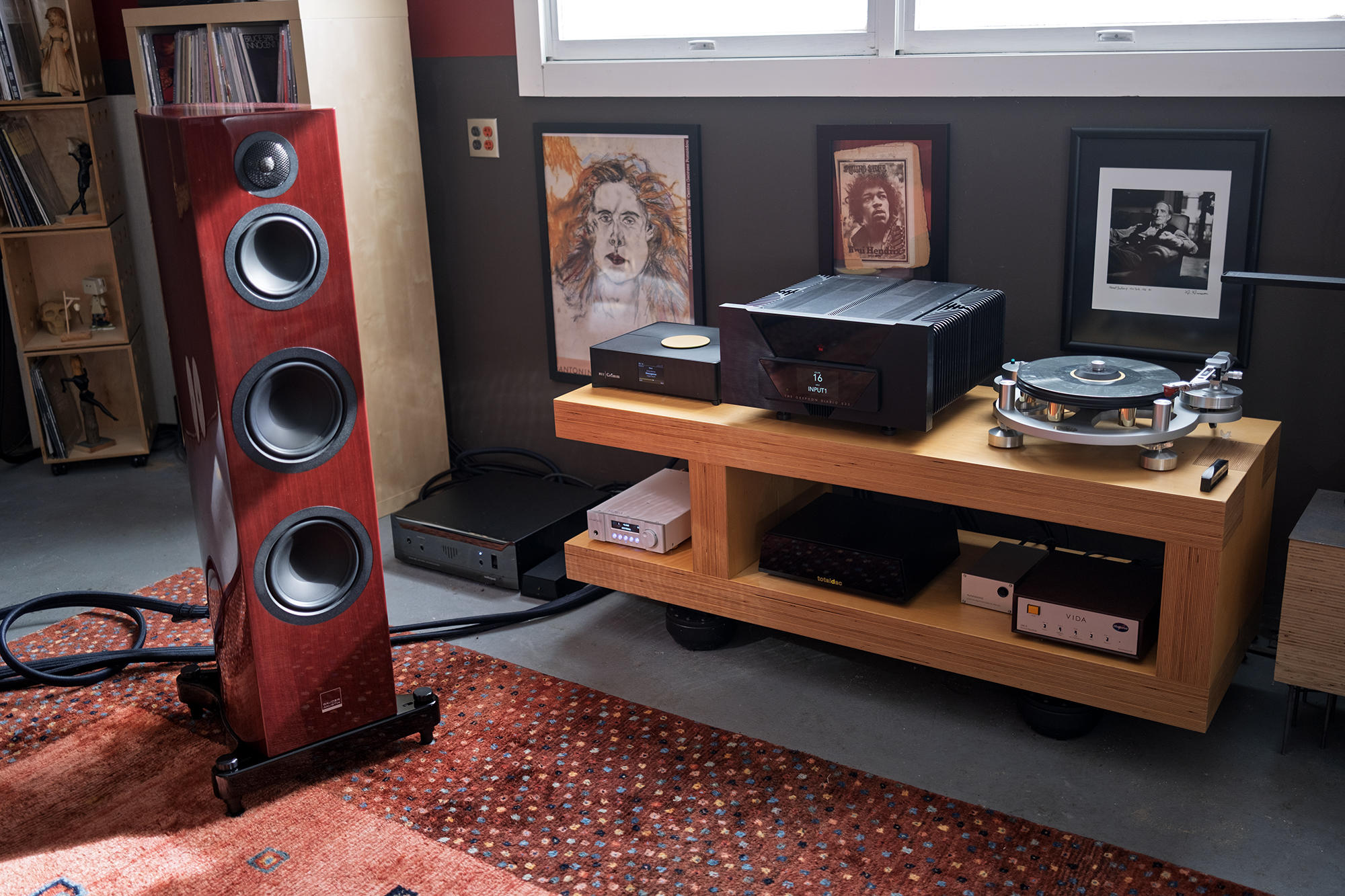
And listen I did, for about two months to all manner of music as is my wont.
Here’s a look at my day from outside—sometime around 7am you can see me walking from our house to the Barn with a thermos full of coffee and a banana. Somewhere around noon I walk back into the house, make lunch, and carry it back into the Barn. Somewhere around 5 I emerge from the Barn and go back home. All the while music is playing. 24/7 even when I’m not here thanks to Roon Radio so the handful of albums I choose to highlight in reviews are like window dressing, a way to show off certain aspects of performance and ideally introduce you to music you might not know and may end up enjoying.
And I can tell you that this formula feels nearly irrelevant here because the D-1 DAC does everything in terms of reproducing all manner of music I want it to do and it does this job exceedingly well. Better, yes outright better, than most of the DACs I’ve experienced in Barn which means that highlighting specific areas of sonics in reproduction with a few album-based examples seems nearly silly. Nearly incidental to the larger and more important point that the Imersiv D-1 is among the best sounding DACs I’ve heard from top to bottom, from left to right, from all around. Period.
Perhaps the most important aspect of the Imersiv’s performance is how well it communicates music, seemingly without any sonic imprint of its own or any sense of subtraction from the recording in play. What you get when you put the D1-DAC in a system is as clear a view into the music as I’ve heard. Plain and simple. But as you know from my daily routine, I am if anything predictable.
One of the recent releases that’s got hold of my attention is Marathon from Maria BC, released on Sacred Bones last month.
“Sometimes when I write songs, I imagine the voice that’s singing is a kind of spirit,” they [Maria BC] say. “Someone from up above or down below calling out to us in warning – ‘You can’t go on like this.’”
This is gentle music filled with familiar and less familiar sounds and listening through this record, over and over through the Imersiv DAC brought me into direct contact with all the intimate workings of Maria BC which is a lovely place to be. I’ve used the ‘window’ analogy before, gauze, dirty glass, clear glass and so on to describe digital replay because I rarely feel as if there’s nothing. Nothing being done to the music, nothing missing, and nothing obscured by the D to A process but here with the Imersiv D1-DAC there’s nothing to talk about other than the direct sound of the recording (taking into account the room, the other gear, the Barn mice, and so on).
This sense of a clear clean direct connection to every sound, movement, mood, pause, and silence no matter the music made for some very exciting listening each time I listened. To say it another way, such seemingly unadorned reproduction removes any barrier between reproduction and experience so we hang on every note, on each beat and the in between, on the flicker of light from a pluck, the sheer beauty in sounds and voices as if we are in their presence.
I recently wrote about A.A. Williams Songs From Isolation, a collection of covers first performed for fans on video from her home during the COVID lockdown. So largely simple stuff with A.A. Williams on vocals with piano, guitar, and on some songs some other layered stuff. The best word for this record, if we felt the urge to boil it down into one, is purity and this happens to be a great word to describe the Imersiv DAC as its accumulation of strengths make it one of the purest sounding DACs I’ve experienced. Direct to ear. Which makes describing its sound largely a matter of describing the sound of the music in play, an exercise I admit makes me feel a bit silly because piano sounds like piano and so on. The immediacy of sounds as music is where the real excitement comes in and the Imersiv DAC lets as much excitement through as any digital product I’ve experienced.
If you want your music, any music, up close, personal and unadorned, the Imersiv DAC is among the most convincing means toward that end in the digital to analog domain I’ve heard.
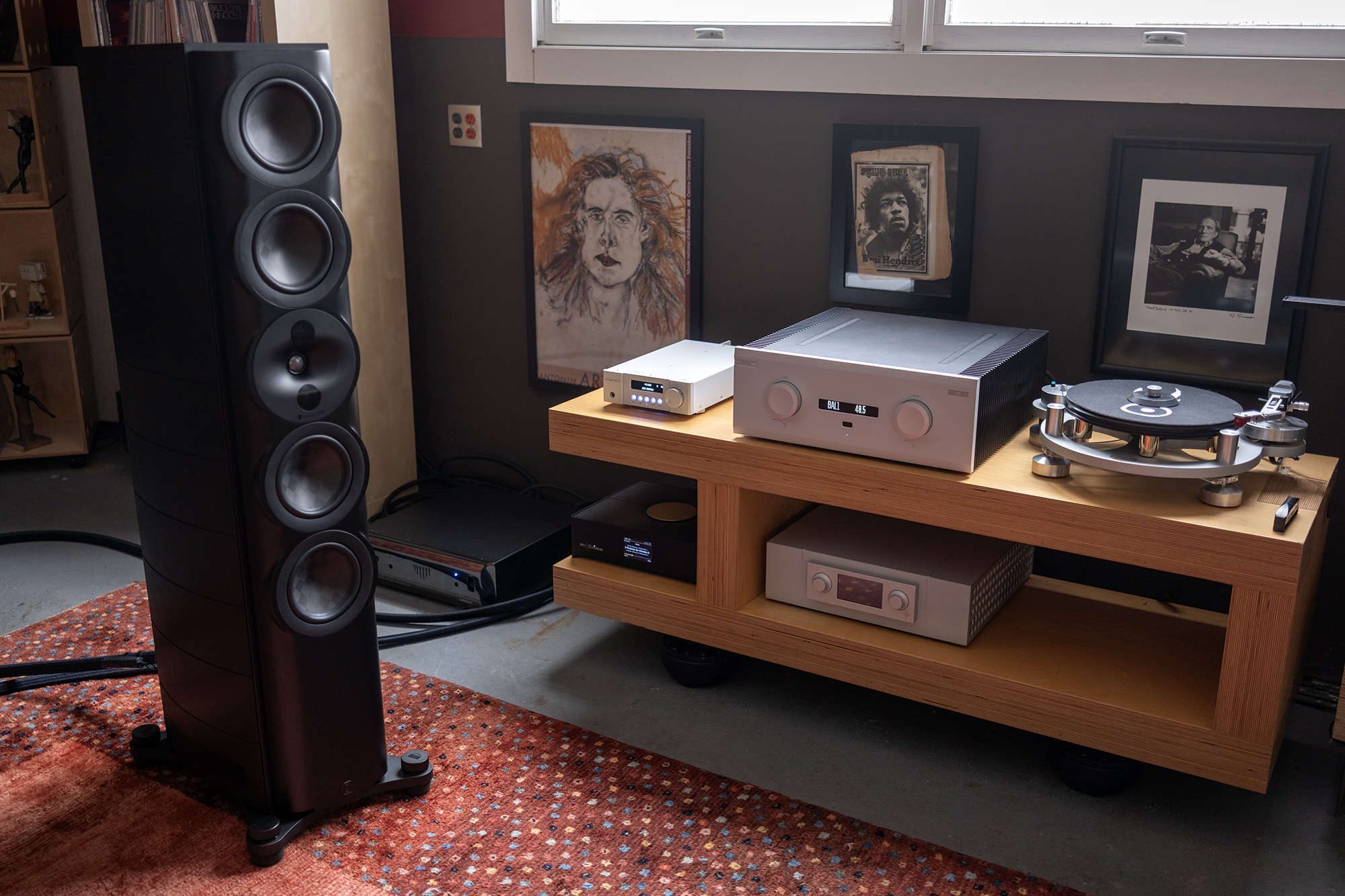
The most obvious and relevant comparison I have on hand is with the Barn resident totaldac d1-unity (review). I’ve been living with one totaldac or another for more years than I can count because they largely get out of the way and let the music through to a degree I’ve only found in more expensive DACs like the Grimm MU2 (review) which is much more than a DAC. If anything, the totaldacs make music sound comparatively lovelier than most other digital.
The Imersiv D1-DAC, to put it as plainly as possible, makes music sound more exciting than the totaldac. And it does this most obviously by delivering a greater sense of transparency and dynamics—it makes music feel more alive. Plus, and here’s the real surprise coming from many years of listening to digital gear, the Imersiv DAC doesn’t give up the rich, warm, and lovely naturalness that I so enjoy with the totaldac. That, my friends, is both great news and a rare accomplishment in my experience.
When it comes to the Imersiv’s outstanding level of transparency and resolution, I’m reminded of the Weiss Helios DAC (review) which also includes streaming capabilities that sits very high on my list of recommended digital gear. And I’ll reiterate that the Grimm MU2, which adds streaming and serving capabilities, is among my favorite digital products, the best one-and-done of its kind I’ve heard. But when we’re talking about DACs, just a DAC, the Imersiv D-1 has moved onto my shortest of short lists ahead of my beloved totaldac (which costs around $13k these days), something I frankly did not see coming. But there you have it. In terms of other options I’d recommend anywhere near the Imersiv’s $12k asking price, there aren’t any.
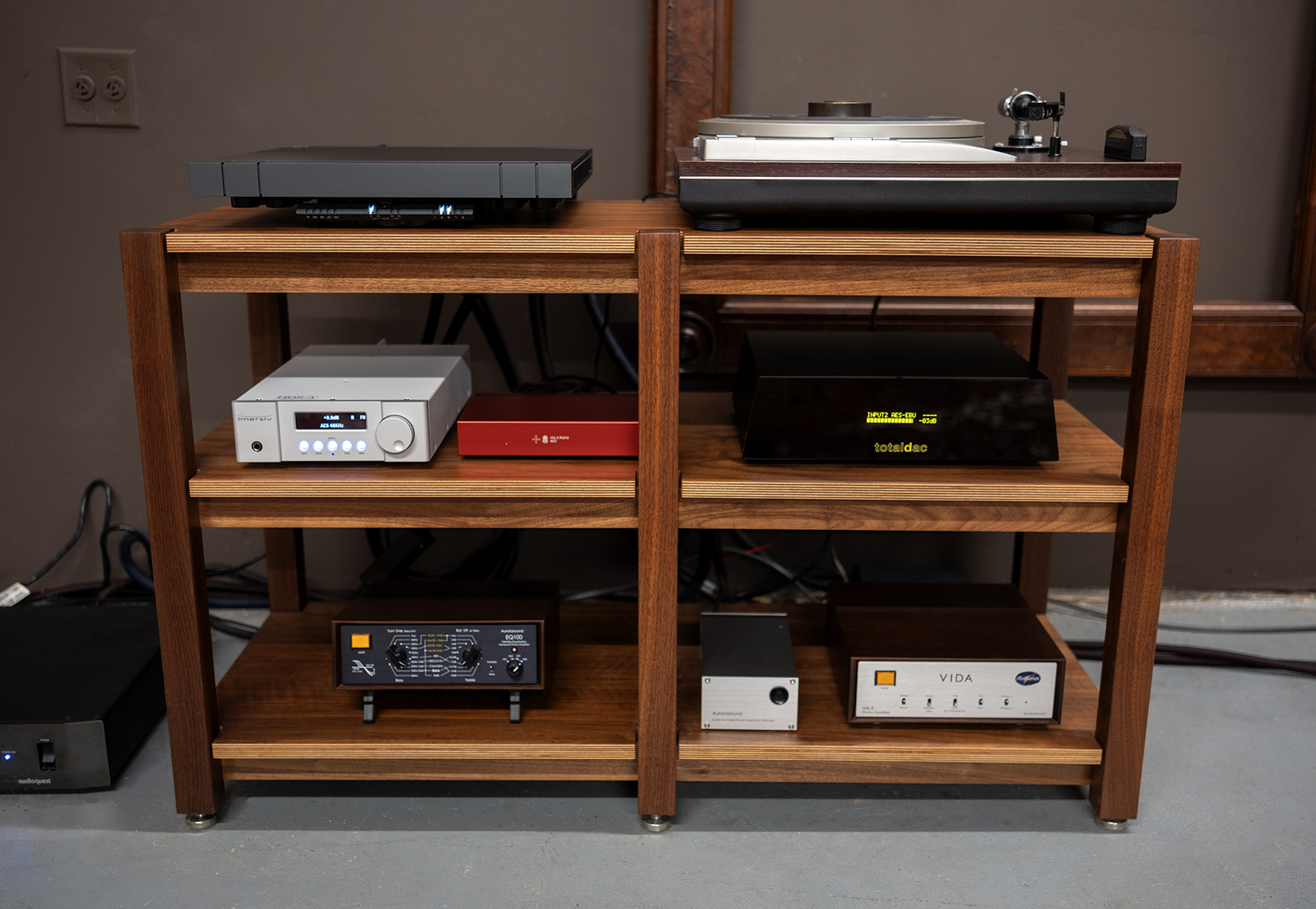
File under, “I had to know!” I connected a pair of Neutrik XLR-RCA adapters to the XLR outputs of the Imersiv DAC which fed the RCA input-only Enelum AMP-54R (more info) that’s in for review using a pair of AudioQuest ThunderBird interconnects and the Barn resident and overachieving HoloAudio Red DDC & Network Streamer (review) as streamer and let things rip, comparing it to the totaldac d1-unity in the same system context that also included the review pair of Fyne Audio F501S (more info) on the Barn’s B-side. Even with system context in mind, I heard similar improvements through the Imersiv D-1 DAC as through the other systems via XLR—improved transparency, dynamics, and overall excitement. These improvements, and I use that word with care, were obvious and just as addictive.
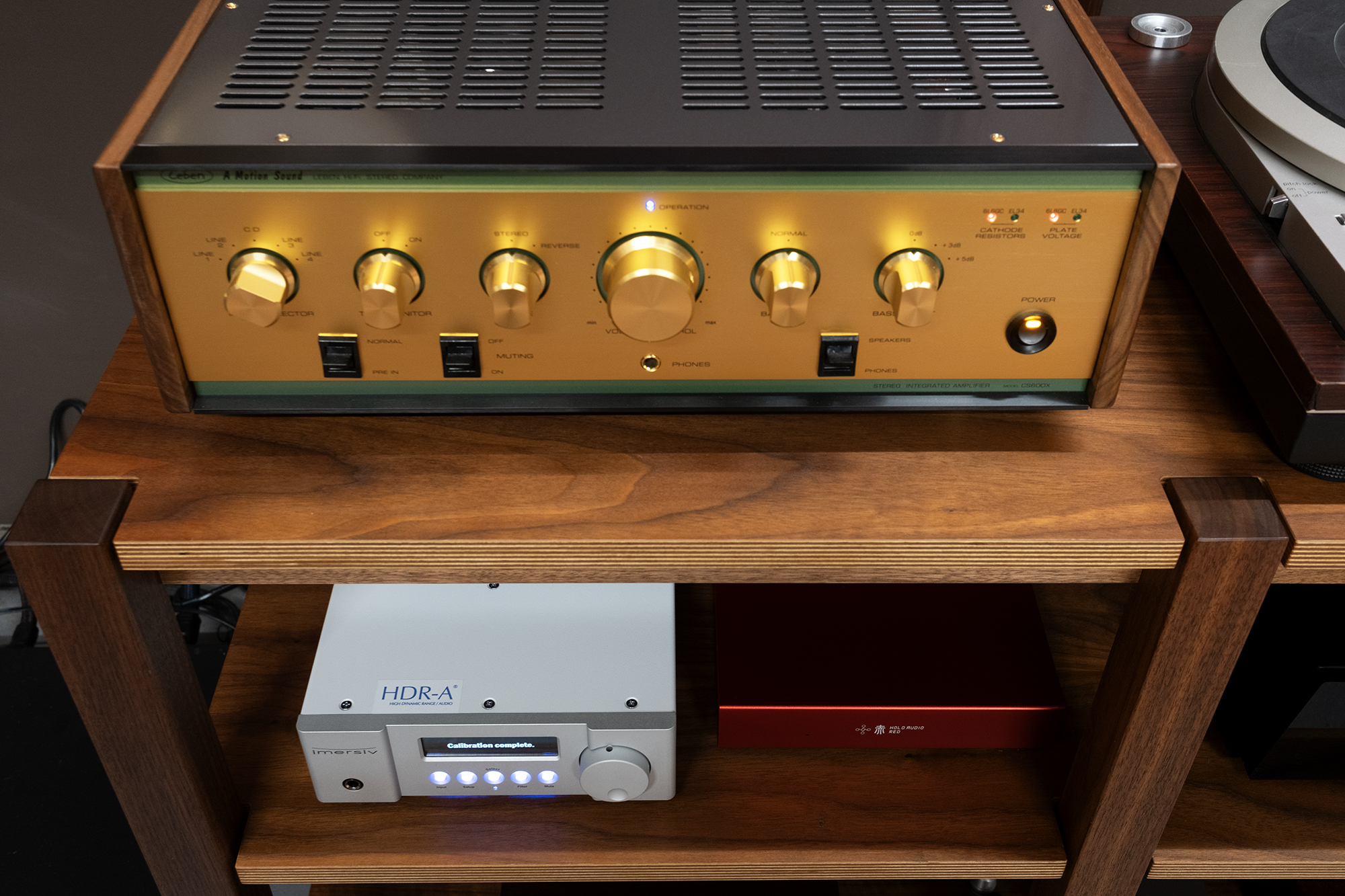
You may also be interested to learn that the Imersiv DAC worked wonderfully with the RCA input-only Barn resident Leben CS600x using the same XLR-RCA adapters and cables. I know I was pleased as punch. Imersiv are careful to point out that the behavior of the D-1 DAC’s RCA outputs will be amp/integrated amp dependent and in some cases using them may result in audible noise which is when their UTB device comes in handy.
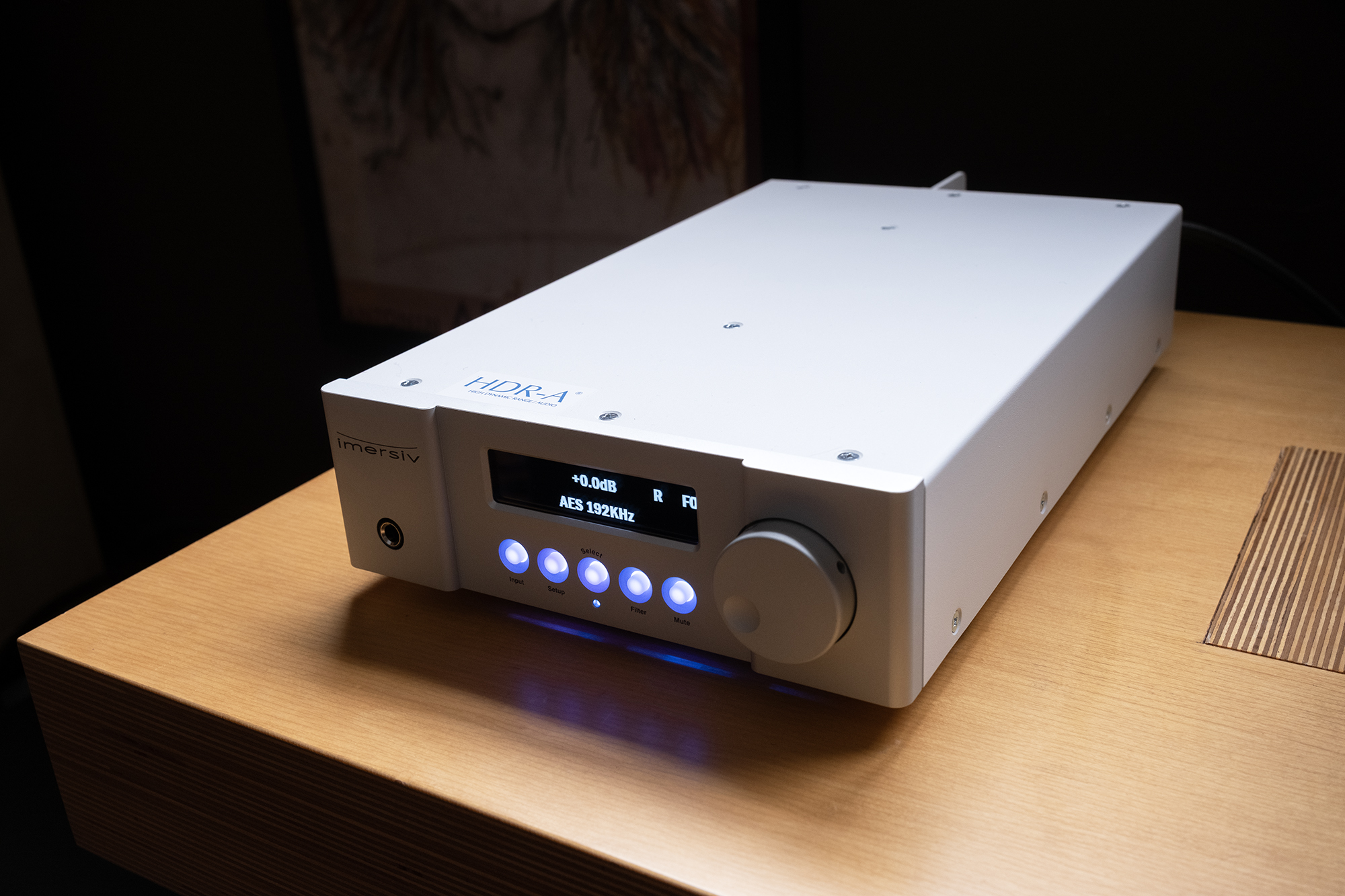
If I wore a hat, I’d tip it to John La Grou and the team at Imersiv for making one of the most exciting and musically engaging DACs I’ve had the great pleasure of living with. Every time I sat to listen over the course of two months the D-1 DAC’s level of sheer magic was addicting for its ability to reproduce music with a level of clarity and transparency I’ve not heard done better with the vibrant beating heart of the musical matter on full display. Bravo!
If you’re looking for a DAC anywhere near its price, you owe it to your music to give the Imersiv D-1 a good long listen.

imersiv D-1 DAC
Price: $12,000
Company Website: Imersiv
Specifications
Frequency Response: 20Hz – 20kHz +/-0.1dB
THD+N at 1kHz (22kHz BW): 0.0002% at +22dBu
THD+N at 20kHz (80kHz BW): 0.0005% at +22dBu
Self-Noise 20Hz-22kHz bandwidth: -146dBu unweighted (calculated)
Dynamic Range: 168dB (28-bits)
Signal-to- Noise Ratio: 168dB (28-bits)
Linearity: 168dB (28-bits)
Crosstalk: Better than -120dB at 1kHz
Headphone Output: 32ohm to 600ohm 2.8W max
DC Offset: 20uV max quiescent
Digital Filter: 6 selectable variations, see user guide
Polarity Flip: 180 degrees
Mute: Output Relay
Resampling: 192kHz
Calibration: See user guide
Supported Input Format: 32kHz to 384kHz up to 32-bits, 1xDSD, 2xDSD, 4xDSD, Dante
Digital Inputs: 1x USB (B) 32-bit, 1x AES XLR, 3x SPDIF BNC, 1x Toslink, 1x Dante (option)
XLR Analog Outputs: +22dBu diff-bal (9.75Vrms) max. Zero Inter-sample overs. 1.8 ohms Z
Level Control: 0.1dB or 1.0dB per step, selectable, 154dB range (-130 to +24dB)
Manual Alignment: to 0.01dB left + right matching
Display: Monochrome OLED: 256 x 64
Front Panel Switches: Input, Setup, Select, Filter, Mute
Remote Control: IR, 27 functions, 4 reserved, 2 AA batteries required
Powering: 90-240V 50-60Hz
Power Use: 15 Watts nominal
Chassis Dimensions: 8.6”W x 16.3”D x 3.2”H (218W x 414D x 81H mm)
Weight: 7 pounds 7 oz (3.4kg)
Shipping Dimensions: 21” x 21” x 8”H (53 x 53 x 20 cm)
Shipping Weight: 13 pounds (5.5kg)
Included Accessories: Power Adapter, IEC Power Cable, Remote Control, 2 AA Batteries, Quick Start Guide, BNC to RCA Adapters (3)
Temperature Range: 32°F to 104°F (0°C to 40°C)
Humidity Range: 35% to 85% RH, non-condensing