
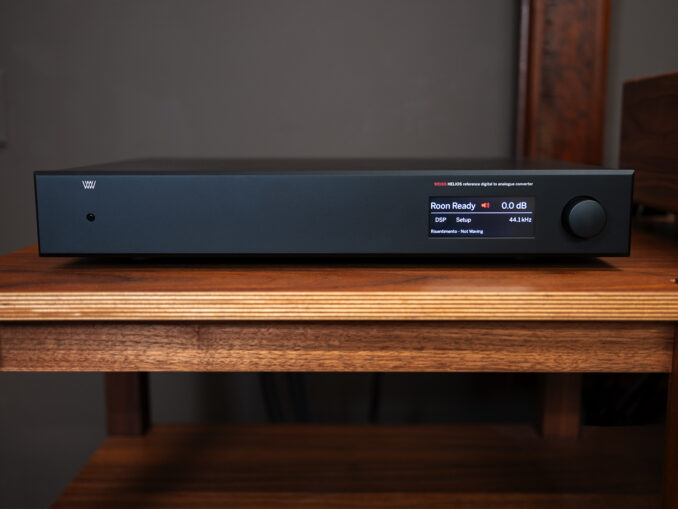
The Helios is the 3rd DAC from Weiss I’ve reviewed in these pages along with the DAC501 and DAC204 and the one thing they have in common, beyond their obvious Weiss origin, is they all sound great. In many ways, exceptional.
If you appreciate measurements as part of a review, I do, you may have seen John Atkinson’s measurements of a few Weiss DACs in the pages of Stereophile where he wrote:
“The measured performance of the Weiss 204 is state of the digital art.”
“Weiss’s DAC502 performed supremely well on the test bench, but its measured performance was exceeded by that of the Weiss Helios!”
I mention this for two reasons—a) because I respect JA and his approach to measurements, and b) seeing as the least expensive Weiss DAC204 “is state of the digital art,” you may be wondering, why pay more for another Weiss DAC? And I have an answer based on experience—because they offer additional features and functionality and they sound better.
Here’s what I concluded about the Weiss DAC204 (review):
“If you got the sense that this review could have been even shorter, I wouldn’t argue the point. The Weiss DAC204 is a D/A converter for people looking for a no frills DAC with a small footprint that sounds as finely nuanced, fluid, fit and full as your music demands. It worked wonderfully, damn near perfectly, as part of my simple desktop system paired with the ADAM A3X powered monitors as well as in the Barn-filling DeVore/Leben/Auralic rig.”
And the DAC501 (review):
“To say that I was impressed with the Weiss DAC501 is a gross understatement as it leaves out the most important aspect of a hifi — its ability to connect us to our music. On this score, the Weiss DAC501 ranks among the top of my running list of favorite DACs. Bravo!”
That’s very high praise, I know because I wrote those words, and the fun thing about the Weiss Helios is it’s even better.
In addition to the reassuring measurements and decades of glowing reviews, Daniel Weiss has a long and successful career in both Pro And Home audio, having founded the company 40 years ago in 1985. Weiss’ personal history reaches back even further when he joined Willi Studer AG in Switzerland as an electronics engineer in 1979 where his work focused on “the design of a sampling frequency converter and the digital signal processing electronics for digital audio recorders.” Weiss received a Technical Grammy Award for contributions of outstanding technical significance to the recording field in 2021.

The Helios sits at the top of the line of Weiss DACs and it differs from the DAC501 and the full-width DAC502 in its use of the ESS 9038 Pro 8-channel chip with four paralleled conversion channels per audio channel and an output stage that relies on Weiss’s own OP2-BP discrete op-amps. Of course we get the full coarse of Weiss DSP-based options including a 3-band EQ, Room EQ, Headphone EQ, Crosstalk Cancellation, De-Essing and more.
From Weiss:
What’s most significant, however, is the unit’s analog stage, whose new discrete operational amplifiers are of the utmost importance. These “discrete operational amplifiers” are called OP2-BP, and are designed and produced by Weiss. Their performance far exceeds commonly-available monolithic op-amp chips, and contribute to Helios’ extraordinary sound quality and unmatched signal to noise ratio of 128 dB. Helios not only performs well on the test-bench, with s/n of 128 dB, but is also eminently listenable, taking the signature Weiss detail and transparency to a whole new level.
I’ll emphasize “What’s most significant, however, is the unit’s analog stage…” for those audiophiles who believe all you need to know about a DAC is what D/A chip is inside.
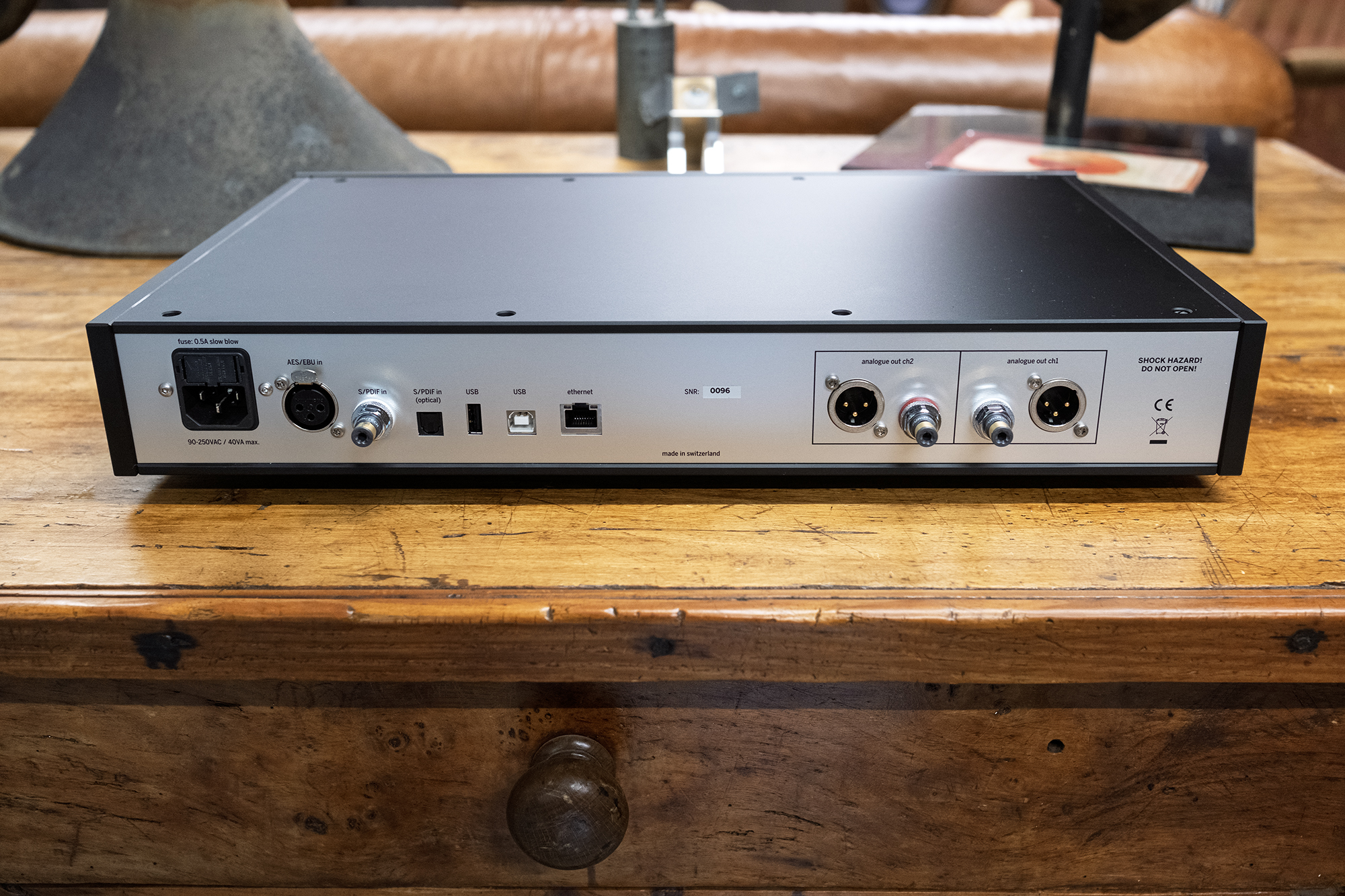
The Helios offers a full suite of inputs including AES/EBU, Coax, Toslink, USB, and Ethernet along with XLR and RCA analog outputs. The Helios wears a dual frame chassis with a stainless steel internal frame and a thick aluminum outer frame that comes in black or silver.
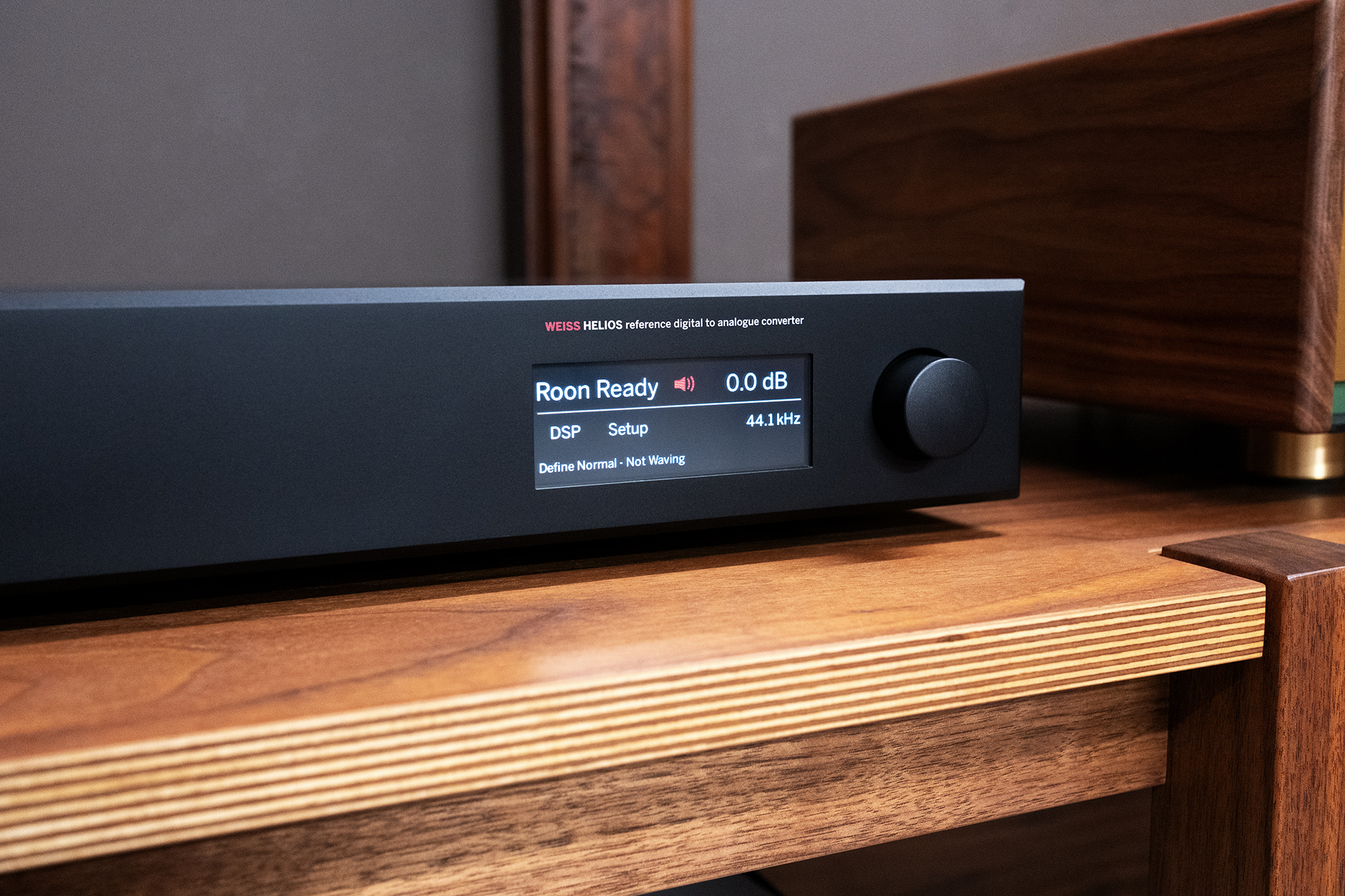
The Helios front panel should be familiar to Weiss 501/502 owners with its LCD touchscreeen and control knob.
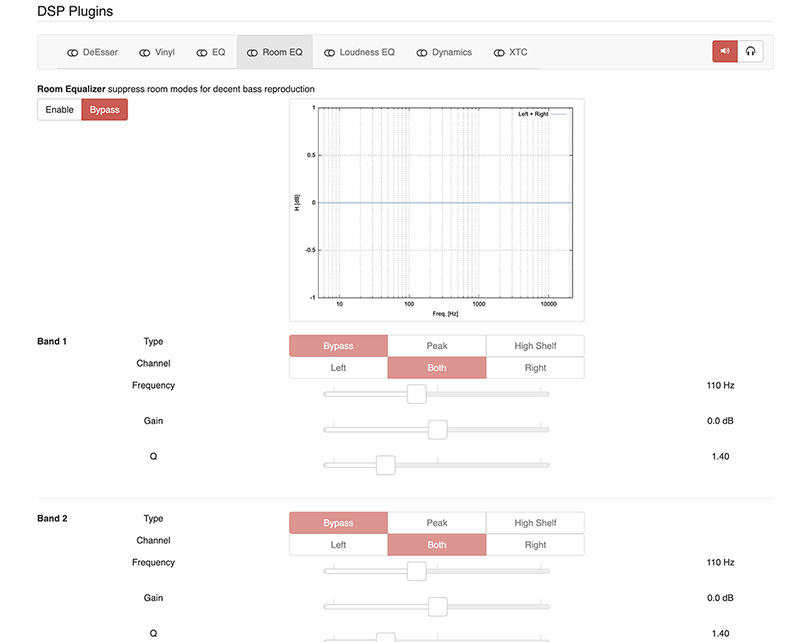
You can also control the Helios via the web interface which lets you really dig into all of those DSP options. If your curiosity is hungry for more info, I recommend a read of the Helios manual for the full story.
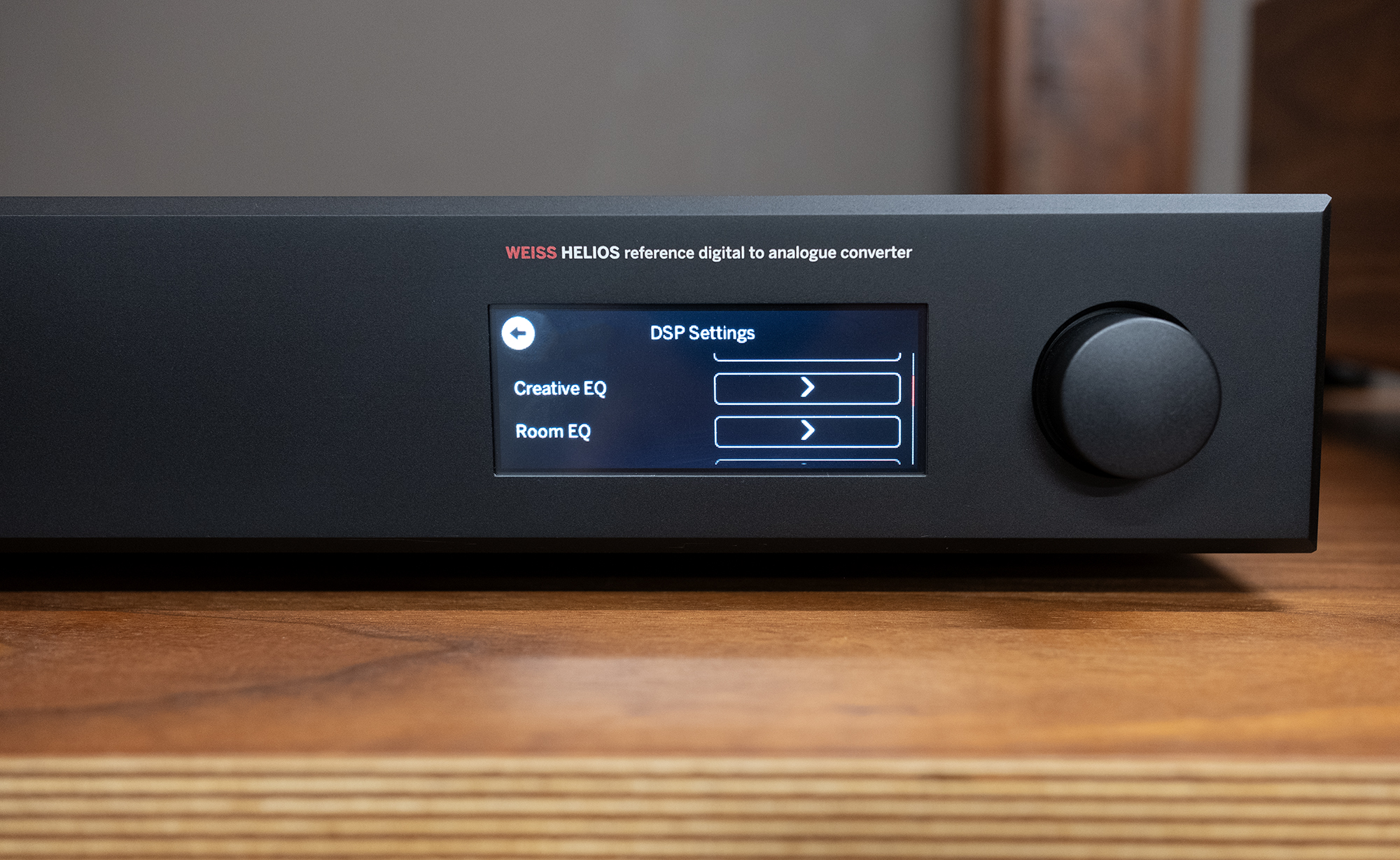
I’m not going to talk about the numerous DSP options in the listening section because I mostly didn’t use them. To my mind, these functions and features nevertheless set the Weiss DACs apart and for some owners they’ll be of great value, especially the Room EQ and Creative EQ for problematic rooms. Headphone users will also benefit from the Headphone EQ and Crossfeed Headphone plugin and I’ll once again encourage readers to fully explore the 40-page Helios manual to learn more.
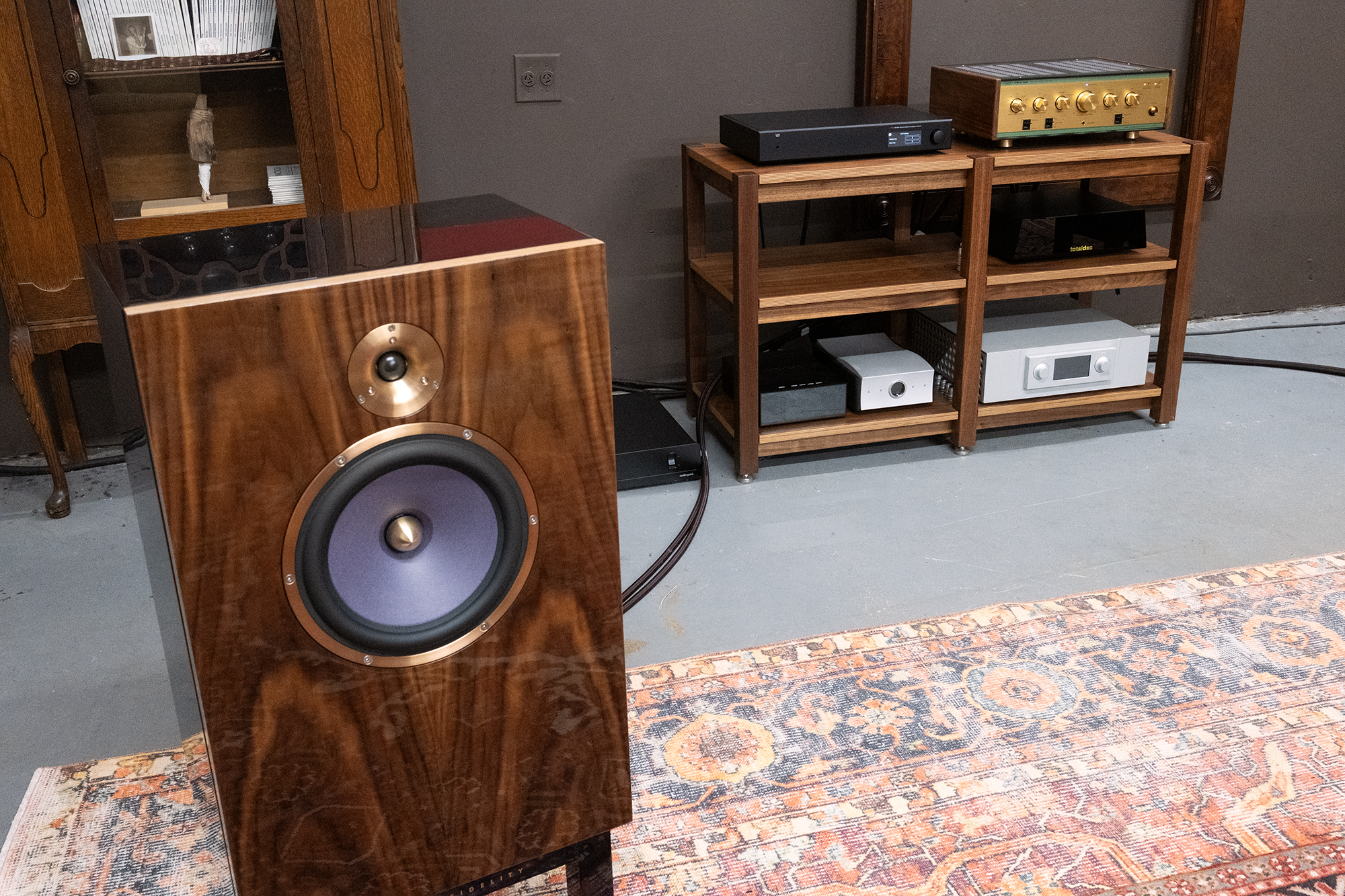
The Helios lived on the B-Side for the duration of its Barn stay, paired with a number of amps including the recently reviewed Qualiton 300B Integrated Amplifier (review), Audio Note Meishu Phono 300B Konzertmeister (review), the Treehaus Audiolab The Preamplifer & 300B-2 SET Amplifier combo (review), and the Barn resident Leben CS600X. The main speakers in play were the DeVore Fidelity O/Bronze (more info) that are also in for review. All cabling is from AudioQuest and includes the Brave Heart speaker cables (more info), ThunderBird interconnects, CAT700 Carbon Ethernet cable, and NRG-Z3 power cables. (See full Barn and system details).
If you haven’t read those amp reviews, I’ll note that these systems with the O/Bronze are all highly revealing of everything in a recording and everything in the rest of the system so I believe I got a very good view into what the Weiss Helios can do. The Helios arrived back on July 17 and it took up permanent residence on the B-Side soon thereafter which is to say it saw a lot of play time through three reviews plus this one. A very full workout with hours, days, weeks, and months-worth of work playing all kinds of music.
And in all that time, from the get go till the bitter end (bitter because we have to say farewell), I never once had any other reaction than, “Wow. That’s a great DAC.” For me, the main thing that makes a DAC a great DAC is its ability to not sound like one and the Helios’ exceptional refinement, or transparency if you prefer, hit me in the ears from the first few notes heard through it, so real and refined I smiled out loud.
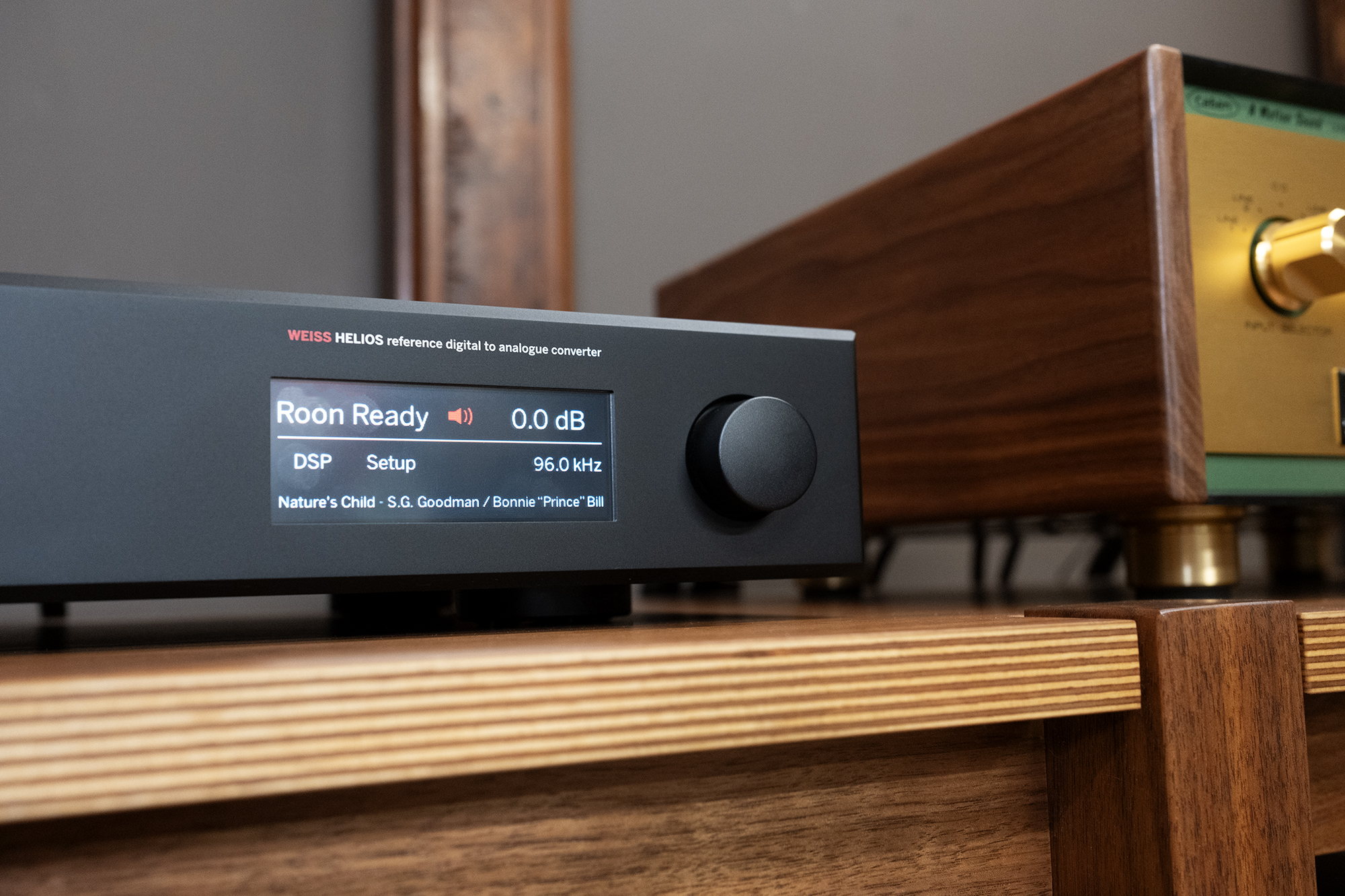
Before I dig into some music, I want to discuss a few ideas I see floating around the interwebs like dandelion seeds in spring. The first goes something like this: DACs that measure well sound sterile. This gets me back, in some ways, to a discussion about resolution in digital audio but the idea that accuracy and great measured performance equates to sterile sound is frankly outdated. I say this because the Grimm MU2 and the Weiss Helios both reside on my shortest of short lists of favorite streaming DACs and they both measure exceptionally well according to John Atkinson’s work on Stereophile.
Where the weirdness comes into play is when some people hold the extreme view that any DAC that measures well is as good a DAC as you can get so just buy the cheapest one and call it a day. Look no further than the Weiss lineup, as noted above, to easily dispel that reductive nonsense. If you believe that someone who has never designed and manufactured a DAC knows more about performance related to design choices than someone like Daniel Weiss because they bought some test equipment and kinda learned how to use it is some magical thinking masquerading as ‘science’.
Lucrecia Dalt’s latest, A Danger to Ourselves has taken up semi-permanent residence in my head of late and I’m all the better for it. This record is a perfect vehicle to talk about the many things the Weiss Helios is so good at doing because the music delights in sounds, in space, in movement, scale, and difference. A veritable cornucopia of sonic wonders that the Helios seemed designed to make whole. Acoustic orchestration, all manner of percussion, electronic creatures scurrying around in the wild, all fronted by Dalt’s spoken sung vocals. This is tasty music in every sense and the Helios has an appetite for presenting every detail and nuance with stunning hear-through clarity. By hear-through I’m talking about the sense of hearing through all the stuff, all the gear, and deep into the things responsible for the music’s making.
I continually smiled with delight throughout the Helios’ stay, finding real joy in the sounds of music. All the percussive bits on A Danger to Ourselves snapped to life with life-like dynamics—silence to present instantaneously—along with deep bass that was well controlled and fully voiced, while the delicacy of this music danced in air with that spark of life feel that animates reproduction well beyond sound quality concerns, digging into the heart of the meaning in the music. I suppose a less wordy way to express something similar is to point out that the Helios is as transparent a DAC as I’ve heard but what fun is that?
I prefer to talk about where things like transparency get you, which is deeper into the music, and what that deeper connection elicits inside me. Call me romantic.
One of the unexpected delights that turned up during my time exploring the contemporary classical catalog way back when is the work of French composer Jean Barraqué who put music to texts by Baudelaire, Rimbaud, Nietzsche, and Hermann Broch, the first three reside on my favorite writers list so it’s no wonder I dove in. His complete works on CPO, there aren’t that many, is in my library ripped from CD but its also available on Tidal and Qobuz. Album opener “Concerto for Clarinet, Vibraphone, and 6 Groups of 3 Instruments” tells a lot on its own but Barraqué is a descendant of the Second Viennese School with a romantic bent. He studied with Olivier Messiaen and lived with Michel Foucault to round out that picture.
I find this music playful if terse but I always hear clarinet as kinda cartoonish which speaks more to my upbringing with Bugs Bunny than the instrument itself which has been used in some of the most harrowing works including Messiaen’s Quartet for the End of Time.
In some ways similar to Lucrecia Dalt, yea I’m making that stretch, Barraqué’s “Concerto” delights in sounds, sudden shifts, and the coming together and breaking apart of the various voices in play. Here in an all acoustic environment the Weiss DAC was equally at home giving rich, full, and distinct voice to each player with its nearly uncanny clarity that doesn’t erase body, tone, or texture which is not an easy task for most DACs in my experience. The Helios, in this system context, allowed these varied sounds to emerge from pure silence in full voice making this music purely delightful in its mischievous herky-jerky movements.
Throughout the Weiss Helios’ Barn stay, every piece of music I played through it offered pure delight. One of the most compelling results coming from this level of refinement when listening to all manner of music was always feeling completely and totally relaxed. Nearly giddy at times in the presence of music that danced in air with an infectious realness and rightness that touched moods and meanings deep inside. Bravo!
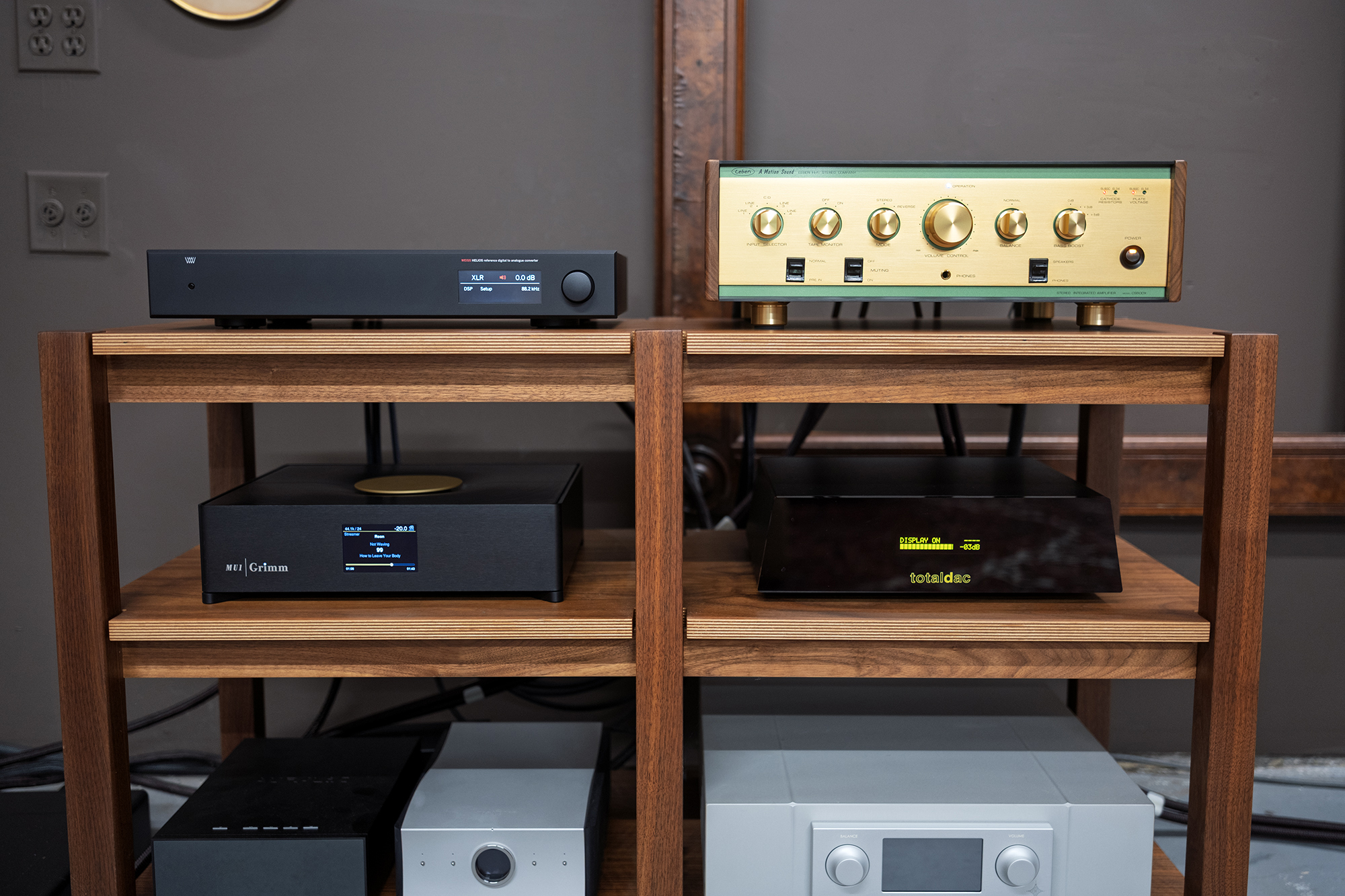
For direct comparisons, I enlisted the Barn resident dynamic digital duo consisting of the Grimm MU1 (review) acting as Roon Core/server and network player feeding the totaldac d1-unity (review) via a length of AudioQuest Diamond AES cable. For an apples to apples A/B, I also used the Grimm as Roon Core/server and network player with the Helios via the same AQ AES cable, obviously bypassing Weiss’ own internal network player functionality. I also compared the Weiss as a streaming DAC to the Grimm/totaldac combo.
Prices:
Weiss Helios: $25,790
Grimm MU1: $14,800
totaldac d1-unity: $13,500 (approximate)
I’ll do the math—the Grimm/totaldac combo comes in at about $28,300 and I say about because I converted the totaldac’s price from Euros which fluctuate with exchange rates. You may be wondering about how the new 39% US tariffs on Swiss imports come into play and in the case of Weiss, the company along with their North American Distributor Bluebird Music have decided to absorb 75% of those additional tariff-related costs.
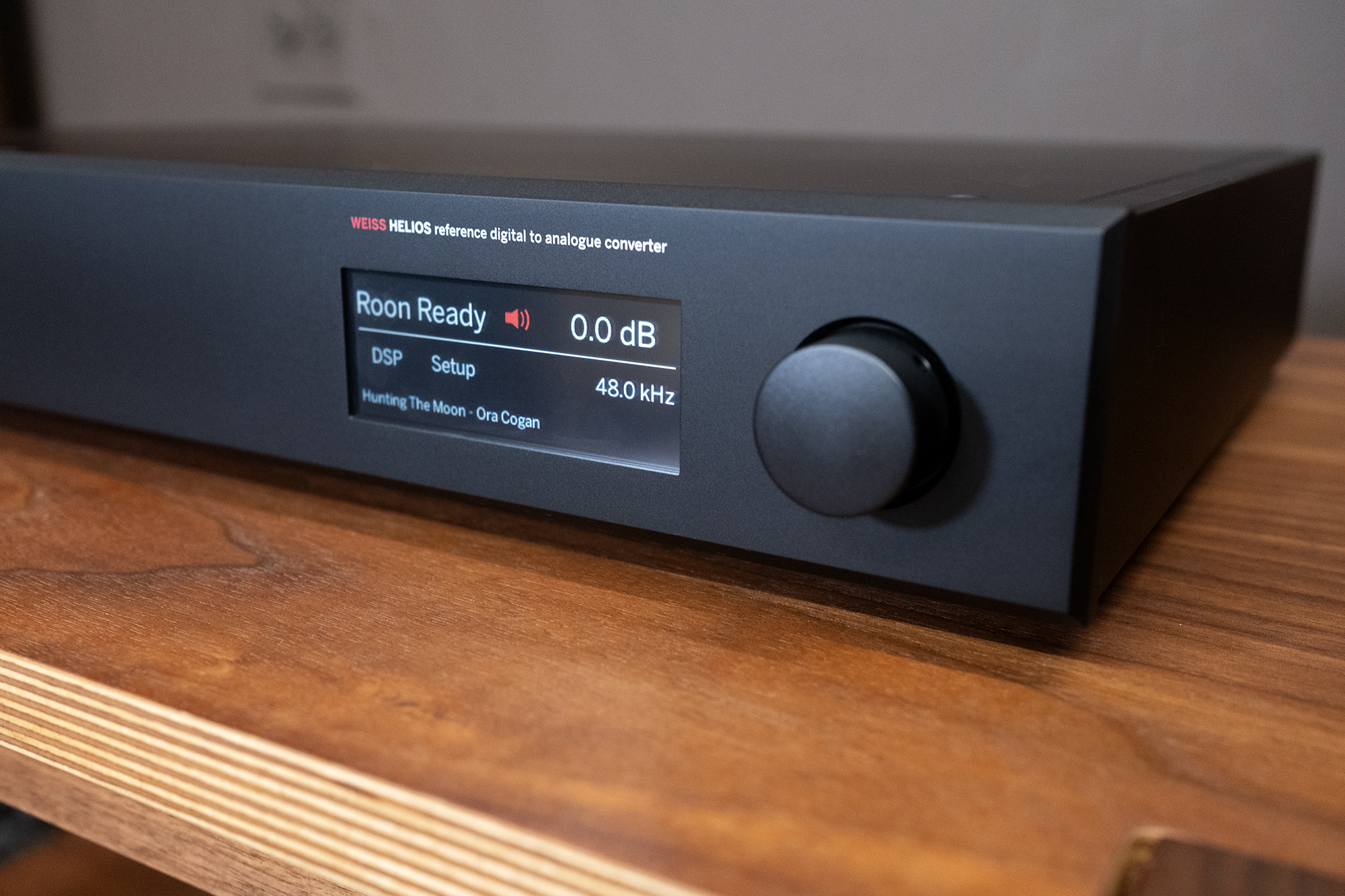
I started the Grimm/totaldac comparisons by using the MU1 with the Helios and then swapping in the d1-unity. An easy to accomplish A then B and back again seeing as I only had to move that Diamond AES cable and FireBird interconnects. Bam!
The most significant difference between the Helios and d1-unity in this context, and where I feel the Weiss betters the totaldac, is overall refinement in every aspect of music reproduction. This kind of clarity is something that every Weiss DAC I’ve reviewed exhibits and while it’s been way to long for me to discuss how the Helios compares to the DAC504 or DAC204, I can say with certainty that the Helios is clearly and obviously more resolving than the totaldac which I view as a real improvement. To put it another way, the Weiss is better than the totaldac when it comes to presenting detail, separation, and distinct placement in space, all things that I perceive as being a more accurate reproduction of what’s in the recording.
The totaldac d1-unity places more emphasis on the body, weight, and timbre of sounds while throwing out a larger and airier sound image albeit a sound image that is less precise than through the Weiss. Kinda like the difference between a Vermeer (Weiss) and a Rembrandt (totaldac).
When it comes to performing this kind of nitty gritty comparison, I used a number of the same tracks through both DACs and made sure the outputs were level matched. While this attention to detail and repetition are well removed from my day-to-day listening, they are required for this type of comparison, especially when differences are obvious but not night and day.
The tracks used for serious A’B’ing:
“Bells” from Crooked Wings by These New Puritans
“cellophane” from Magdelaee by FKA twigs
“Skeleton Key” from Halo on the Inside by Circuit des Yeux
“I Was Young When I Left Home” from Dark Was the Night (Red Hot Comlilation) by AHOHNI and Bryce Dressner
“Nature’s Child” from Planting by the Signs by S.G. Goodman with Bonnie “Prince” Billy
These New Puritans “Bells” from their latest Crooked Wings is one of the tracks used for these comparisons because I enjoy the music (a lot), it’s relatively complex in that there are at times layers of sounds including chimes, bells, double bass, piano, and vocals that inhabit a large and open-sounding space, the exact size depending on the gear in play. Here, the Helios’ superb clarity made even the most dense and layered bits of “Bells” sound pristine and as well defined as I’ve heard with an overall purity that was simply lovely to experience. The d1-unity made those bells and chimes ring out with a greater sense of body and dimensionality, they sounded richer and fuller, while the space of the place grew in every dimension, but giving up the Helios’ superb sense of refinement.
This refined view into music from the Helios was made plain on “I Was Young When I Left Home” when AHOHNI on vocals with acoustic guitar are joined by violin. With the Helios in charge that violin is perfectly defined in space and more importantly in voice clearly separate and apart from AHOHNI and that acoustic guitar. This same part of this same song through the totaldac lost some of that fine grained distinction and clear separation making the sonic differences between these elements less distinct. One positive side-effect of the totaldac’s richer and comparatively fuzzier sound is it’s more forgiving of less than ideal recording quality than the Helios.
It’s worth noting that I feel it would be silly to buy a Helios and use it at just a DAC, as was the case here for comparison purposes. Unfortunately, direct A/B comparisons rely on the gear that’s here. A better A/B would be between the Weiss Helios and Grimm MU2 (review) which can act as a Roon core/server, streamer, DAC, and preamp. Alas, the MU2 left the Barn in March of last year, way too long ago for me to talk about its sound versus the Weiss. A better apples-to-apples price wise comparison would include one of totaldac’s higher end DACs like the d1-triunity (review) I reviewed back in April 2024 seeing as I found it bettered the d1-unity “offered a more lifelike and fine grained view onto and into music.”
All that being said, let’s talk about how the Helios all on its own as a streaming DAC compares to the Grimm/totaldac combo, which is a more sensible use-case scenario, at least according to my way of thinking. I’ll make this short and sweet—I prefer the Helios in this system context. And I prefer it for all the reasons already noted which include its superb transparency that doesn’t trade resolution for rich tone colors and an overall sense of refined ease that makes listening to music all consuming and smile inducing in its sheer likability. If you like music.
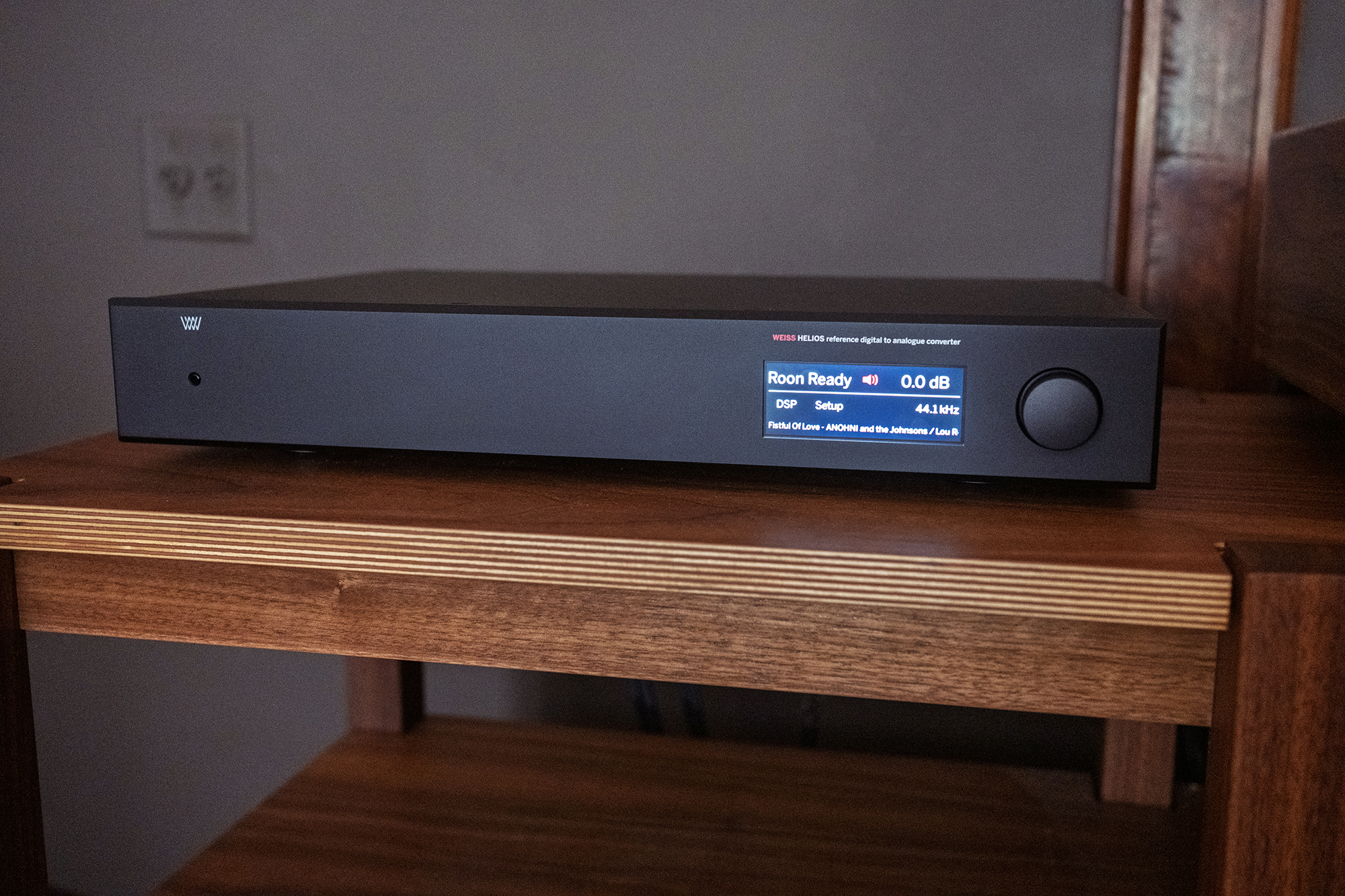
There is no doubt the Weiss Helios Reference DAC is one of the finest streaming DACs I’ve had the pleasure of experiencing in Barn. Regular readers know of my affection for integrated amps and streaming DACs, less boxes, and the Helios may give up some things to more costly separates but I haven’t heard them. The Helios also offers a suite of DSP-based options that separates it, feature wise, from the competition.
If you’re looking for a streaming DAC that is feature-rich and superb sounding, the Weiss Helios belongs on your shortest of short lists and comes with my highest recommendation.

Weiss Engineering Helios DAC
Price: $25,790
Company Website: Weiss Engineering
North American Distributor: Bluebird Music
Specifications
Power:
-
- Mains voltage: 100…120 V or 200…240 V, automatic voltage selection
- Fuse rating: 500 mA slow blow
- Power consumption: 25 VA max.
- Power consumption in standby: 2.2 VA max.
Dimensions (D x W x H): 30 cm x 45 cm x 7.4cm
Weight: 9.4 kg
Size Remote (D x W x H): 2.1 cm x 4.5 cm x 16.6 cm
Available Colours: Silver, Black
Digital Inputs
-
- (1) XLR connector
- (1) RCA connector
- (1) TOSLINK connector (optical)
- (1) USB type B connector
- (1) RJ45 Ethernet connector
All inputs accept professional or consumer standard, i.e. accept AES/EBU or S/PDIF signals.
Sampling frequencies
-
- AES/EBU and S/PDIF inputs: 44.1 kHz, 48 kHz, 88.2 kHz, 96 kHz, 176.4 kHz, 192 kHz
- USB and RJ45 Ethernet inputs:44.1 kHz, 48 kHz, 88.2 kHz, 96 kHz, 176.4 kHz, 192 kHz, 352.8 kHz, 384 kHz, DSD64, DSD128
- Toslink input: 44.1 kHz, 48 kHz, 88.2 kHz, 96 kHz
Input word-length: max. 24 / 32 Bits
Digital Outputs: None
Analog Outputs
-
- (2) XLR connectors (hot on pin 2), short circuit proof output circuitry, DC coupled, low output impedance
- (2) RCA connectors, short circuit proof output circuitry, DC coupled, low output impedance
The output level is selectable via the LCD menu or the web interface; four settings are provided as shown below:
XLR Output
-
- 0dB setting: 16.3 Vrms +26.5 dBu
- -4dB setting: 10.2 Vrms +22.5 dBu
- -8dB setting: 6.5 Vrms +18.5 dB
- -12dB setting: 4.1 Vrms +14.5 dBu
- -16dB setting: 2.6 Vrms +10.5 dBu
- -20dB setting: 1.6 Vrms +6.5 dBu
- -24dB setting: 1.0 Vrms +2.5 dBu
- -28dB setting: 0.65 Vrms -1.5 dBu
As input a 0 dBFS sine wave signal was used
These levels are achieved with a 0.0 dB setting for the level control on the LCD screen.
RCA Output: half the values of XLR (-6 dBu)
As input a 0 dBFS sine wave signal was used
These levels are achieved with a 0.0 dB setting for the level control on the LCD screen.
Synchronization: Via the input signal in case of the AES/EBU and S/PDIF inputs. Via the internal oscillator in the case of USB and Ethernet inputs
D/A Converter chip: Over-sampling multi-bit sigma-delta converter – Four converters per audio channel.