
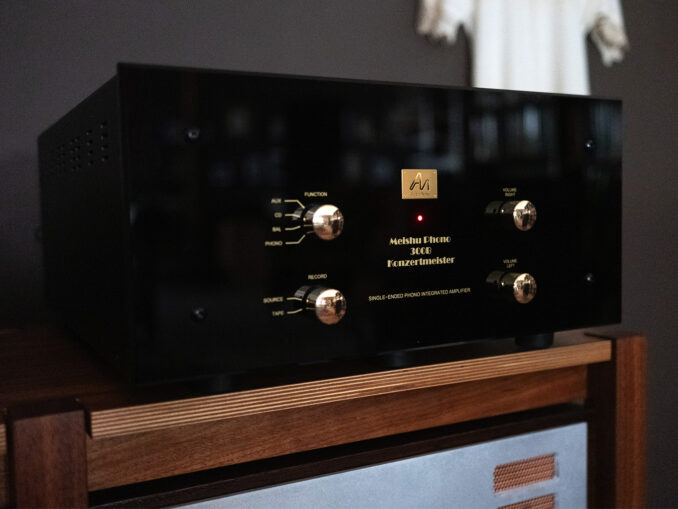
Pretty damn exquisite. That’s one of the things I have to say about the sound of the Audio Note Konzertmeister—it’s pretty damn exquisite.
French painter Gustave Courbet kicked off the Realism movement in the 19th-century and the relevant bits are twofold—Courbet was only interested in painting real things and he wasn’t interested in creating illusions in paint.
If you’ve ever stood in front of a Courbet, you’ve seen that his use of paint is apparent with rich, thick strokes but the subject transcends in some cases to a near mystical degree. Which is unlike those painters who tried to hide the paint with technique meant to fool the eye. All to say the ‘Realists’ made paintings that looked like paintings, which reminds me of a favorite quote from Michael Cimino’s film Deer Hunter as spoken by Robert De Niro, “Stanley, see this? This is this. This ain’t something else. This is this.”
Reproducing music has schools just like painting even though they are very loosely defined in hifi, typically broken down into two (competing) approaches—subjective and objective. A false dichotomy if ever there was one, just like tubes versus solid state, where the more extreme you become in either camp, the further you get from the reason hifi exists which is nothing more and nothing less than the appreciation and enjoyment of music.
Imagine if a similar extremist view was taken when looking at art, where only one limited style was deemed correct with the only real result being the outright dismissal of the majority of works in any museum by self-proclaimed ‘experts’ who can barely see past the tip of their own nose.
I’m in favor of open eyes and open ears, an approach that elevates experience over ideas and ideals when it comes to the appreciation of art. One positive result of having an open mind is you just might learn something new. Or something old.
“Beauty, like truth, is relative to the time when one lives and to the individual who can grasp it.” — Gustave Courbet

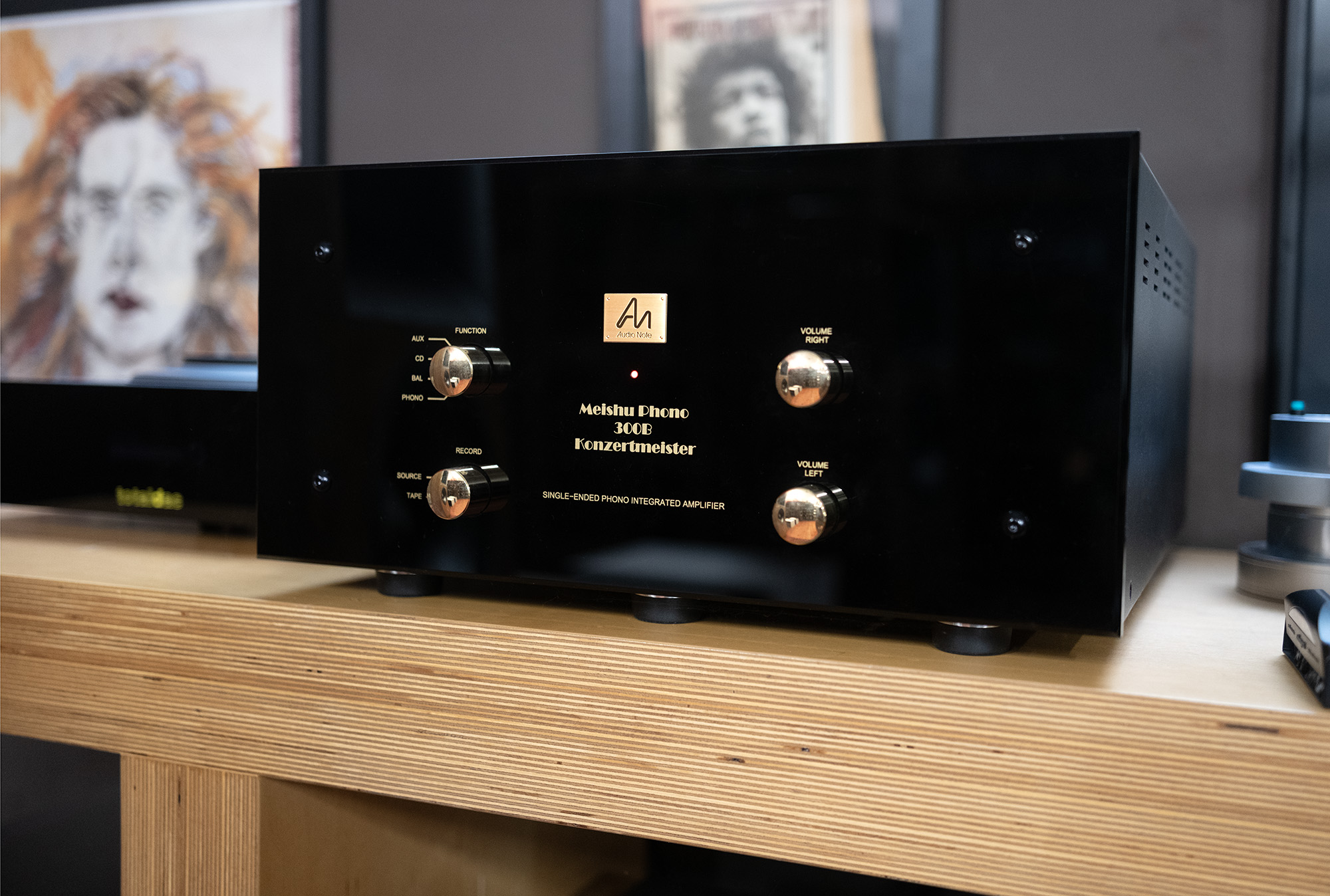
The Audio Note Meishu Phono 300B Konzertmeister Integrated Amplifier is a long name that says a lot on its own. The first Audio Note Meishu hit the market back in 1994 and like this current version, it also used a pair of 300B directly heated triodes run in pure Class A in the output stage. The Konzertmeister is one of three current Meishu models and its sits in between the Tonmeister and Kapellmeister in Audio Note’s hierarchy. If we dig deeper into the company’s schema that categorizes products according to Performance Levels that range from Entry to Level 6, the Tonmeister is a Level 3, the Konzertmeister a Level 4, and the Kapellmeister a Level 5. With each uptick in Level comes better parts and better performance according to company.
The Konzertmeister is chock full of Audio Note’s own parts, either made in-house or according to their specifications. One thing you learn after spending in-person time with lots of hifi gear is everything matters, more or less, so having this level of hands-on control deep inside the circuit if you will provides a very high degree of control when it comes to voicing the final product.
From Audio Note:
The company is one of the few to offer complete in-house designed and manufactured systems. From the tip of the cartridge on the turntable, through the cables and amplification, right through to the drive units in the loudspeakers, everything is designed and produced by Audio Note (UK) in their factories in the UK and Europe.
It’s worth noting there are over 150 products in the current Audio Note catalog. That’s a lot.
The Meishu Konzertmeister includes the following components (from Audio Note):
- In house designed and manufactured, copper / silver wired Double C Core UHiB interstage and output transformers.
- In house designed and manufactured, copper wired Double C Core SHiB mains transformer, Double C Core IHiB filament transformer, and Double C Core SHiB choke.
- Copper and silver internal signal wiring throughout.
- Audio Note (UK) copper foil signal capacitors
- Audio Note (UK) STD and Kaisei Electrolytic Capacitors
- Audio Note (UK) 1W and 2W Non-Magnetic Tantalum, Non-Magnetic Niobium and Non-magnetic Silver Niobium Resistors
- Audio Note (UK) custom resistor based mono stepped attenuators using Non-Magnetic Tantalum resistors.
- Point-to-point silver hand-wired circuit, using Tufnol board materials.
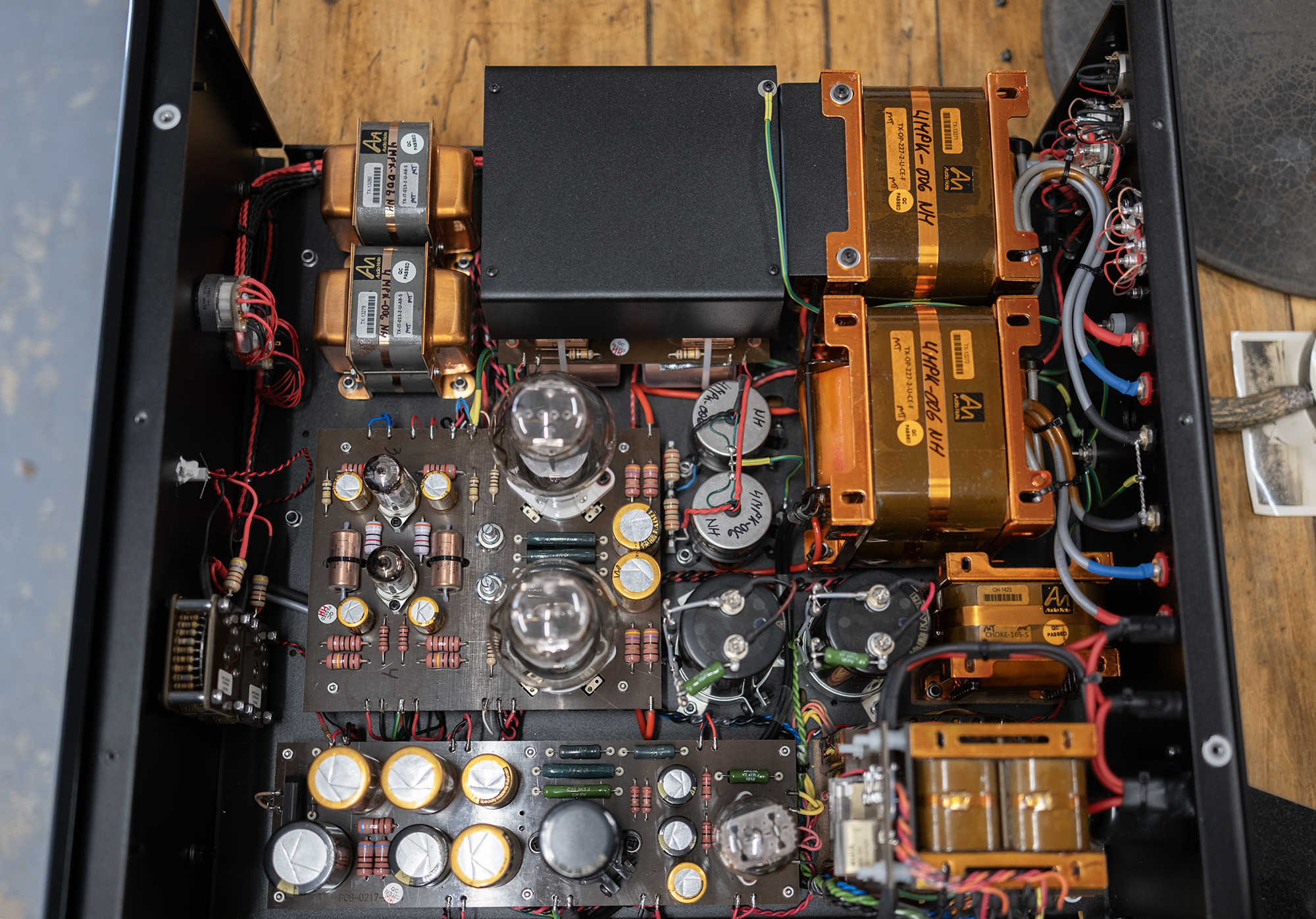
From a bird’s eye view, the Konzertmeister employs a single 6463 and CV4068, both dual triodes, in the input and driver stages and an interstage transformer which drives the Psvane HiFi Series 300Bs in the output stage. You can read all kinds of opinions when it comes to an interstage transformer versus capacitor coupling versus direct coupling but the way I see it, the proof lies in the listening and I’ve heard all three approaches deliver splendid sonic results.
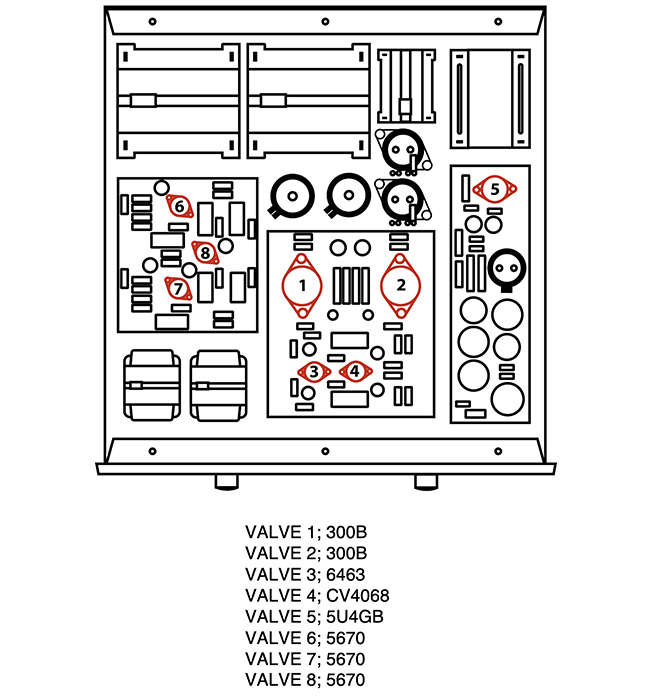
A single 5U4GB handles rectification, converting AC to DC, while three 5670s are used in the phono stage. You may not believe this, but some people argue over tube vs. solid state rectification. The 300Bs and 5U4GB are installed by the owner (or reviewer) which requires removing 20 Phillips head screws that hold the black aluminum chassis in place. All other tubes are already in their respective spots but the manual recommends checking to make sure they didn’t get unseated in shipping.
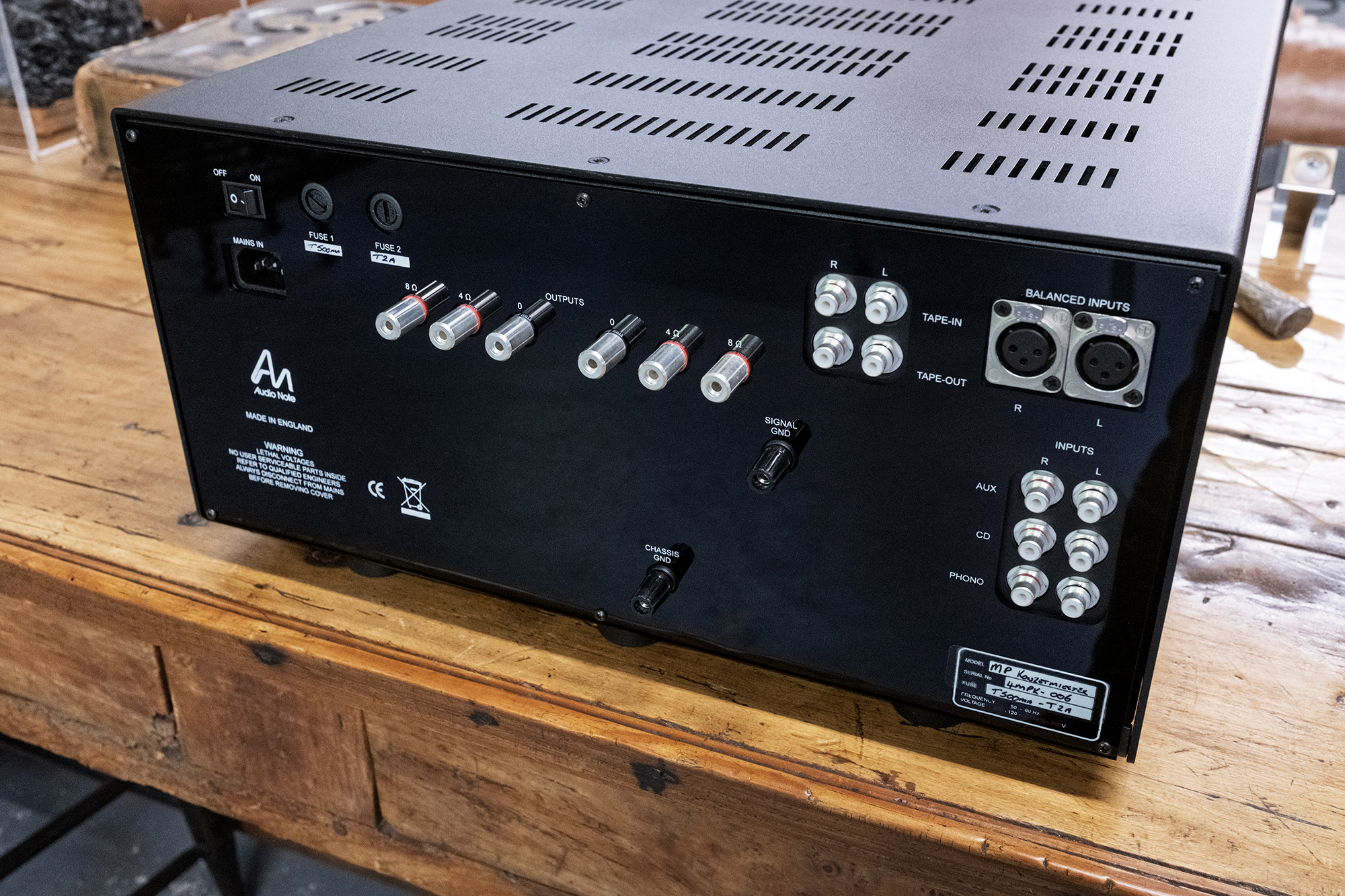
The Meishu Konzertmeister measures roughly 18″ W x 20″ D x 8.5″ H and weighs a lift-with-your-legs 77lbs. ‘Round back we find a black acrylic panel with 2x RCA and 1x XLR line level inputs, 1x MM Phono input, Tape In/Out, 4 and 8 Ohm speaker terminals, Signal Ground, Chassis Ground, On/Off switch, access to fuses, and an IEC inlet.
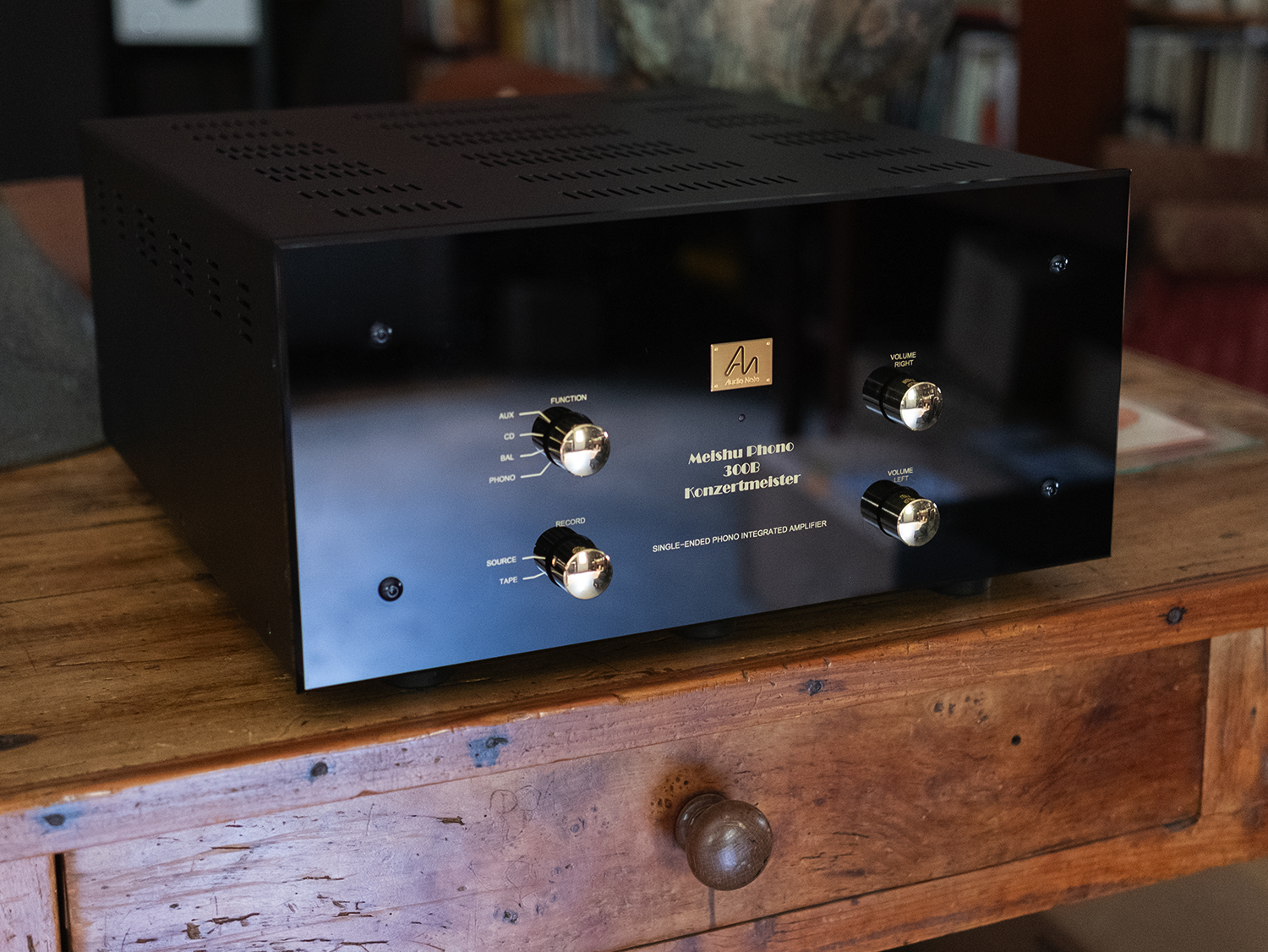
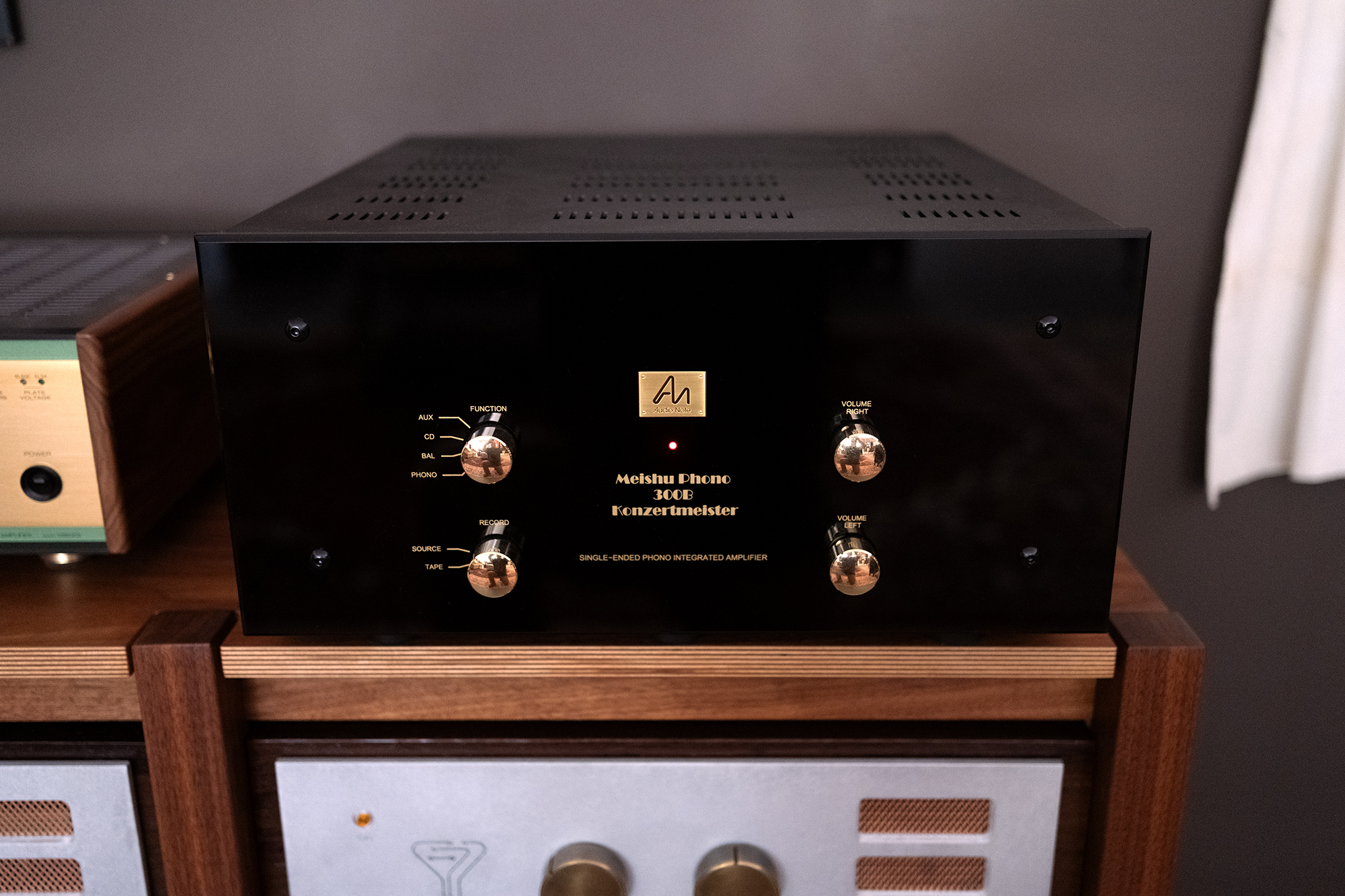
The front panel comes in two styles, Brushed Aluminum or Black Acrylic, and the review unit shows the mirror-like finish of the Black Acrylic option. Four gold colored knobs sit symmetrically in pairs with Function (input) sitting over Record (for Tape) and dual volume controls, one for each channel, a feature I appreciate for its balanced approach (wink). There is no remote control option.
The Konzertmeister is a big amp, which comes into better focus once it’s sitting on a rack. In terms of looks, I think it’s safe to say most of the Konzertmeister’s cost is inside or invisible as it has to do with making things in-house by hand. Some people value this approach, I do, while others prefer lower cost machine-made stuff. In terms of price and value, I am of the opinion that how much other people spend on things that bring them enjoyment is none of my concern. One funny thing about passing judgement on people based on a price tag is the judges somehow always spend just the right amount on all their stuff, no matter the cost. I think there’s a word for that.
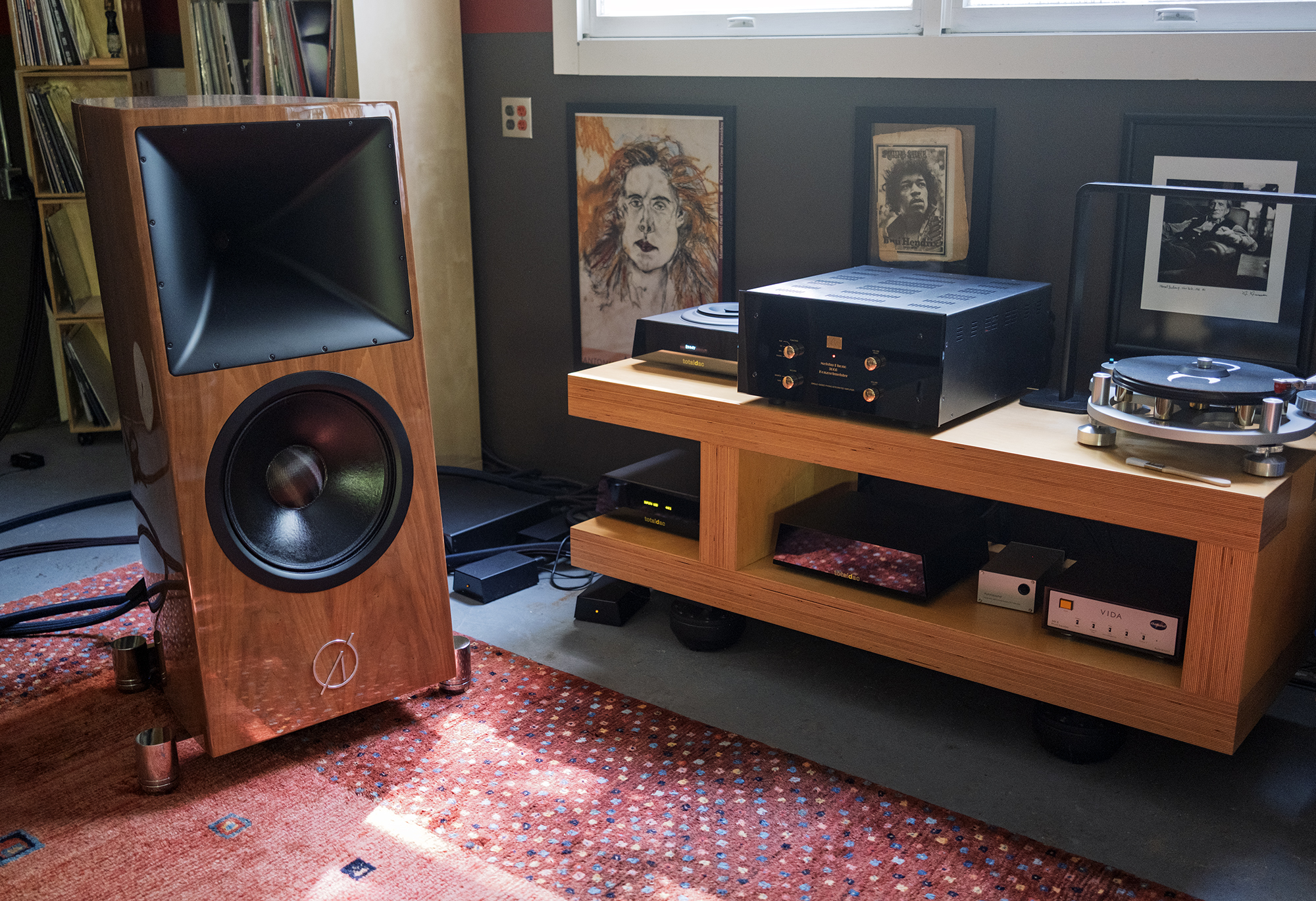
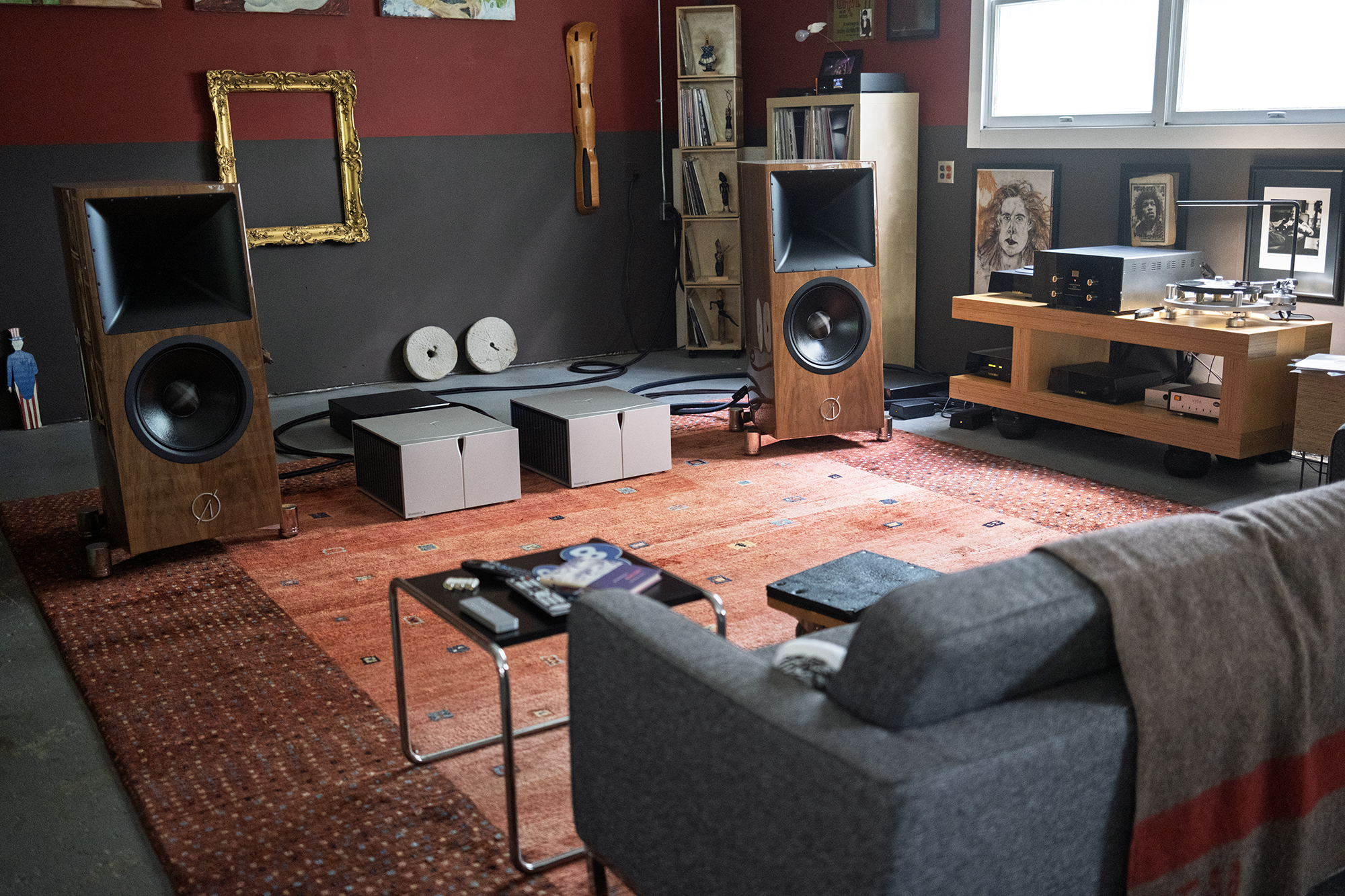
The Konzertmeister spent Barn time driving the recently reviewed Ø Audio Verdande (review) and the in for review DeVore Fidelity O/Bronze (more info). I used my Michell Gyro SE/Sorane SA1.2 rig mounted with an Ortofon 2M Black MM cartridge to take the Konzertmeister’s phono stage for a long spin, while the Barn resident Grimm MU1 (review)/totaldac d1-unity (review) combo, as well as the totaldac d1-CD Transport & d1-streamer-live (more info) took care of digital duties on the Barn’s A-Side while the review Weiss Helios streaming DAC (more info) played on the B-Side (see full Barn and system details).
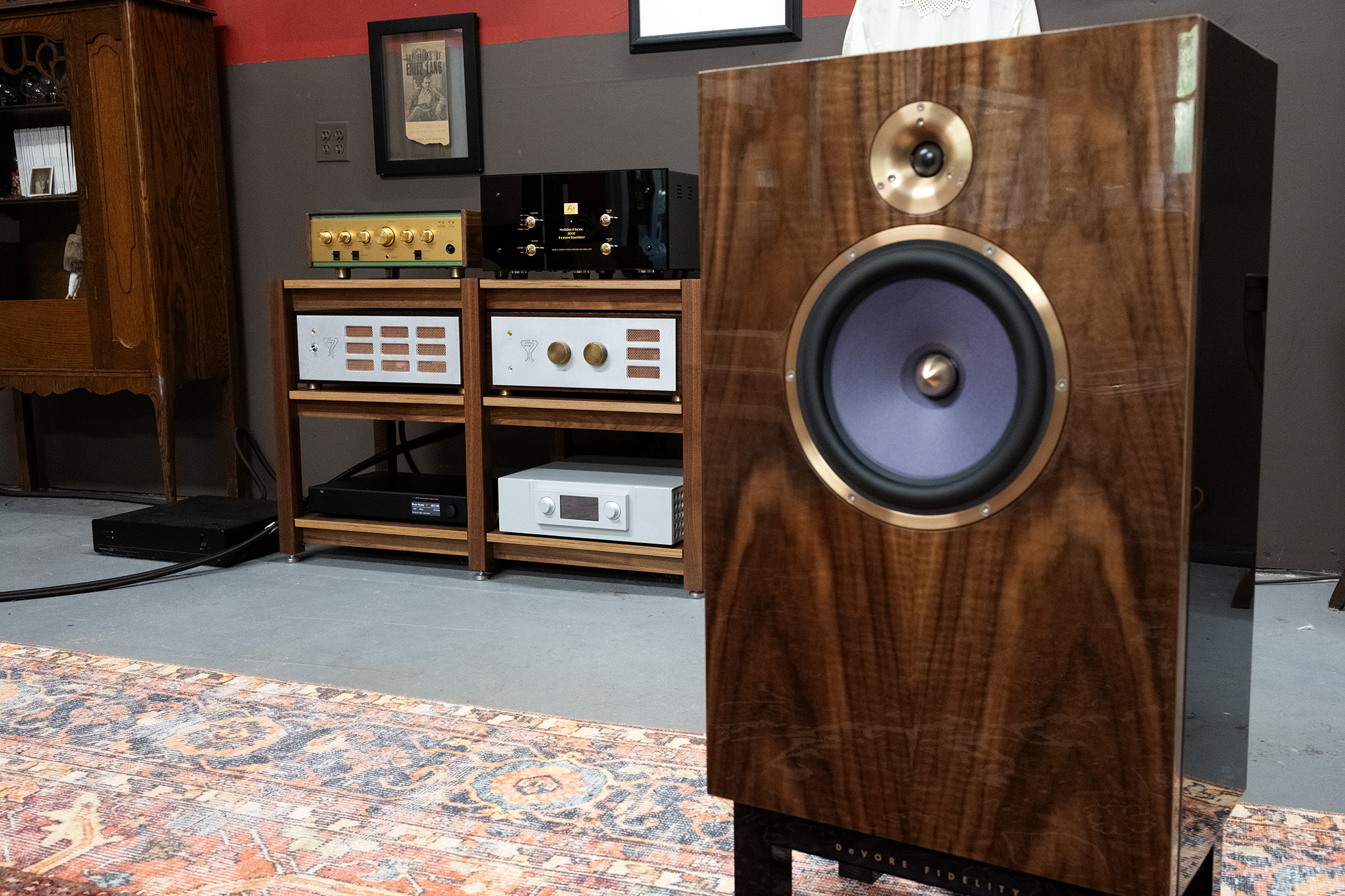
No matter the speaker or source, the Audio Note Konzertmeister elicited shocking levels of realism, the kind of quality imparted to sounds that makes reproduced music feel materialized albeit in an immaterial manner. Sounds and music are fleeting after all, purely sonic aberrations floating in air, only coming to life inside the listener. If Jazz at the Pawnshop plays in a forest and no one is around to hear it, does it make sound boring? To my way of thinking, the ultimate quality of reproduction is best measured inside the listener and seeing as we’re human with vastly different experiences, knowledge, likes and dislikes, not to mention physical differences that directly impact sensual input, there’s no such thing as an objective best or worst when it comes to judging things that reproduce music.
For me, shocking levels of realism is about as good as hifi gets and the Konzertmeister hit that mark hard throughout its 2-month+ Barn stay. For those who need some kind of measurable proof regarding realism, I’ll refer you back to Courbet.
Hiraeth by Sofie Birch and Antonina Nowacka was released on Unsound in July. These musicians brought a guitar, zither, and a portable Nagra reel-to-reel deck into the hills of Sokołowsko in Southern Poland where they improvised with strings and voices. Incidentally, the world’s first sanatorium for the treatment of tuberculosis was opened here in 1854, a place for healing, a kind of Magic Mountain. Birch and Nowacka brought the raw tapes, field recordings, back into the studio where they added DX7, minimoog, vibraphone, percussion, steel drums, and pipe organ to the mix creating an enchanting album.
From the liner notes:
“We wanted to get away from screens as much as possible,” says Birch, “to bring to the world something vulnerable and honest. Without advance preparation, every day we went out into the open air, finding places to sit, during sunset or the midday sun. We discovered new tunings on our instruments, picked up a melody, and started the machine, playing over and over till we got a take.” In the autumn, they met again in a Copenhagen studio, sparingly and carefully layering old synths and organs to add more depth without muddying the mix.
Here, touch, delicacy, timing, intimacy, and nuance play equally important roles as do the voices of instruments, voices, and nature and this lovely recording highlights many of the Konzertmeister’s strengths. Chief among them in this context being the ability to recreate every one of those varied and delicate voices with a dimensional purity and richness that brought this music to life in Barn. I could nearly smell the sweet Sokołowsko mountain air.
This level of tactile realness, the feeling that we are experiencing the thing and not a reproduction, is something I value greatly and the Audio Note Konzertmeister is among the finest transformers I’ve heard. A master of the note, a revealer of the full voice.
Throbbing Gristle’s 20 Jazz Funk Greats from 1979 remains a favorite as much for its tongue planted firmly in cheek as for its lack of jazz or funk.
Here’s band member Cossey Fanni Tutti:
We did the cover so it was a pastiche of something you would find in a Woolworth’s bargain bin. We took the photograph at the most famous suicide spot in England, called Beachy Head. So, the picture is not what it seems, it is not so nicey nicey at all, and neither is the music once you take it home and buy it. We had this idea in mind that someone quite innocently would come along to a record store and see [the record] and think they would be getting 20 really good jazz/funk greats, and then they would put it on at home and they would just get decimated.
Time has softened the decimation but this music still thrills for its vacant industrial vibe. Here, amidst the glitchy twitchy propulsive slaps and dashes, the Konzertmeister showed off its outstanding clarity and control where every element in the mix was offered up in high relief with rich voice and real physical presence. Nice.

If you’ve been in an Audio Note room at a hifi show recently, you more than likely were treated to some wild bass heavy sci-fi techno from Charlotte de Witte’s Sanctum at club-loud levels which drives home the point that a low powered tube amp, this very Konzertmeister was in play at Axpona 2025, in an all Audio Note system can rattle the rafters and your bones.
The Konzertmeister had no problem driving the O/Bronze and Verdande to louder than I typically listen levels but it you have a large listening space and like to listen really loud, as in 100dB+ peaks on a regular basis loud (something I do not recommend), I would stick with speakers that offer a high 90dB benign load (or higher) like the Audio Note AN-E/SPx Ltd. Field Coil loudspeakers that were paired with the Konzertmeister at Axpona, speakers the Konzertmeister was designed to drive.
All that said, the Konzertmeister / Verdande duo moved the Barn’s loose bits with Throbbing Gristle at the wheel with superbly rendered physicality. I hope this goes some way in dispelling the wrongheaded notion that lower power tube amps can only do justice to music-lite.
Behind every wrongheaded notion there lies some grain of truth and the Konzertmeister / DeVore O/Bronze combo offered up some of the most engaging sounds from Wal Waldron’s 1962 masterpiece The Quest I’ve had the great pleasure of experiencing in Barn. Eric Dolphy in all his restless glory on alto sax and clarinet, Ron Carter on cello!, Booker Ervin on tenor sax, Joe Benjamin on double bass, Charlie Persip on drums with Mal behind the keyboard created vital, compelling music with one foot well into the avant-garde. These are master musicians in their prime rooted around hard bop structures with a staggering sense of interplay and timing and the Konzertmeister felt like it understood every twist and turn, digging deep into macro and micro movements. Stunning.
There’s also no ignoring the Konzertmeister’s ability to display sheer beauty in the sounds of things. The pluck of a string, the quiver of a voice, the final faint trills of Mal Waldron’s farewell on the nearly too beautiful “Warm Canto.” Mesmerizing.
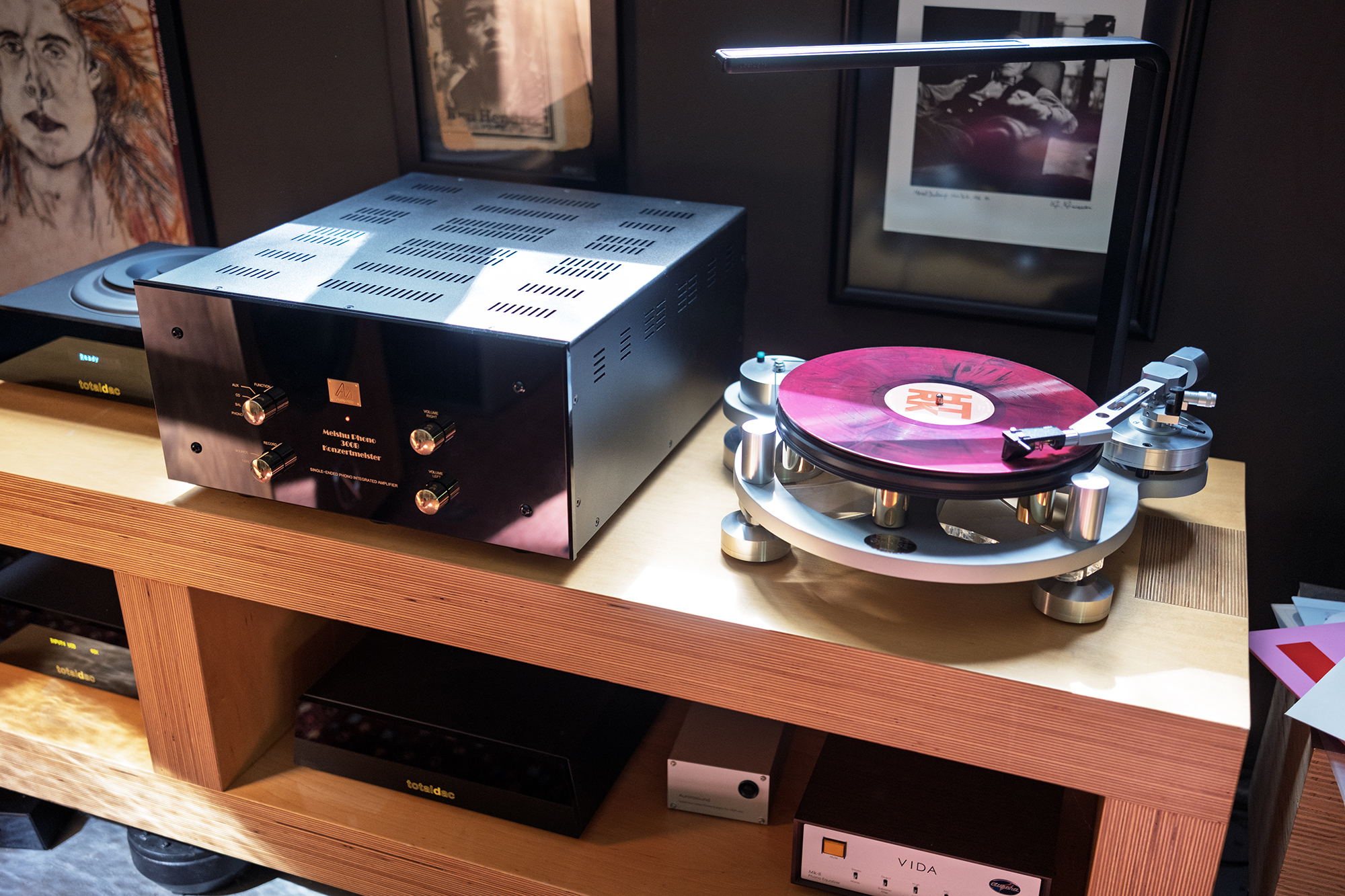
I began my vinyl run with the The Quest LP just for kicks and spent a number of days spinning records using the Konzertmeister’s phono stage. Admittedly in this company my Michell Gyro SE/Sorane SA1.2/Ortofon 2M Black setup is a bit of a mismatch price wise but it’s what I got and I had no problem digging into every record from my small but growing collection that is about 1/18th the size of the one I sold. Sigh. Among records spun were HTRK’s debut Marry Me Tonight, a bunch of PJ Harvey, Aldous Harding, Martha Argerich’s Bach, Are You Experienced (I am), and host of others which was more than enough to convince me that the Konzertmeister’s phono stage is pretty damn exquisite too.
My only comparison is with the Barn resident Aurorasound VIDA MK.II Phono Stage which offers a cooler and crisper sound by comparison for what that’s worth. As most reader’s know, I do not review stand alone analog gear these days as I prefer to save listening to records for my non-reviewer self so I admit to some amount of guilt intruding during the days I spent listening and enjoying, forgetting to put my reviewer cap back in place. The way things should be in an ideal world.
The in Barn for review Treehaus Audiolab The Preamplifer & 300B-2 SET Amplifier (more info) costs $54,000 for the entire kit and caboodle and it’s no coincidence they’re here at the same time as the Konzertmeister. The Treehaus combo does not include a phono stage, something worth taking into account when doing the math. In terms of sound, one main difference between the Treehaus combo and the Konzertmeister is evident in their portrayal of space, specifically the space in a recording. The Treehaus combo has a much more expansive sound image, floating very nicely formed sonic elements within a vast space filled with plenty of air. By comparison, the Konzertmeister drew a much tighter sound image, more compact and less airy, which made music feel a bit more muscular at the expense of overall dimensionality. To say it another way, the Treehaus created a more realistic sense of space. The Konzertmeister imparted a bit more timbral vividness, a main ingredient in its ability to shock, but the Treehaus combo was plenty rich. I feel like I’m describing the differences between two chocolate frostings and saying one is sweeter than the other, which is not too far off.
If we take a step back and look at these very different looking products and take into account the companies and people behind them, my best guess is these concerns along with the design principles employed in each will be as large a determining factor in deciding which has more appeal as much as their respective sonic strengths and distinct voices.
Of course when we look at other amplification in and around the Audio Note’s price, there are lots of strong contenders for your ears (and wallet). Among my favorites are the Riviera Labs APL10 Preamplifier / AFM25 Monoblock combo (review) I reviewed way back in 2022. I did have an opportunity to spend some time with the AFM25s in Barn more recently and was reminded of the their uncanny seductive holographic sound I’ve yet to hear equalled. As its name says, the AFM25 monoblocks offer 25W of power so they can obviously drive a wider range of speakers than the 8W Audio Note and to my mind the Riviera’s sound is equally compelling albeit not the same. Once again, I think people looking for a 300B-based SET amp are looking for a 300B-based SET amp so comparisons to other amps with other topologies misses that relevant point.
As is the case with all of my favorite gear, the Audio Note Konzertmeister had me looking forward to hearing favorite music I know, a list that’s becoming nearly endless by expanding each week, thank goodness, and when reproduction elicits this level of excitement and this level of pure involvement thoughts of comparisons fade away into pure joy in the moment.
The Audio Note Konzertmeister is pretty damn exquisite. When used in a sensible system context, the Konzertmeister offers a shocking degree of musical realism that captured my heart and soul every moment music played.

Audio Note Meishu Phono 300B Konzertmeister Integrated Amplifier
Price: $65,000
Website: Audio Note
Specifications
Input Impedance: 100K Ohm, line level | 47K Ohm Phono
Input Sensitivity: 110mV for full output
Maximum Output: 8 Watts (approx.) per channel into 4 or 8 Ohm loads
Channel Balance: +/- 0.3dB
Valve Complement: 1 x 5U4G, 2 x 300B, 1 x 6463, 1 x CV4068, 3 x 5670 (phono stage)
Unit Weight: 35 kg
Unit Dimensions: 220mm (h) x 460mm (w) x 530mm (d)
Mains Input: AC 100-120V / 220-240V 50/60Hz
Max. Power Consumption: 200W