
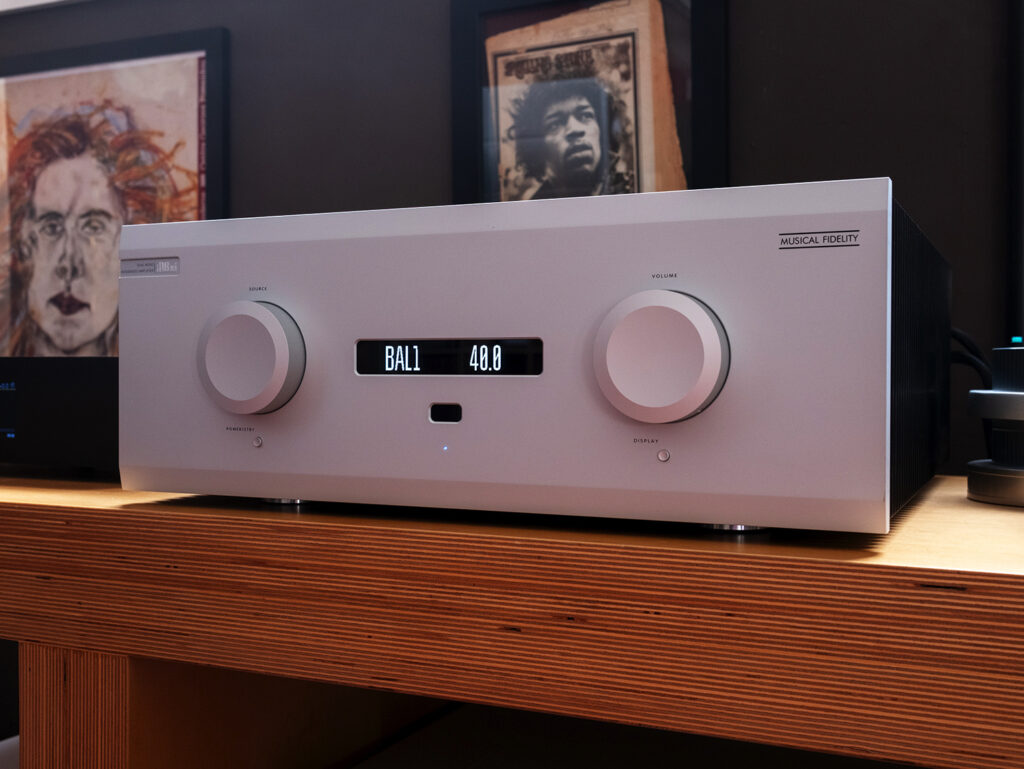
Sometimes there’s no way around Watts. And pounds.
The Musical Fidelity M8xi offers 550/870 Wpc into 8 and 4 Ohms respectively with Peak Power numbers hitting 1.6kW into 2 Ohms according to the company while weighing in at 101 lbs. More so than most amps near its price that have come through the Barn, the Musical Fidelity “Super” integrated amplifier pretty much demands to be partnered with a speaker that needs this kind of power. Otherwise what would be the point of having it.
With this in mind, I timed the M8xi’s nearly 3-month Barn stay to coincide with the recently reviewed Perlisten S7t Black Edition speakers (review) and the more recently arrived Dynaudio Confidence 60 (more info). The S7t have a reported sensitivity of 91.4dB (2.83v/1m) with a 4 Ohm nominal and 3.2 Ohm minimum impedance with a “typical room response” that reaches down to a claimed 16Hz, while the Confidence 60 offer a reported 87dB (2.83V/1m) sensitivity and a 4 Ohm nominal impedance with a 3.7 Ohm minimum impedance @ 71Hz and reach down well into the 20Hz range. But as anyone who’s read John Atkinson’s speaker measurements at Stereophile over the years knows, how speakers behave when playing music, under an active load, can get a bit gnarlier than the specs suggest especially with full range speakers that go real low. All to say, I think both of these speakers gave the M8xi a good workout.
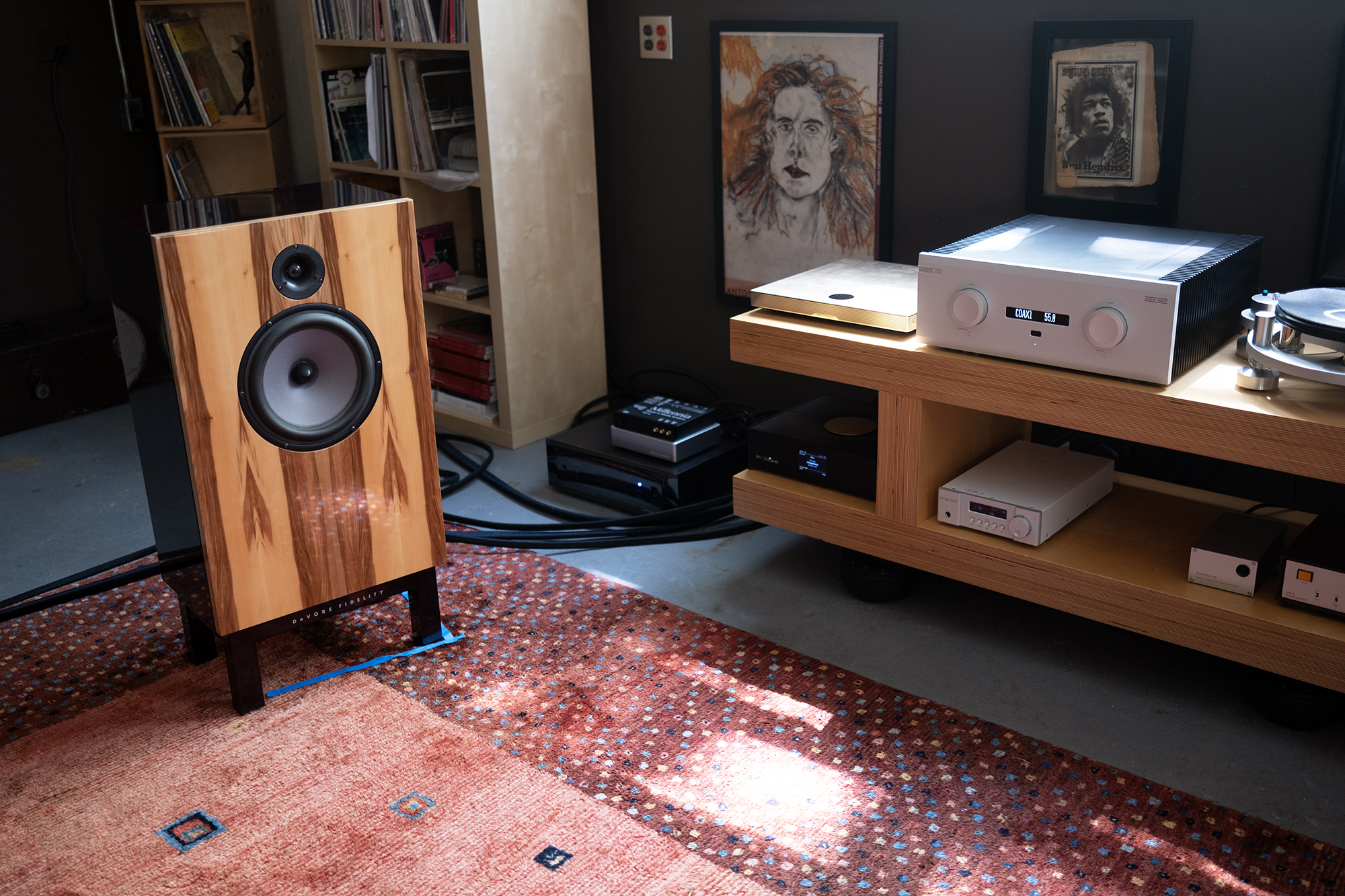
I did give the Musical Fidelity muscle amp some time with the resident DeVore O/96 (review), a speaker that can be driven to Barn rattling heights by as little as 8 Watts (or so), as a kind of voicing test. What I mean by that is while no one in their right system-building mind would purposefully mate these two, I know what the DeVore’s are capable of having lived with them for years and paired them with dozens of amps of all shapes and sizes so they give me a nice view into the voicing of the associated amplifier. And here’s what I found—the M8xi is nice and nimble, not at all hard or harsh but a bit flat sounding in this (admittedly silly) context. Overall cool rather than rich. Take that for what it’s worth as I’ll dig into real world scenarios shortly.

The M8xi is a ‘true dual mono’ design with a separate preamp and driver stage that runs in pure Class A mated to a pair of monoblock power amps run in Class A/B balanced/bridged mode inside its big, heavy chassis. Interestingly the specs for the M8xi do not include its weight but the manual says 101 lbs. (my back agrees) which is heavy enough to make moving it around something to consider—do I really need to move it to the other side of the Barn (sigh)?—made even more concerning due to the fact that the amp sits low enough so you can’t just slip your hands underneath without first lifting and those thorny yet useful heatsinks are not exactly finger friendly.
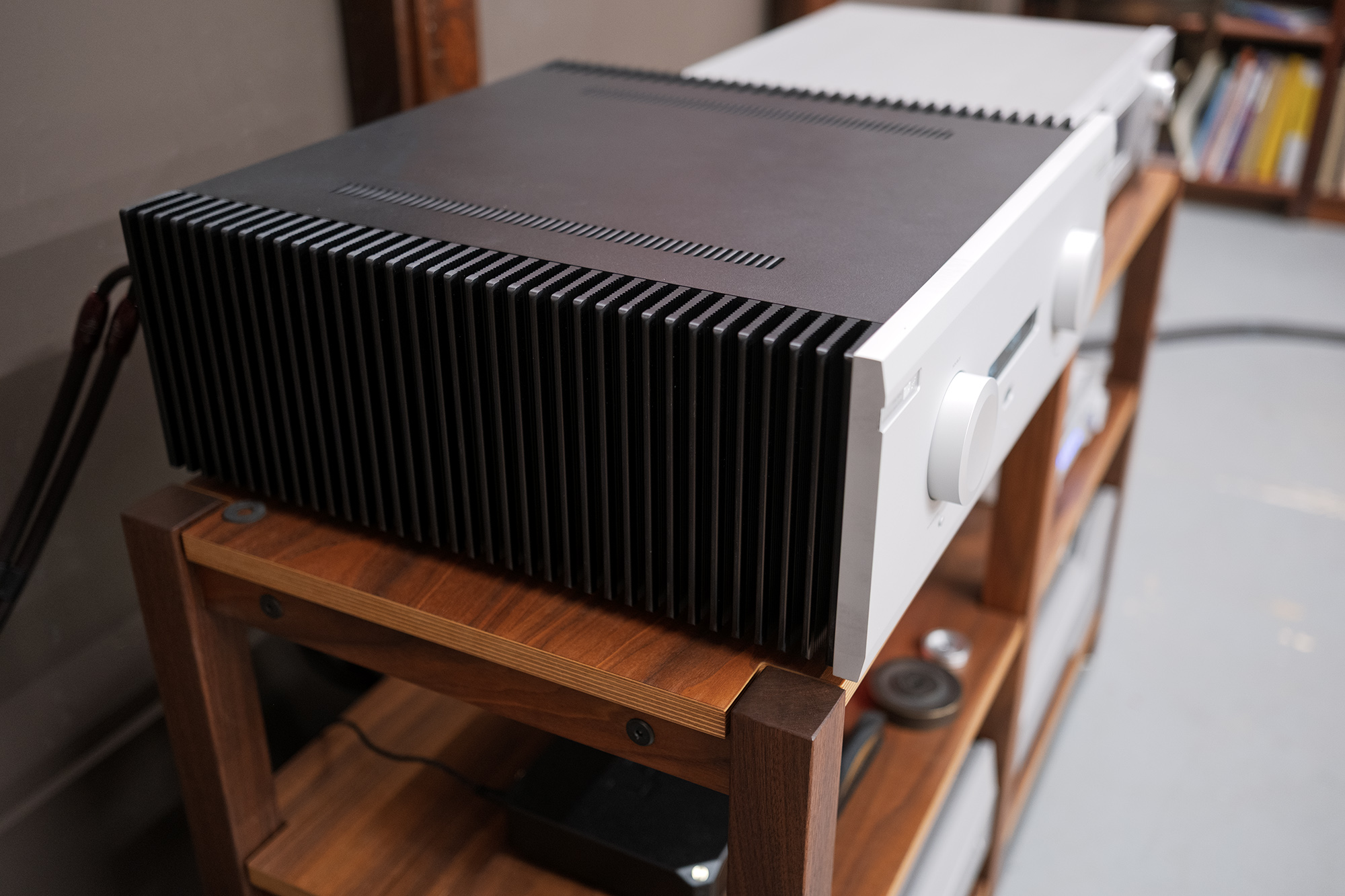
I do have one other quibble—the M8xi’s footers have rubber washer-shaped rings at their base which easily come off if you try to slide the amp into place leaving just bare metal that can gouge a wooden rack rack faster than you can say “Oh shit!” Lift, don’t slide.

The M8xi offers plenty of connectivity options with XLR and RCA inputs and outputs as well as 5 digital inputs to feed its internal DAC based on the Texas Instruments PCM5242 TI DAC chip and 2 digital outputs. Two sets of speaker binding posts stand at the ready to feed those big Watts to your speakers of choice.
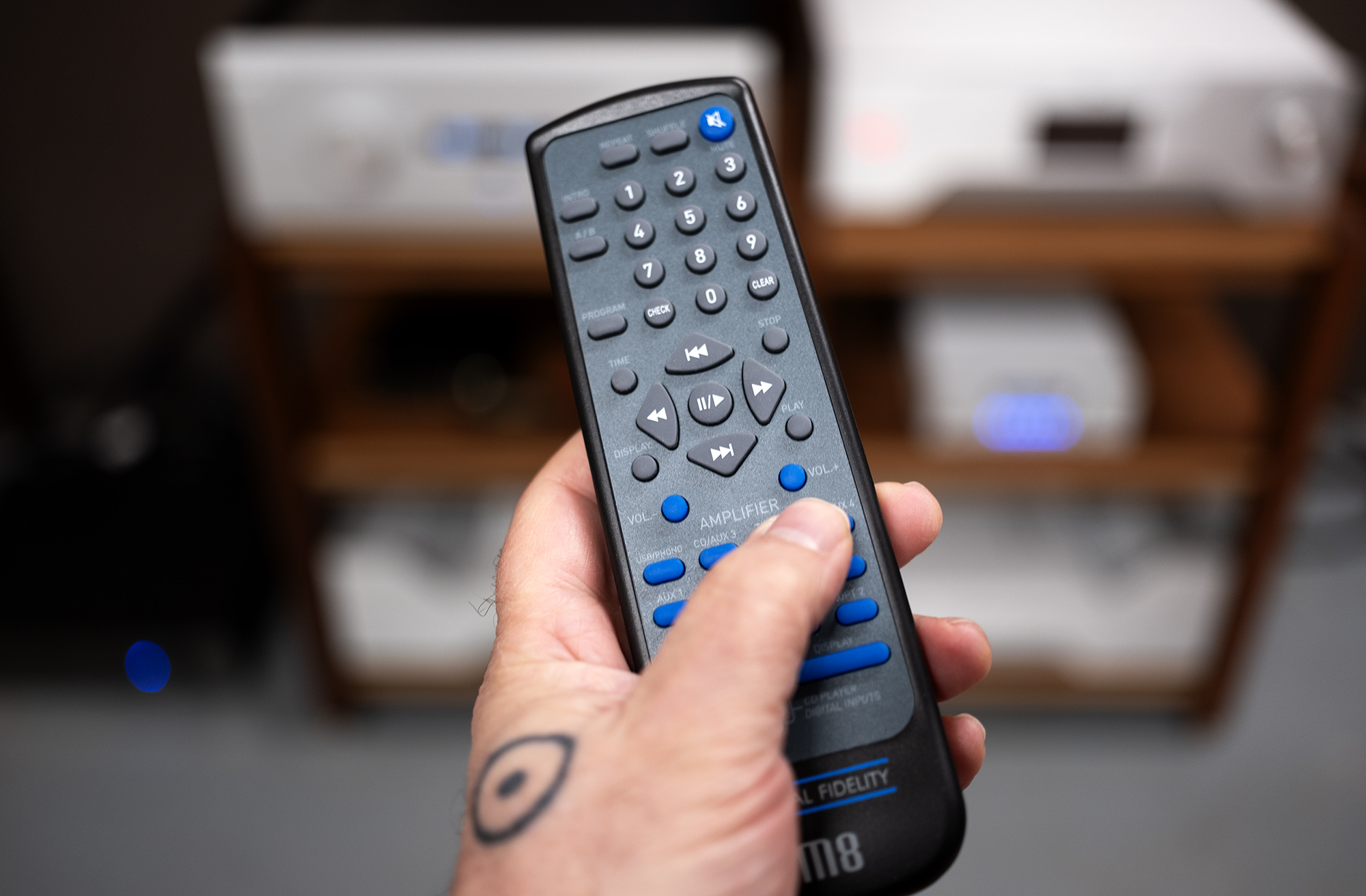
The included plastic remote offers more functions than needed for operating the M8xi but they’re there to work other Musical Fidelity products. I will say I found the squishy volume buttons a bit finicky in that a press did not always return the degree of change in level I was looking for.

The nicely sized and silky smooth volume knob on the amp’s face is much more user friendly as is the matching input selector on the other side of the display and I find the M8xi’s looks overall to be sturdy, minimal, and kinda massive (it’s 20” deep), two things I appreciate. Musical Fidelity calls the M8xi a Super Integrated Amplifier, following in the footsteps of the A1000, NuVista M3, Tri Vista 300, kW500, M6/500i, NuVista 800.2 and NuVista 600.2. My best guess is if you gathered all of ’em up they’d weigh about as much as a battleship.
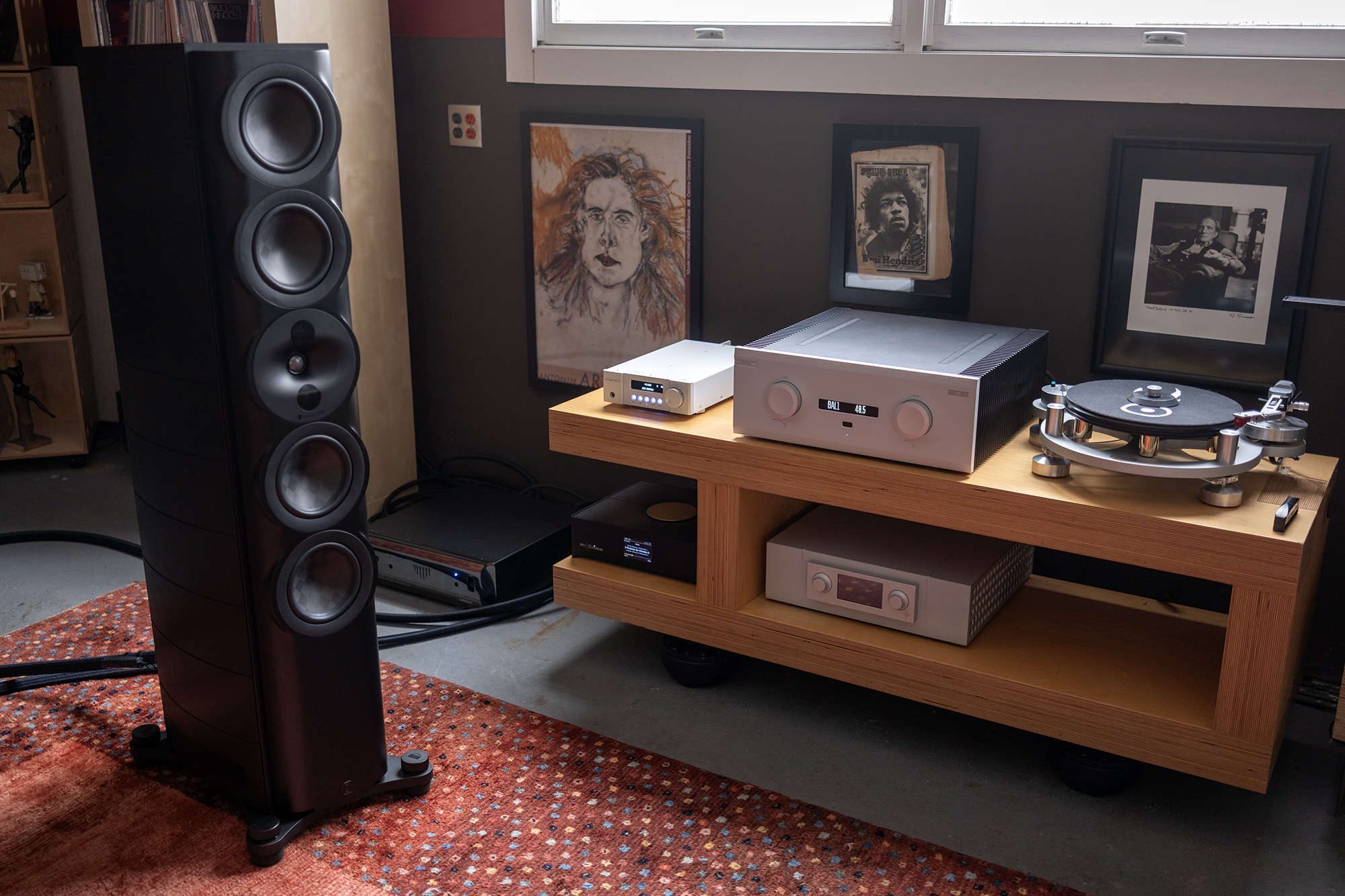
$7,999. I had to remind myself—a number of times throughout the course of this review—that this is what the Musical Fidelity M8xi Integrated Amplifier costs because it behaves like more. Much more. No matter the speaker, the M8xi proved to be startlingly fast and furious when called for, capable of delivering big, bold, and superbly controlled bass from the Perlisten and Dynaudio speakers, with a smooth and nuanced voice that drew me into the finer workings of the music in play. Considering the S7t come in at $29,995/pair and the Confidence 60 are an even $50k/pair, the M8xi kept pace with some fine company indeed.
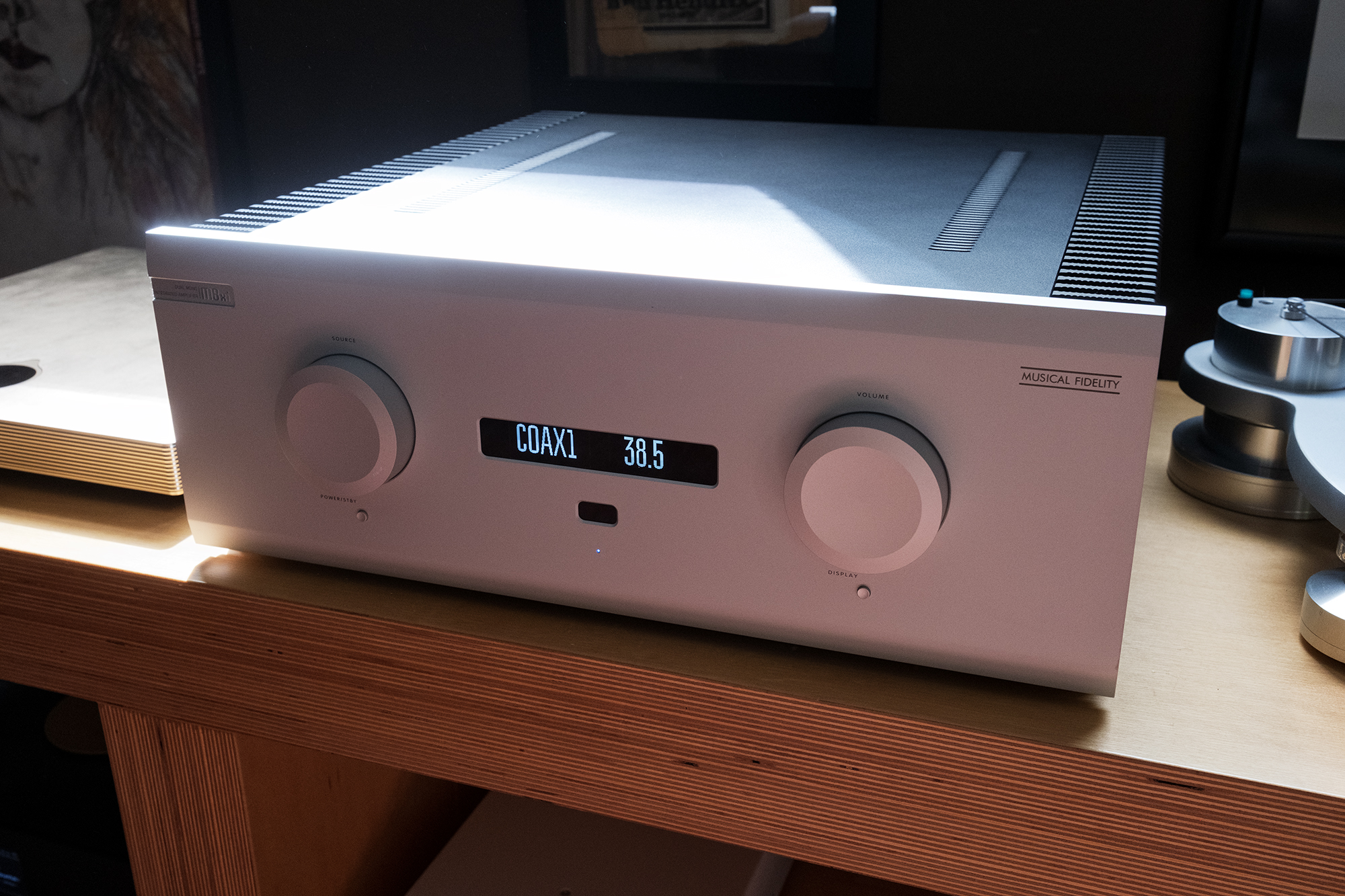
Let’s talk about the M8xi’s DAC up front to get it out of the way—it works and sounds just fine paired with the Barn resident Holo Red DDC (review) and a run of AudioQuest’s Coffee Coax cable but it is so far outclassed by the performance of the M8xi as an integrated amplifier I recommend upgrading to an external option when/if budget allows as you will not hear everything this “Super” integrated can do if you only use its internal DAC. For those who care, this internal DAC is limited to 24-bit/192kHz via coax or 24-bit/96kHz over Toslink which are its two digital input options. You can have a look at my Favorite Digital Gear for recommendations for something better, starting with the Wattson Emerson ANALOG on up.
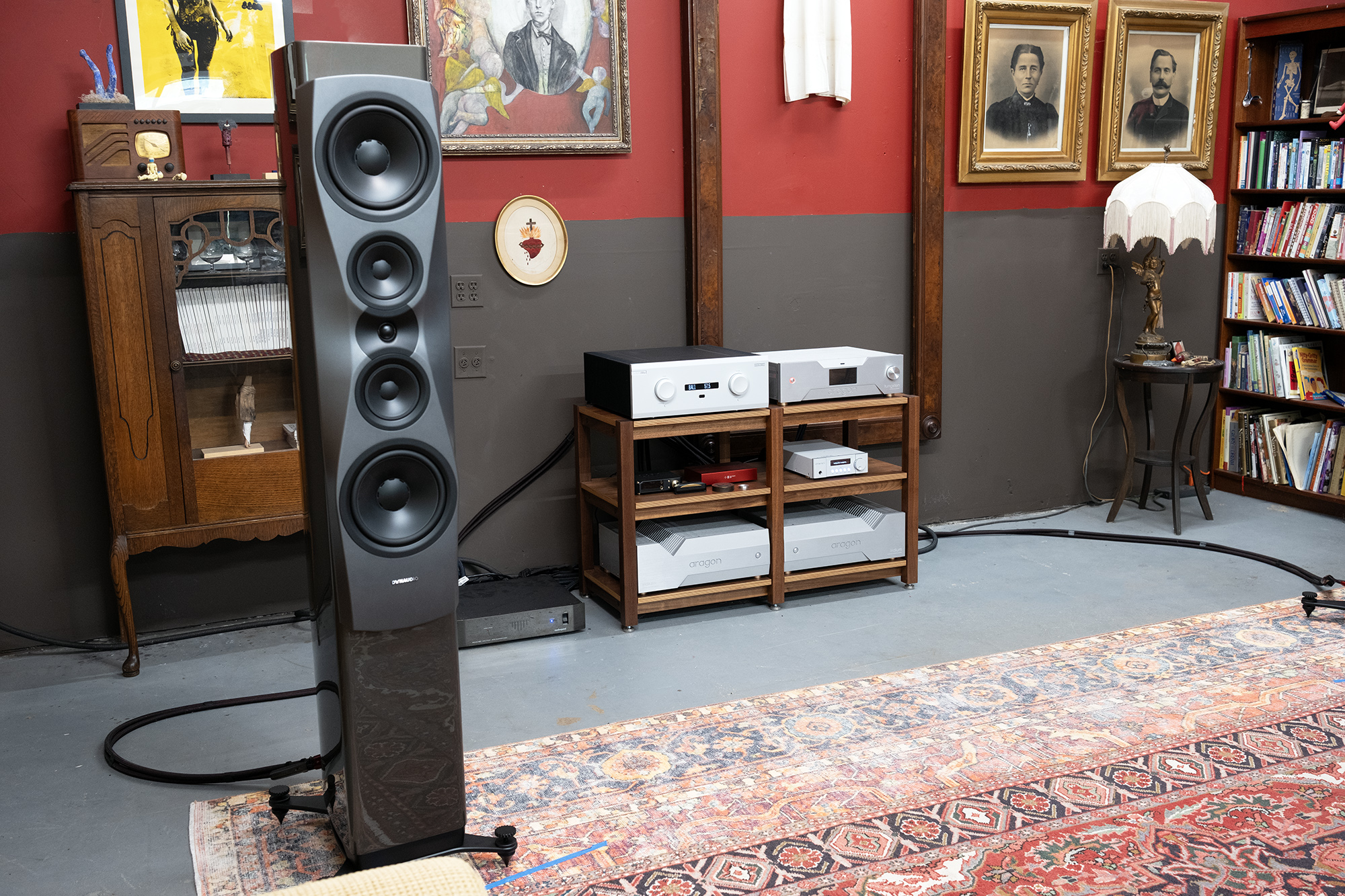
The two system contexts for the bulk of my listening time with the Musical Fidelity included the aforementioned Perlisten S7t Black Edition speakers, Barn resident Grimm MU1 (review)/totaldac D1-unity (review) combo and the Dynaudio Confidence 60 with the Holo Red feeding the Imersiv D-1 DAC (review) with all cabling courtesy of AudioQuest (see full system and Barn details). The M8xi was plugged into an AudioQuest Niagara 7000 power conditioner on the Barn’s A-Side and a Niagara 3000 on the B-Side.
About a million years ago I was living in NYC and visiting the uncle of a woman I knew. She was a writer, her father was a writer, and her uncle was a writer and soon after I sat he asked, as he always did, “What are you reading?”
“Magic Mountain.”
“What do you think?”
“I’m enjoying it!”
“No one enjoys Magic Mountain!” He said sternly.
This wasn’t the first time we had a disagreement over something I thought was in no way disagreeable. In any event, I imagine a similar reaction to the music of Giacinto Scelsi which I was devouring and enjoying at this same time. Voraciously. I’m not going to get into Scelsi here except to say imagine striking a tuning fork and spending a few decades composing music around the result.
While I’m mainly attracted to his works for solo piano and string quartet, Quattro Pezzi su una nota sola (Four Pieces on Only One Note), for 25 Musicians is among my favorites paired here with Anahit and Uaxuctum on Accord from the 1989 CD release which I bought new from Tower Records on Broadway back in my Magic Mountain days. As you might imagine with music this minimal everything matters when it comes to reproducing it in a meaningful way and paired with the Confidence 60 the M8xi re-created a stunningly powerful and moving rendition. This music also demands some volume both in terms of level and soundscape and this system had no bounds playing as loud as I cared to go without tightening up or getting hard with an impressive sound image that left little to the imagination. I will share that the Aragon stack that’s in for review added more dimension, space, and inner detail to these proceedings but that combo comes in at about 8 times the price of the Musical Fidelity.
From the liner notes:
Sound lives and moves: it oscillates in space, it vibrates and quivers like plasma, it is filled with depth and breadth. This inner vibration of spheric sound is made audible by clusters, trills, tremolos, glissandos, by various articulations, by contrasts in the “grain” such as rough or smooth, but above all by that rapid and broad vibrato widening the pitch’s trail from a linear ray into a large beam.
Spheric sound, indeed. Of course I’m talking about a system in play so this massive and moving portrayal relied on each piece of this puzzle that also included the Holo Red DDC, Imersiv D-1 DAC, AQ cables and power as well as the Box Furniture rack doing the heavy holding. Images in space were rock solid, rock steady, and exploded into the space of the Barn as if unencumbered by physical constraints. Free-flowing effortless quivering power and glory summoned from only one note. Bravo!
Ana Roxanne’s, Poem 1 released on Kranky earlier this month, is a study in moods and atmospheres with synthesizers, piano, strings and things lifting her vocals upward. This is quiet, gentle music slow in pace and deep in longing and the M8xi paired with the Perlisten S7t Black Edition speakers did a fine job with the details and sounds however the space of this recording was not as vast as I heard it through the Dynaudios when using the Musical Fidelity muscle amp. The Dynaudios also sing with a sweeter voice which brought me deeper into this moving music.
This illustrates why I would put the M8xi on the cool side of neutral so when thinking about good speaker partners I’d look for something on the warmer side of the wheel. While I’m talking about relatively subtle shadings, they are nonetheless very important when we’re just listening for long stretches of time over time. And I can’t stress this point enough—small and subtle differences can be the difference between casual enjoyment and complete engagement when we’re doing nothing but listening.
I’ve talked about Tracey’s self titled EP before because I enjoy its bounce and swagger and the deep bass hits hard right off the bat in EP opener “Sex Life” and the Musical Fidelity seemed to smile as it delivered that bass big, bold, and beautifully. There was a very clear sense of complete control from top to subbasement through the Confidence 60 which boogied the Barn’s loose bits as I turned this party in sound up and up again. If you enjoy big bold music with deep bass and you like to play it loud through tall towers that need some real drive to get ‘em going, the M8xi was designed with those things in mind (at least that’s how I hear it).
As a matter of fact I was so deep in this hybrid trip-hop dub groove I went directly back in time to King Midas Sound’s 2019 inferno of sound from Roger Robinson and Kevin Martin Solitude and let that soliloquy in loss shake up the Barn and me some more. The M8xi’s whip-like dynamics had Martin’s eerie crackled backdrop sparking to life in air as if these strange sounds originated there and Robinson’s broken spoken stories were full figured and well out into the room with a physical presence that made this music feel all that much more dangerous. Nice. Think superb control = effortless everything.
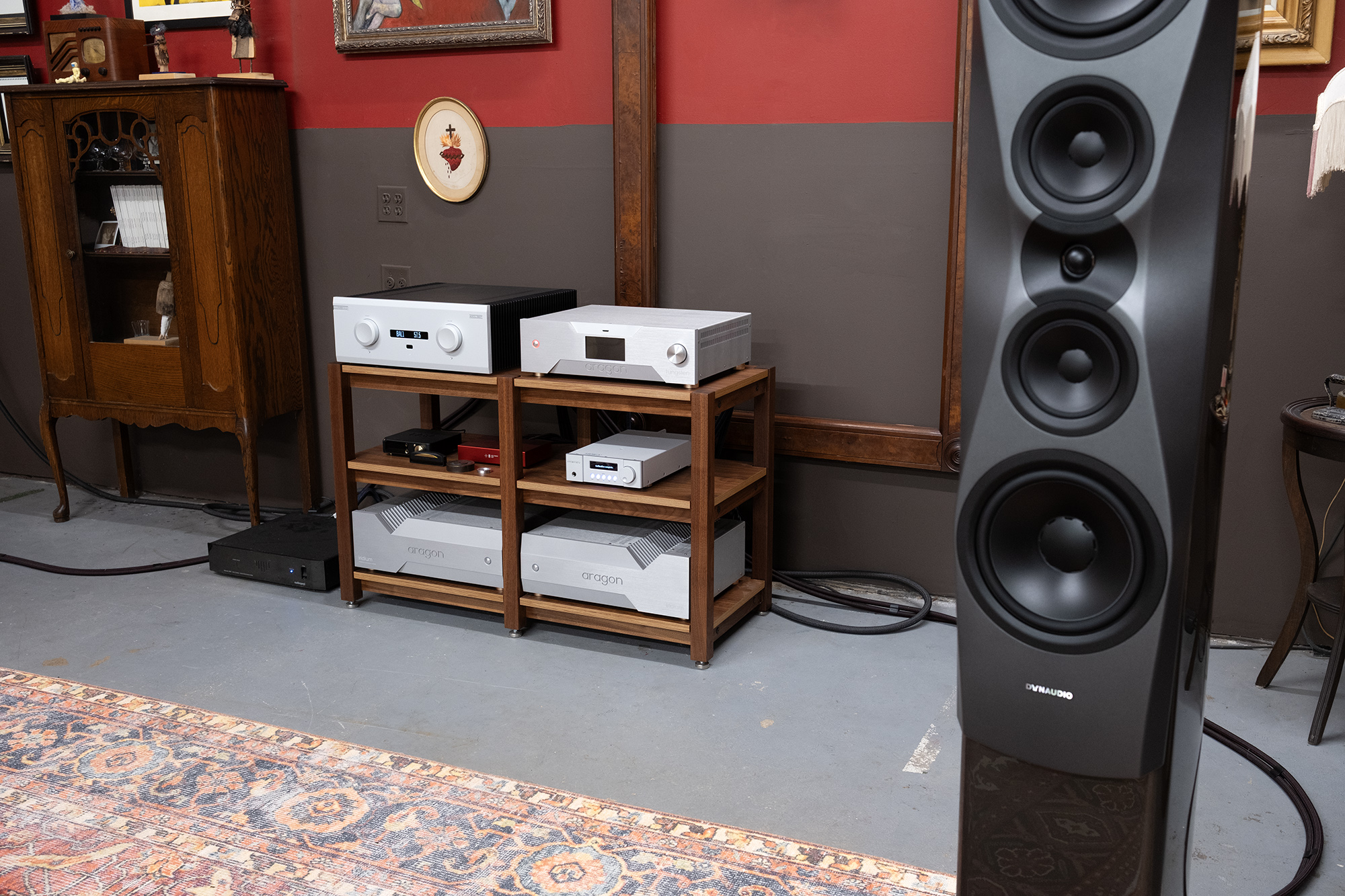
In terms of relevant comparisons with price, performance, and specs in mind I’m going to come up shy. For example, the Barn resident Leben CS600x costs $9995 and offers about 30 Watts of power so we’re talking about tanks and apples and there’s no other amp on my list of Favorites that comes anywhere near the M8xi’s total package for its asking price. All to say if you need what the Musical Fidelity amp has to offer for anywhere near its price I recommend…it.
It’s only when moving up in price that I have something to say. Way up in price to the Audia Flight FLS 10 (review) I reviewed back in 2023 which now costs $14,999 and offers a richer and fuller voice compared to the M8xi while offering 200/380/700 Wpc into 8/4/2 Ohms. The in for review Aragon Tungsten Preamp / Iridium Monoblock Stack (more info) which is about $46k in total provides a meaningfully more complex and nuanced view into music that makes the M8xi sound flatter and slightly dull by comparison but I share this observation knowing it’s mostly useless information.
If you’ve already headed down this road with speakers that require this kind of power, the M8xi is simply a great choice at a very nice price.
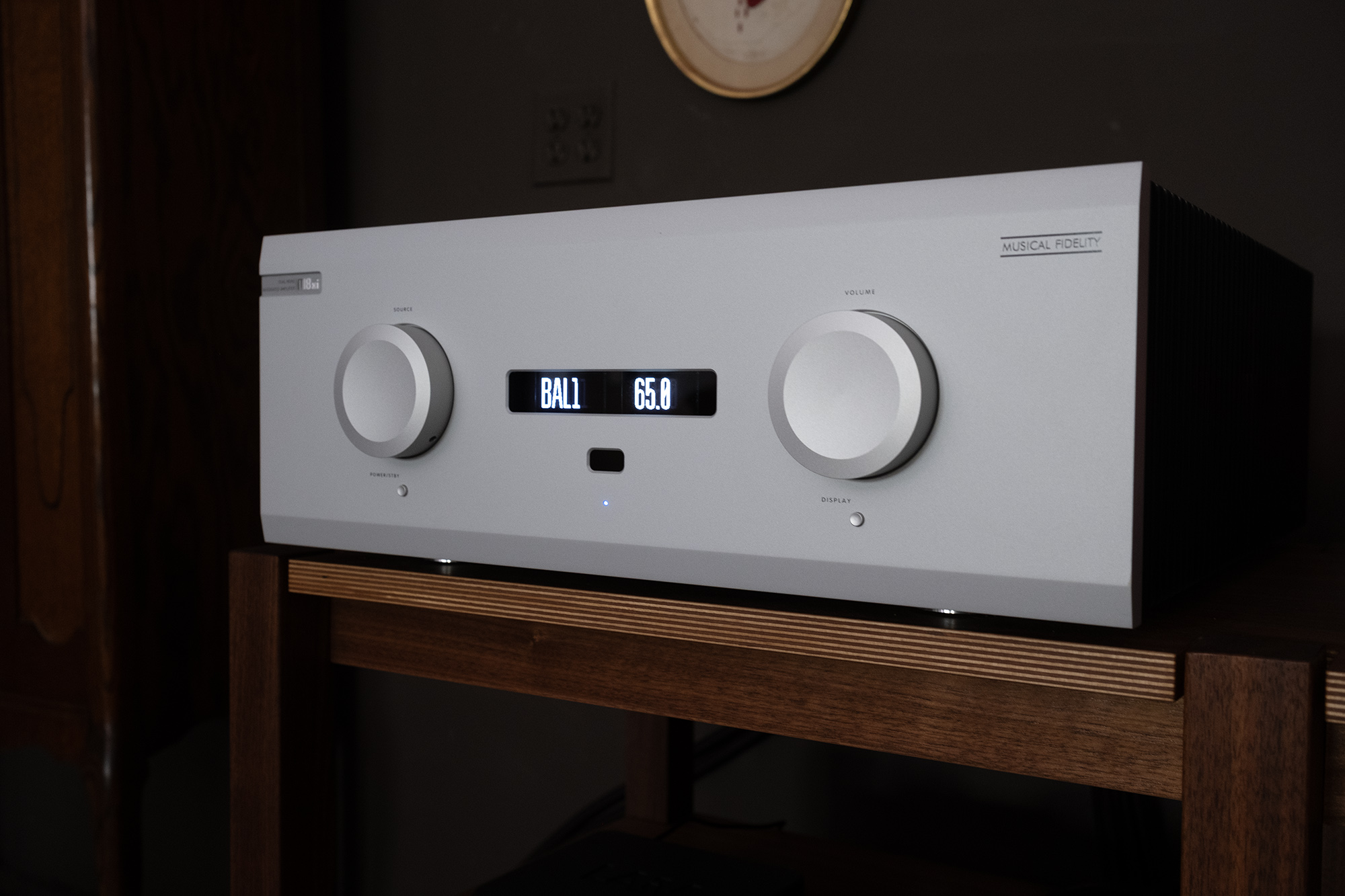
There’s no avoiding the utility aspect of the M8xi’s power/performance which is in no way a criticism. It’s just that it’s rare to find an integrated amplifier for about $8k that can drive just about any speaker on the planet (if you find a speaker that needs more power, I recommend finding a different speaker). Rarer still is to find an integrated amplifier for about $8k that can drive just about any speaker on the planet in such a convincing and musical manner.
When paired with the Perslisten S7t and Dynaudio Confidence 60 speakers, the M8xi proved to be capable of startling dynamics, superb control as low as either speaker can go, coupled with a surprisingly nimble and nuanced sound that belied its utility. All told, the Musical Fidelity M8xi is one of the easiest recommendations I can offer if you’re looking for real music power at a very reasonable price.

Musical Fidelity M8xi Integrated Amplifier
Price: $7,999
Company Website: Musical Fidelity
US Distributor Website: Harmonia Distribution
M8xi – Specifications
Amplifier
- Power Output (20Hz – 20kHz): 550 Watts per channel into 8 Ohms (870W into 4 Ohms); Peak 1.6kW into 2 Ohms
- Maximum output voltage: 67 Volts RMS, 20Hz to 20 kHz; onset of clipping (190 Volts peak-to-peak)
- THD+N: <0.004% typical, 20Hz to 20 kHz (XLR)
- Signal/noise ratio: > 86dB ‚A‘-weighted (XLR)
- Input impedance: 25KΩ (RCA), 50KΩ (XLR)
- Frequency response: +0, –1dB, 10Hz to 100 kHz
- Maximum peak output current: 105 Amps
- Damping factor: 150
- Output devices: 3+3 pairs (bridged arrangement) per channel
Inputs (analogue)
- 4 pairs line level RCA connectors
- 2 pairs line level XLR (balanced) connectors
Inputs (digital)
- 2x Coax S/PDIF up to 24 bit 192kHz
- 2x Optical S/PDIF up to 24 bit 96kHz
- 1x USB B Asynchronous USB up to 24 bit 192kHz
Outputs (analogue)
- 1 pair line level RCA fixed
- 1 pair pre-out RCA variable
- 1 pair line level XLR variable
Outputs (digital)
- 1x Coax S/PDIF up to 24 bit 192kHz
- 1x Optical S/PDIF up to 24 bit 96kHz
General
- Dimensions (WxHxD): 485 x 185 x 510mm
- Max. Consumption: 2000Watts