
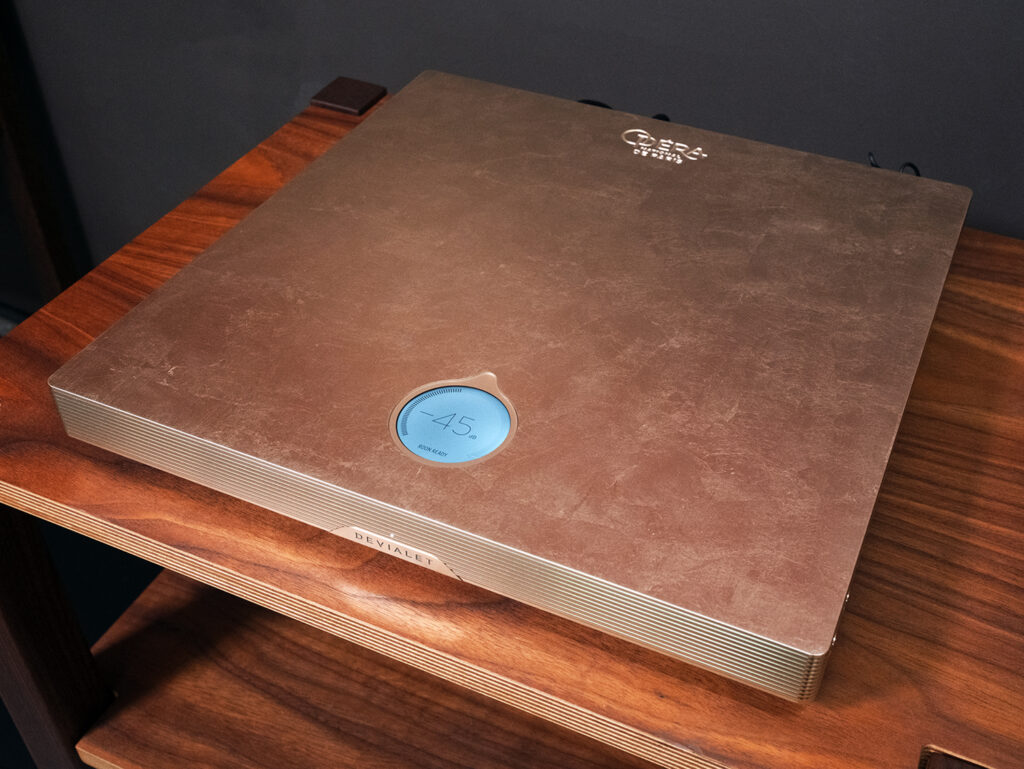
When it comes to hifi, can we really have it all—looks, style, substance, and great sound? This is one question the Devialet Astra Opéra de Paris Edition raises and my answer, after having lived with one, is a very confident hell ya!
At least that’s how I heard things here in the Barn over the course of the past few months where the Astra saw playtime with the recently reviewed Perlisten S7t Black Edition speakers (review), the Barn resident DeVore Fidelity O/96 (review), and the Dynaudio Confidence 60 (more info). The substance referenced refers to the Astra’s unique feature set that offers a deep level of customization to match speakers and cartridges with the company’s ADH (Analog Digital Hybrid) technology acting as the cherry on top when it comes to fitting its 150wpc (into 8 Ohms) of output power into a roughly 2” tall, 16 lb. chassis.
What is ADH? I’ll let Devialet explain:
The world’s first hybrid amplification technology delivers all the refinement of Analog amplification (Class A) with all the power and compactness of Digital amplification (Class D). Based on the same principle as advanced driver assistance, the idea of ADH is to maintain the analogue amplifier’s voltage generating function (to maintain their excellent audio performance levels), while entrusting the current generation function, and accordingly, that of generating power for the load, to an amplifier equipped with drastically superior energy efficiency: in this case a digital amplifier, otherwise known as a switch amplifier.
You can read more about ADH on the Devialet website.
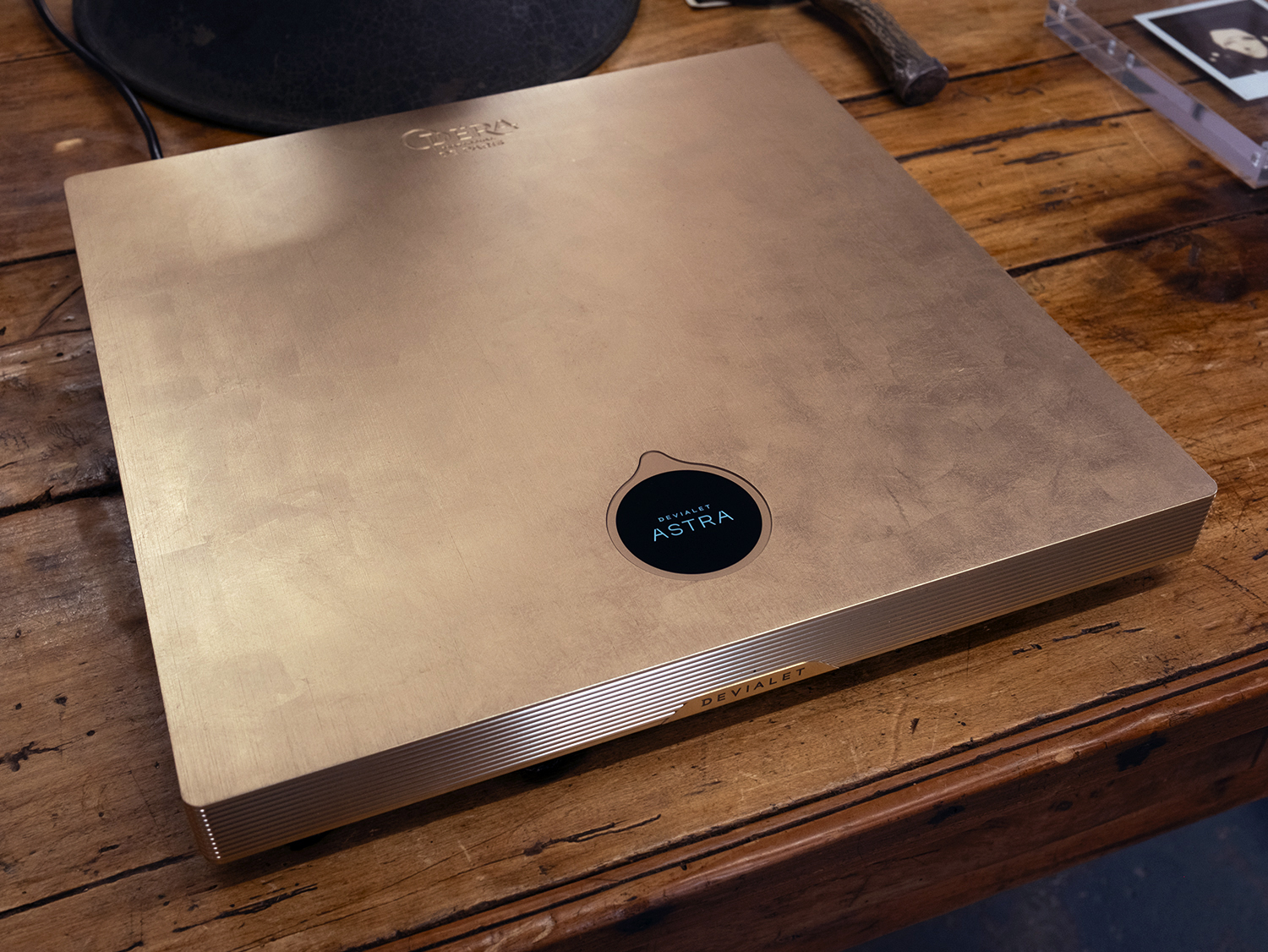
From a bird’s eye view, the Astra can be used as an integrated amplifier with inbuilt streaming capability as well as an MM/MC phono stage which is how I rolled. Output power is rated at 150wpc into 8 Ohms and 300 into 4. It’s worth noting that analog inputs are converted to digital as all the Astra’s processing as well as the volume control take place in the digital domain while its advanced features rely on DSP. My feeling about digitizing analog signals and DSP is straight forward—if I like what I hear, who cares. You can also configure the Astra as a mono block pair if you need more power.
In terms of streaming options, the Astra is full-featured supporting Roon, AirPlay, Tidal and Qobuz Connect, UPnP, Google Cast, and Spotify. As is my preference I went with Roon for the duration of this review other than to insure the connect apps work and they do. I will note that the Astra handles PCM resolutions up to 24-bit/192kHz via the network input and 24-bit/384kHz via USB-C according to the specifications but seeing as the Astra’s Class D stage is fed a 192kHz signal, there’s some conversion going on inside and I mention this for those audiophiles who take issue with their digital being converted to digital (wink).
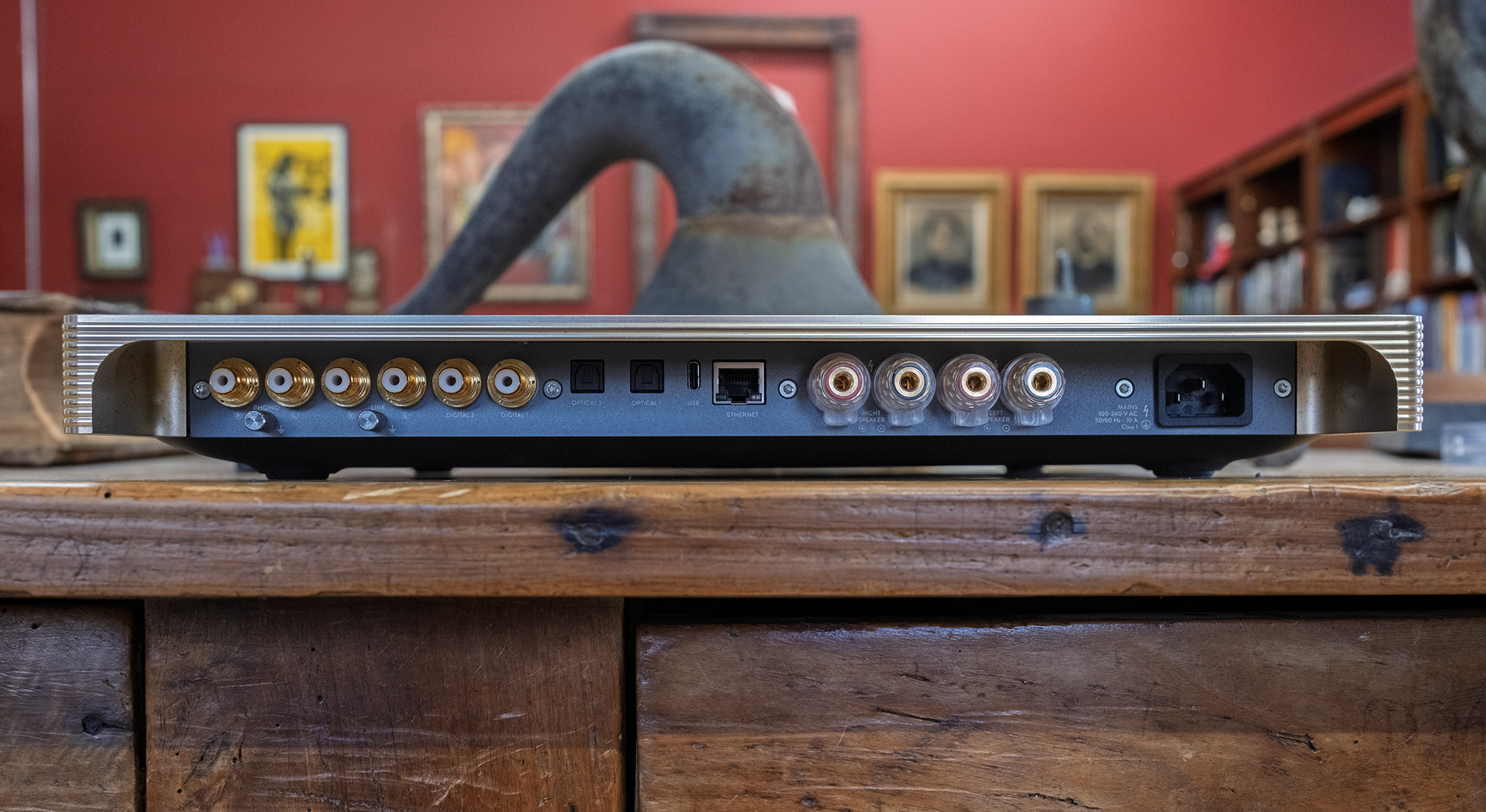
The ins and outs are tucked away in the recessed back panel which makes connecting some things a bit cumbersome. I went with AudioQuest’s banana-terminated Brave Heart speaker cables because there’s no way you can connect stiff spade-terminated cables into that small space. Plugging in interconnects, RCA-only, was no big deal as long as I had my trusty flashlight and patience handy. Screwing down the ground cable from the review Technics ‘table required some minor cursing but I’d like to think that most owners would be doing a heck of a lot less connecting, disconnecting, and re-connecting as compared to a reviewer so this entire point may be inconsequential.
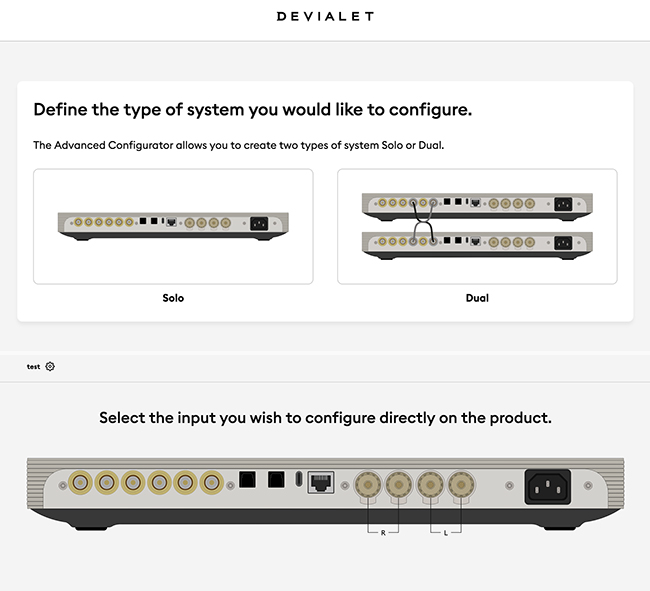
The default settings for the inputs include 1x Phono, 1x line-level RCA, 2x COAX, 2x Toslink, Ethernet, and USB-C but these can be changed in the Devialet app or its browser-based interface which offers additional options like editing or deleting saved configurations which came in handy. You can change the default input settings as follows—set the first RCA pair to Line or Phono input, the 2nd pair to Line, Phono, or 2x COAX inputs, the 3rd RCA input to COAX in or COAX out, and the 4th to COAX in, out, or Pre-Amp out. These interfaces also offer access to a number of speaker config options including stereo or mono operation, Channel Mix (left, right, mono), Delay which might come in handy when using one of those Toslink inputs with your TV, and Filtering (full-range, high-pass, low-pass).
Then there’s SAM (Speaker Active Matching). Once again I’ll let Devialet explain:
SAM® analyzes transducer characteristics using laser technology. These include displacement, deformation, maximum displacement, speed and acceleration. By measuring passive filters, we can determine resonance (event bass-reflex and passive radiators) while factoring in the overall impact of casing and damping. Once this data is compiled, SAM® is able to produce a full physical behavioral model. The collected data also allows us to calculate the transducer SOA (Safe Operating Area). By doing so, SAM® offers permanent protection from overload, letting users reach higher volumes than ever before. Similar to transfer function, this physical model is inverted in real time using digital signal processing technology before digital-analog conversion occurs. The result: acoustic pressure in the air perfectly matches the signal registered by microphones during the recording process.
The main speakers used for this review—Perlisten S7t Black Edition, Dynaudio Confidence 60 and DeVore O/96—are not among the currently listed 1,180 SAM-ready speakers so I did not get to take SAM for a test run. For those who need some SAM-less tweaking, there’s also a Tone control under Audio Settings in the app with a 2-band digital EQ which I also left alone. I encourage anyone interested in learning more about the Astra’s rich feature set to explore the guides and manual.
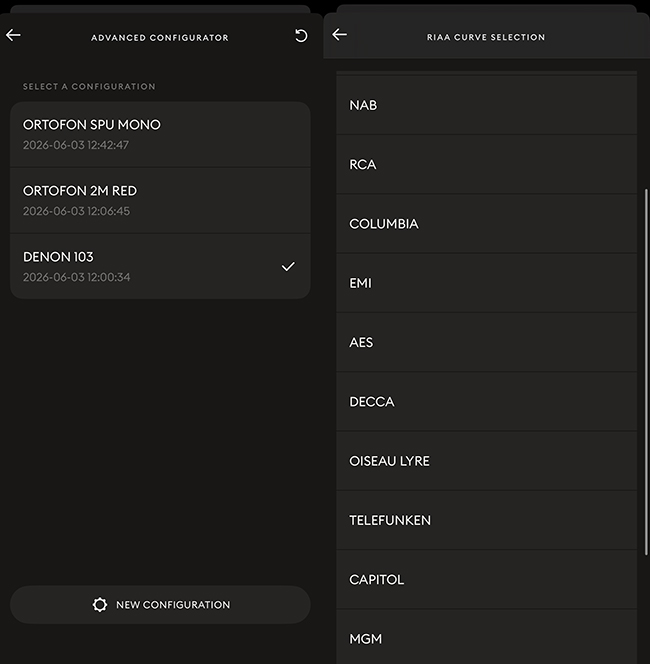
But the real config fun for me came in with the fairly extensive pre-loaded cartridge configurations which allowed me to simply select the Ortofon 2M Red that came with the review sample Technics SL-1500CS Direct Drive Turntable (more info) as well as the Barn resident Zu/Denon DL-103. And I said fairly extensive because the app does not currently have a pre-loaded configuration for my EMT HSD-006, or any EMT cartridge for that matter, or the lovely Ortofon SPU Mono CG 65 Di MkII that I use for playing 78s which came in handy seeing as the Astra also includes a number of EQ curves for playing back pre-RIAA records, i.e. 78s in my case. But not to worry—the app also allows for manual cartridge configurations so my EMT and SPU were covered.
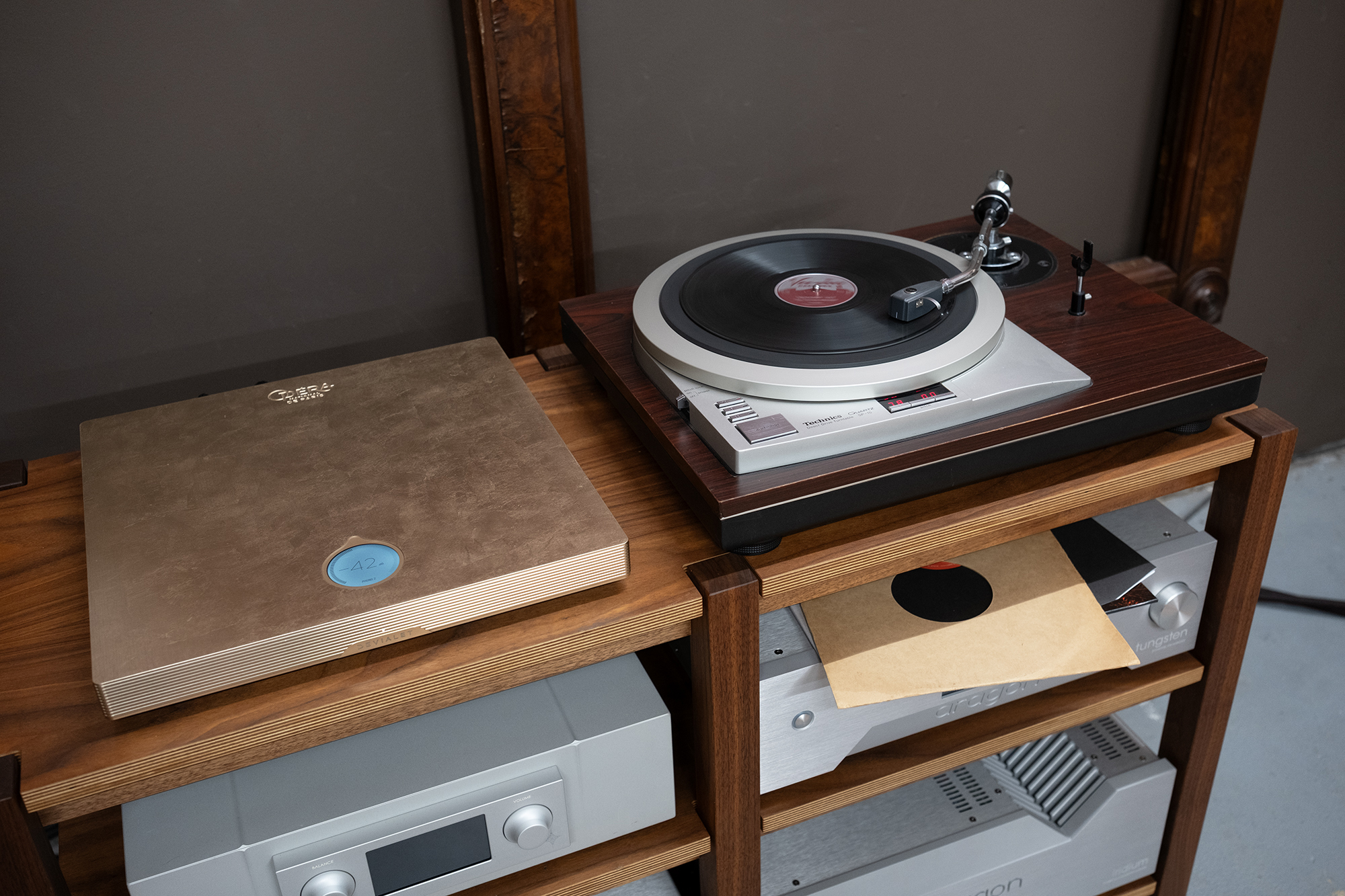
I’ll pause to reflect on EQ Curves—as regular readers know, I enjoy listening to 78s because they offer a unique kind of music discovery and a unique kind of sound energy that I would describe as joyously infectious. To put it another way, I’m 78 times more thrilled with my 78 of “It Takes A Lot of Love” by Bobby Sue and Her Freeloaders than the DSD file of Tea for the Tillerman that somehow ended up in my library (I prefer the original LP). Of course these are just my preferences talking but the fact that Devialet chose to include EQ curves inside this very high tech integrated amplifier tickles my fancy to no end. Respect.
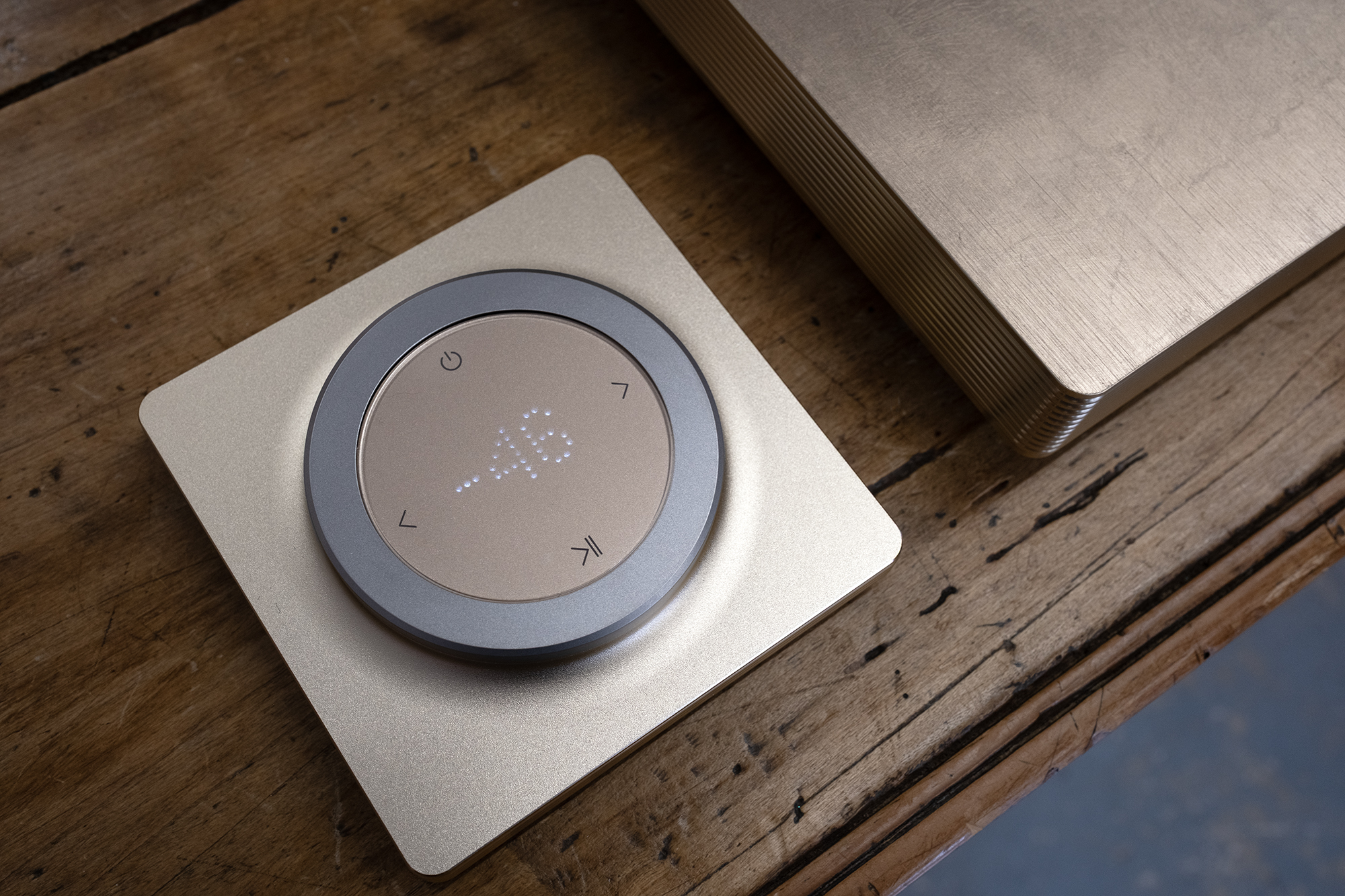
Let’s talk about that remote—without question, the Devialet remote is the loveliest remote volume control I’ve had the pleasure of using by a distinct and very wide margin. Nothing comes close to its perfect proportions, weight, resistance, and silky glide. I may have changed the volume more than needed just to feel that feel. Some people might not care about this attention to user experience but I sure as heck do as the marriage of form and function is a delicate balance that most remotes get pretty much wrong. That said, I preferred using the Devialet app for changing inputs as the remote isn’t as superb in this regard.
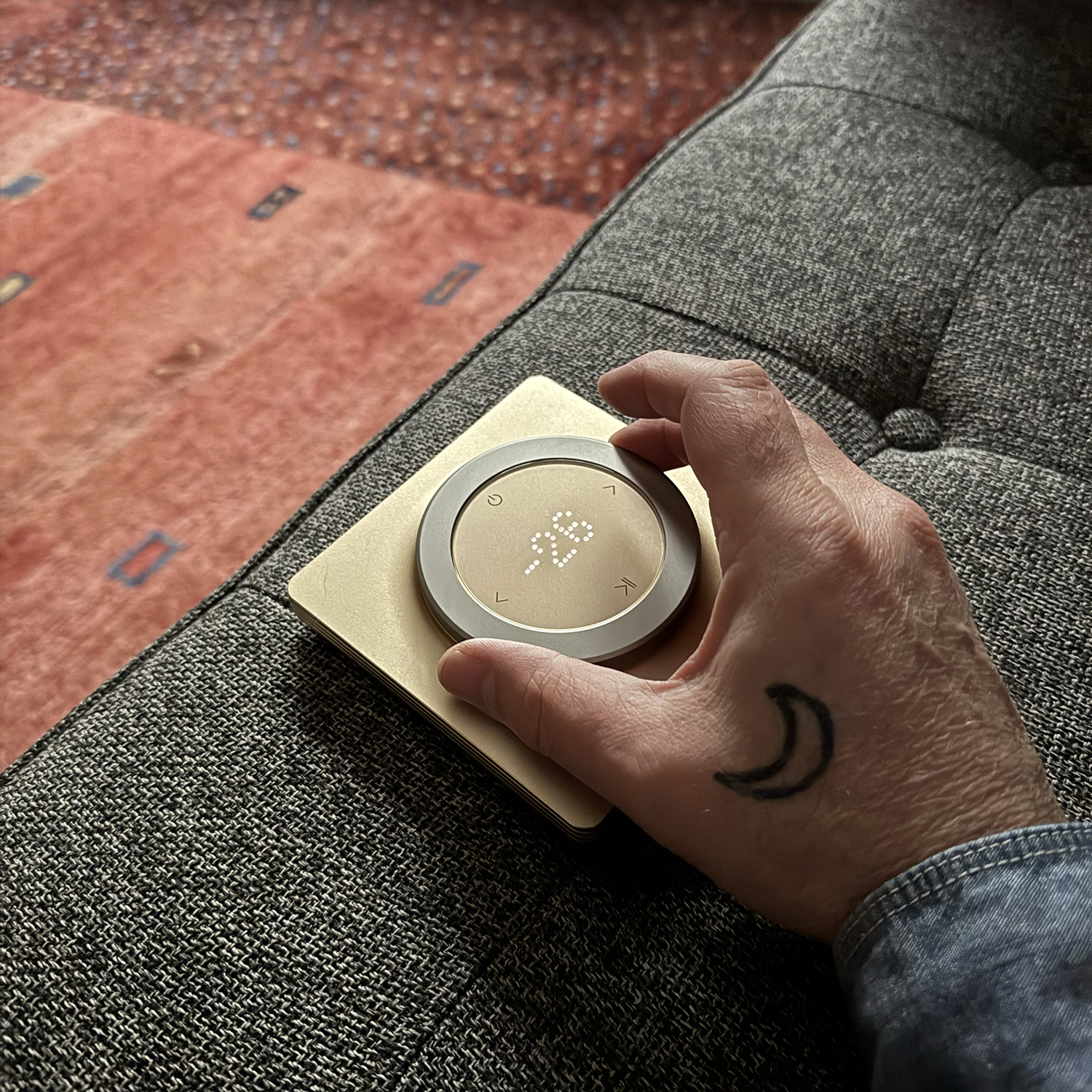
The remote uses Bluetooth to communicate with the Astra and is charged via USB-C. There’s a fairly dimly lit display dead center as well as touch sensitive dimly lit icons for power, play/pause and with a long hold access to the Source menu, and Previous/Next and with a long hold changes over to input selection. There are some counterintuitive quirks during use one of which is the selected input is not displayed on the remote which is another reason I preferred using the app.
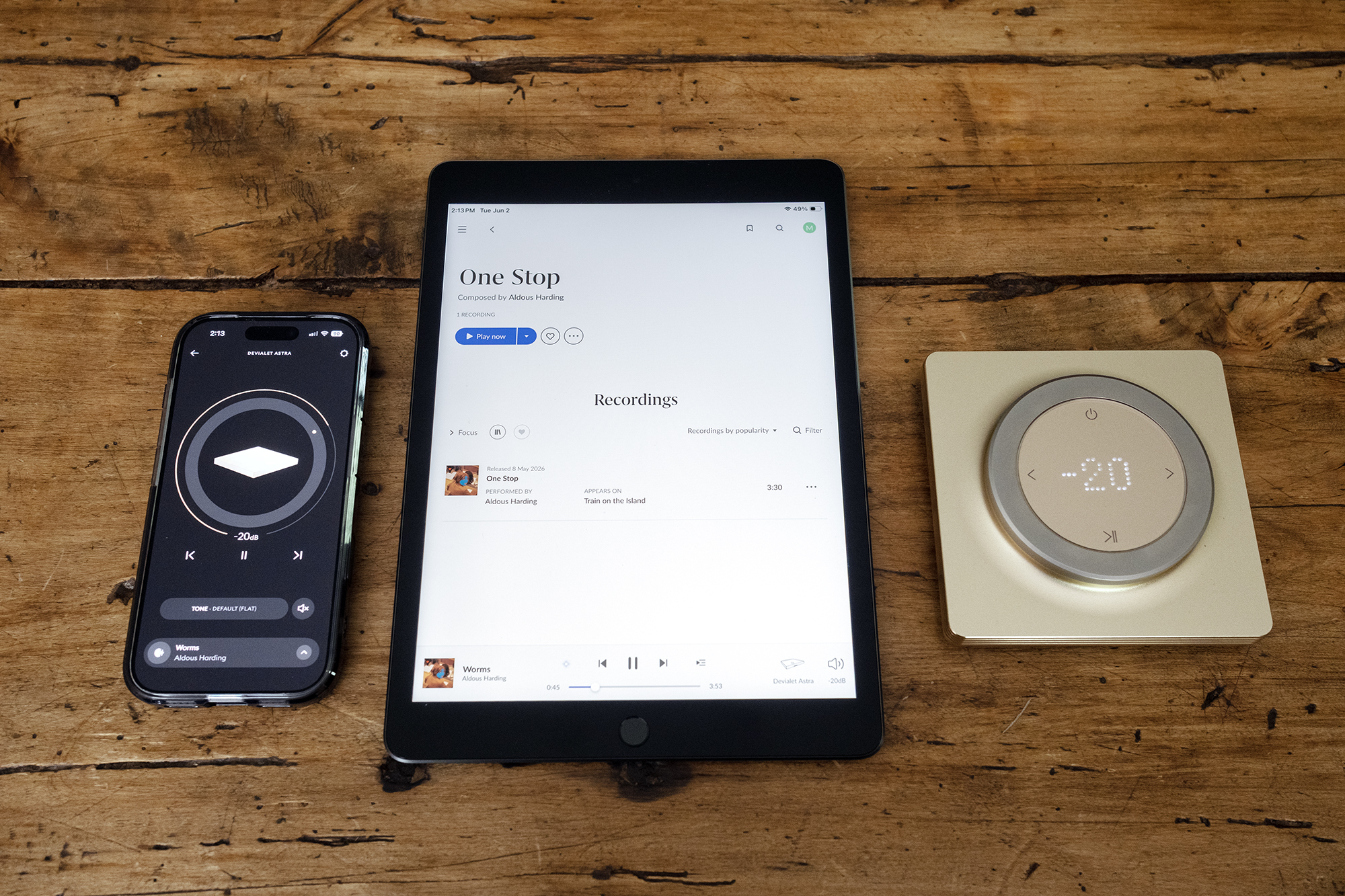
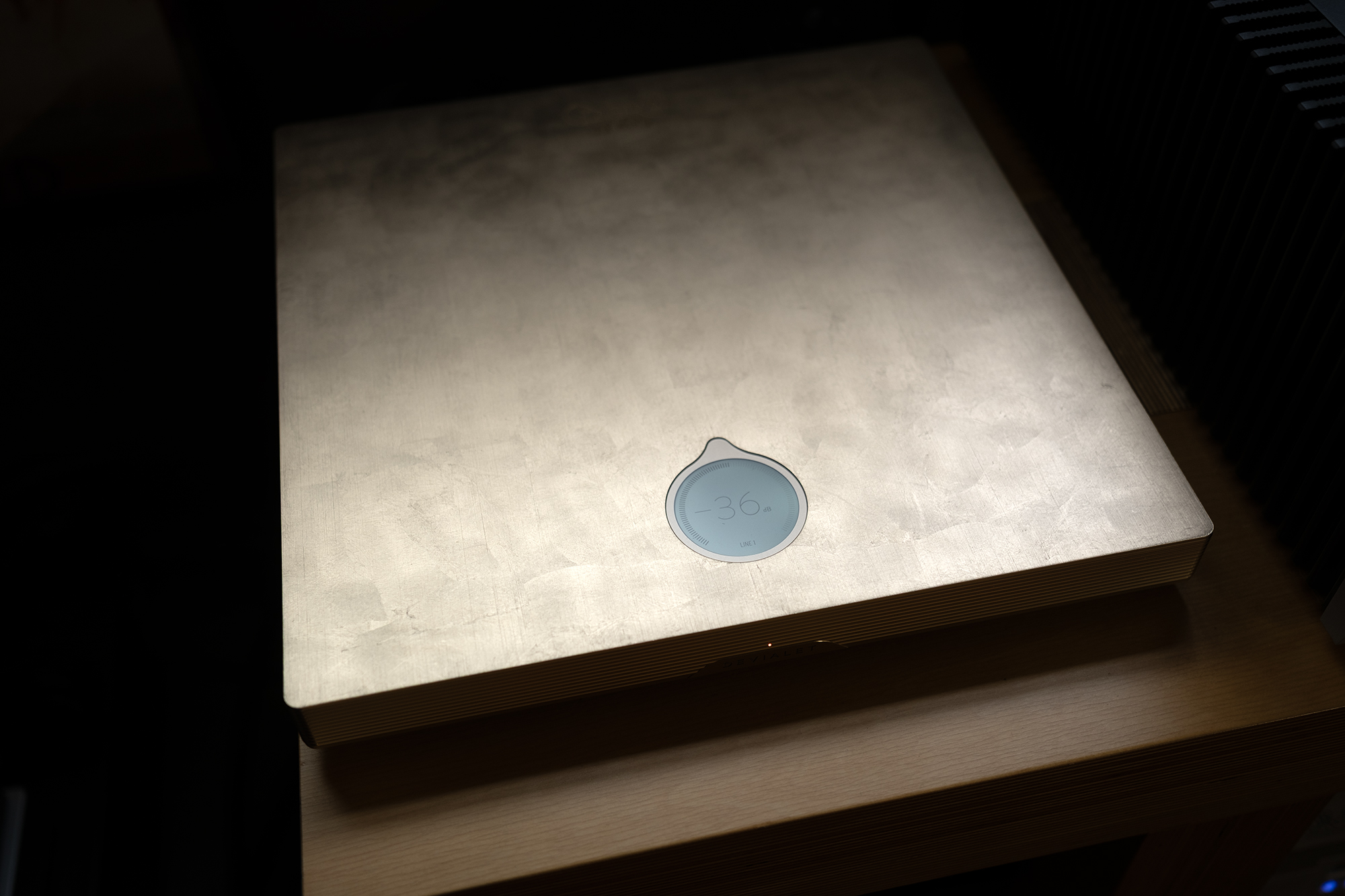
Here’s a photo that illustrates, if you look closely, how the Devialet app, Roon, and the remote sync up when changing volume which is, if nothing else, a neat trick especially so for someone who grew up before home computers, the internet, cellphones, or remote control in any form were a thing. Imagine having to get up and walk over to your black and white TV in order to turn the dial to switch between the 5 or so available channels that weren’t even on 24/7. What in the world did we do with all that free attention?
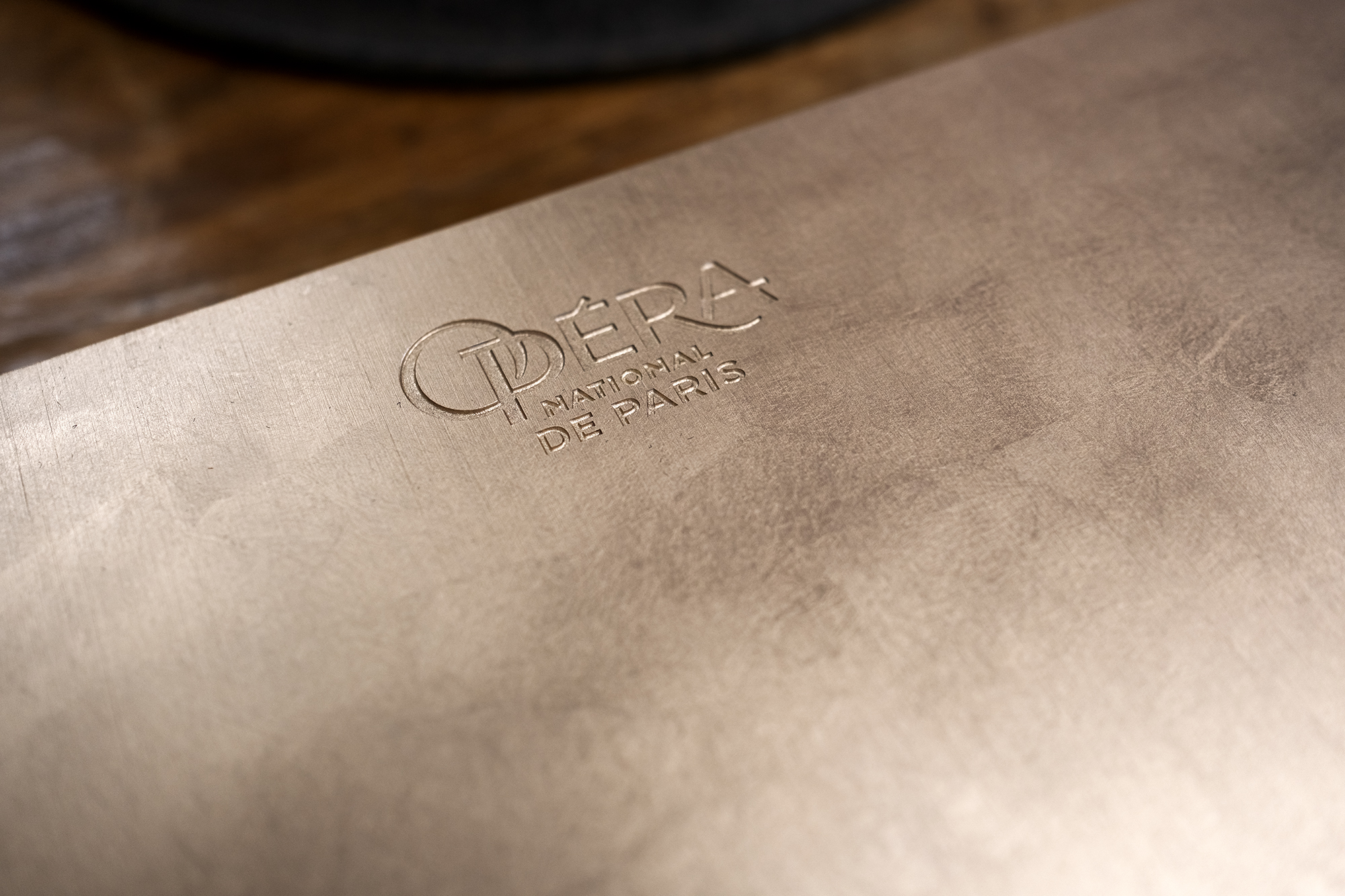
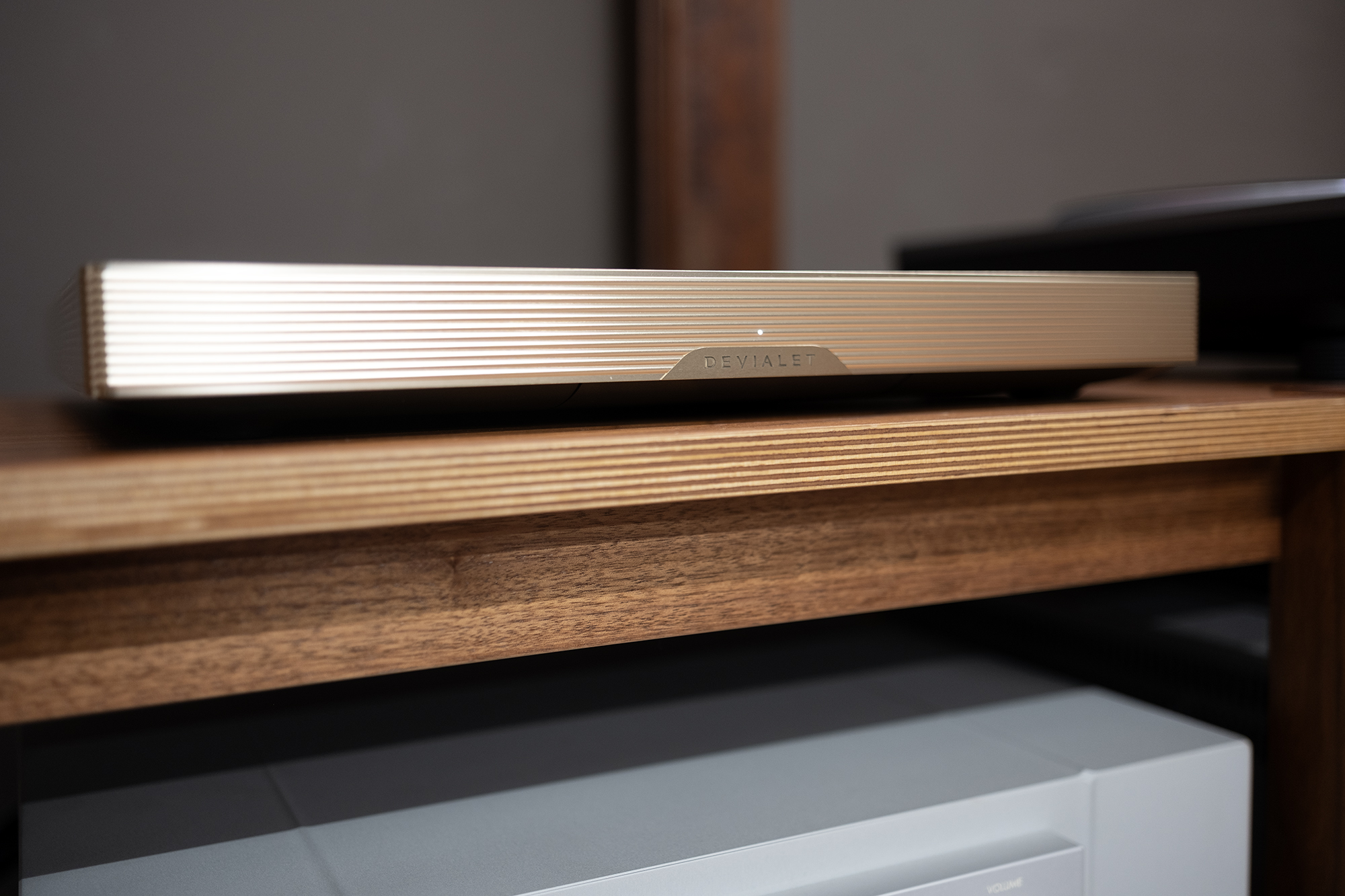
The review sample is the Opéra de Paris Edition which adds a laser engraved, brushed, and shot peened 23-carat golf leaf finish over the single block of carved anodized aluminum chassis. This finish adds $5000 to the price over the standard finish and before anyone complains it’s important to note that this is an option. Meaning it’s optional—you can decide if the gold finish is worth the spend so there’s no need to complain about its existence. I think it’s an attractive addition and this coming from someone who typically views covering things in gold as pure gaudy artifice hiding a lack of substance.
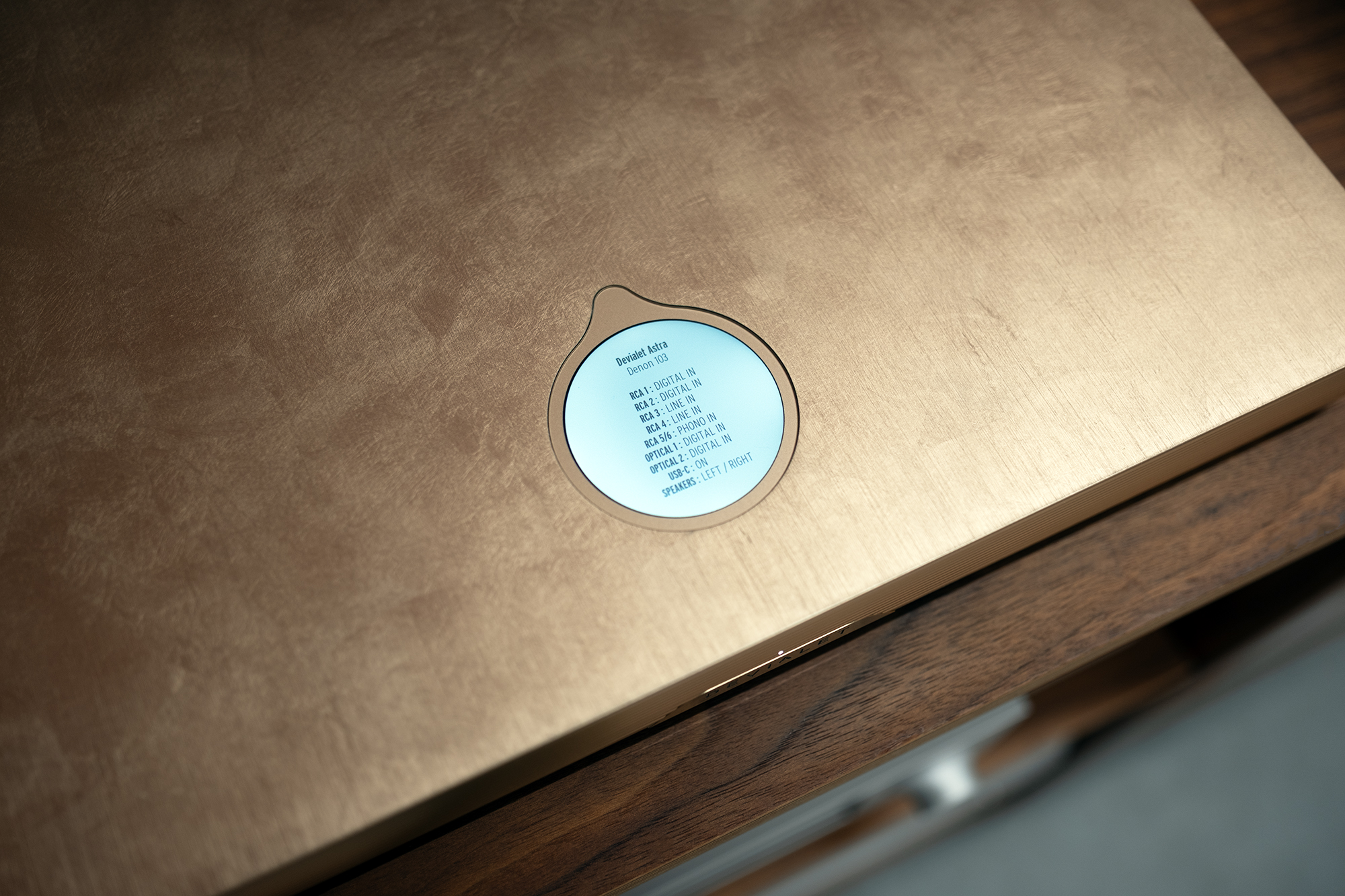
There’s a round display up top that shows volume level/active input and two buttons on the front right side for power on/off or with a longer press to display the input configuration, while the second switches to a Bluetooth source or with a longer press initiates Bluetooth pairing. There’s also a small multi-color LED front and center that changes color to indicate device status.
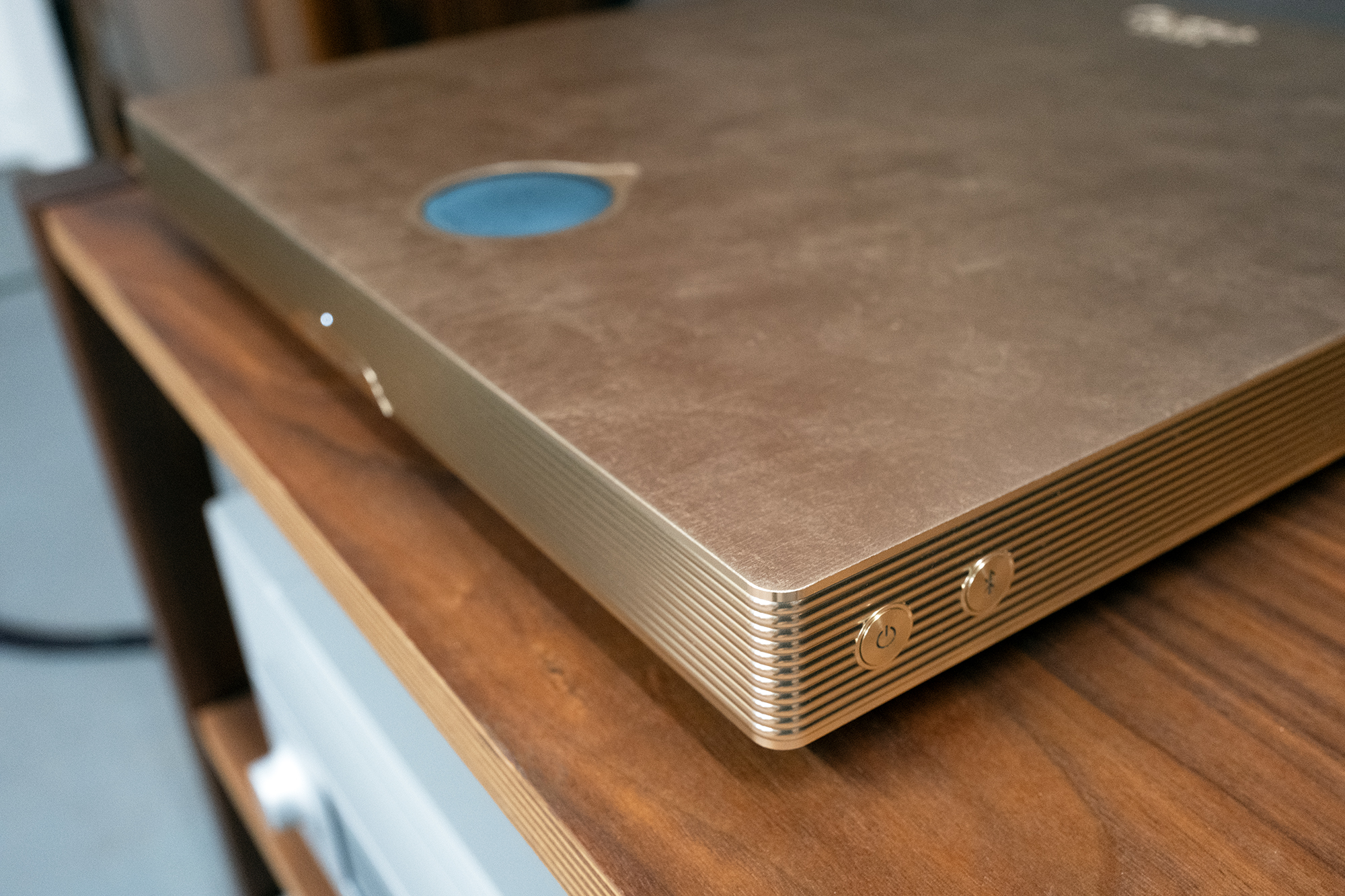
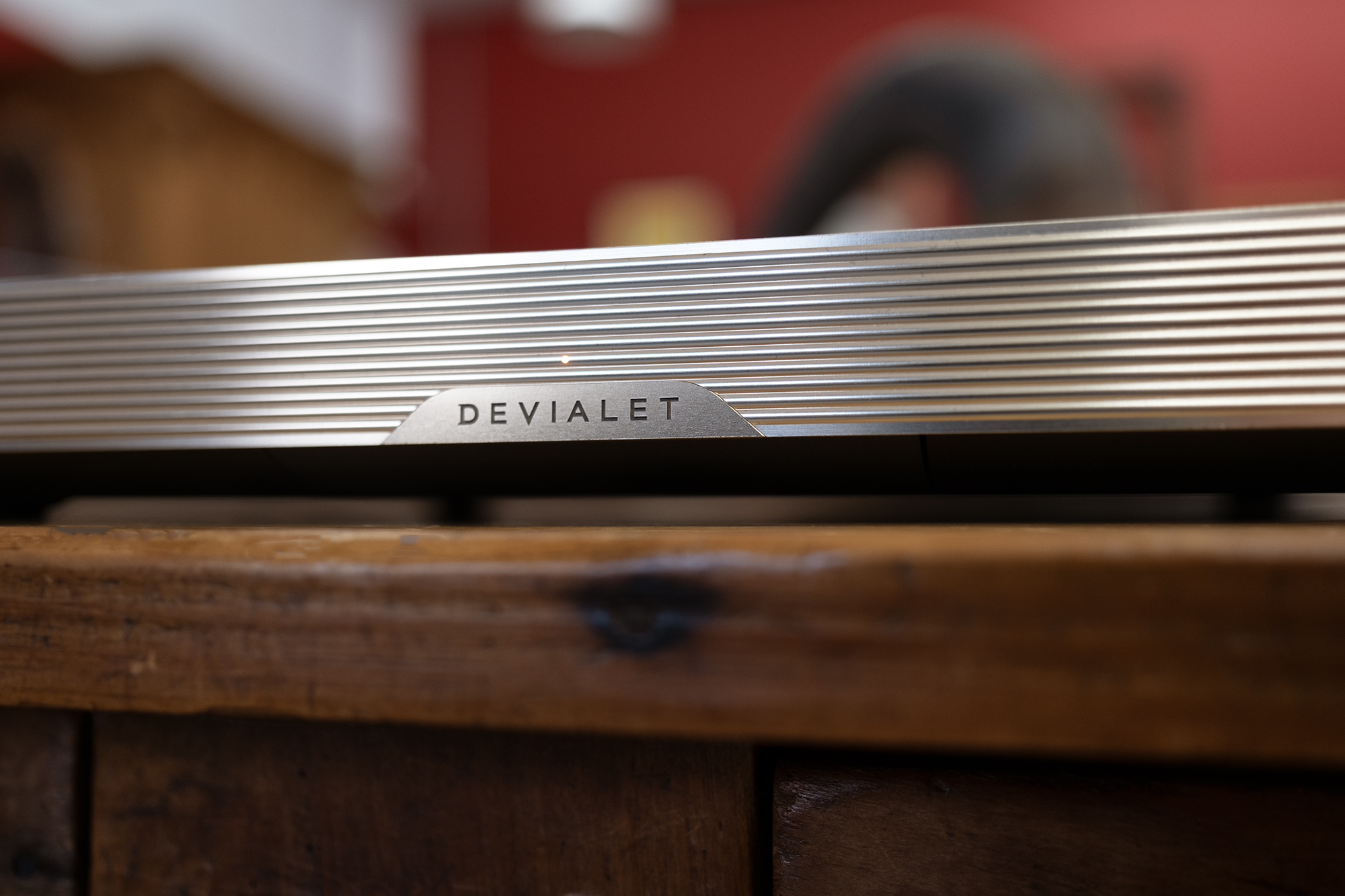
Taken in as an object, I found that living with the Astra Opéra de Paris Edition added a nice sense of sleek sophisticated flair to the Barn and I have nothing but compliments when it comes to its build quality. The entire package exudes attention to details that elude many an amp-in-a-box.
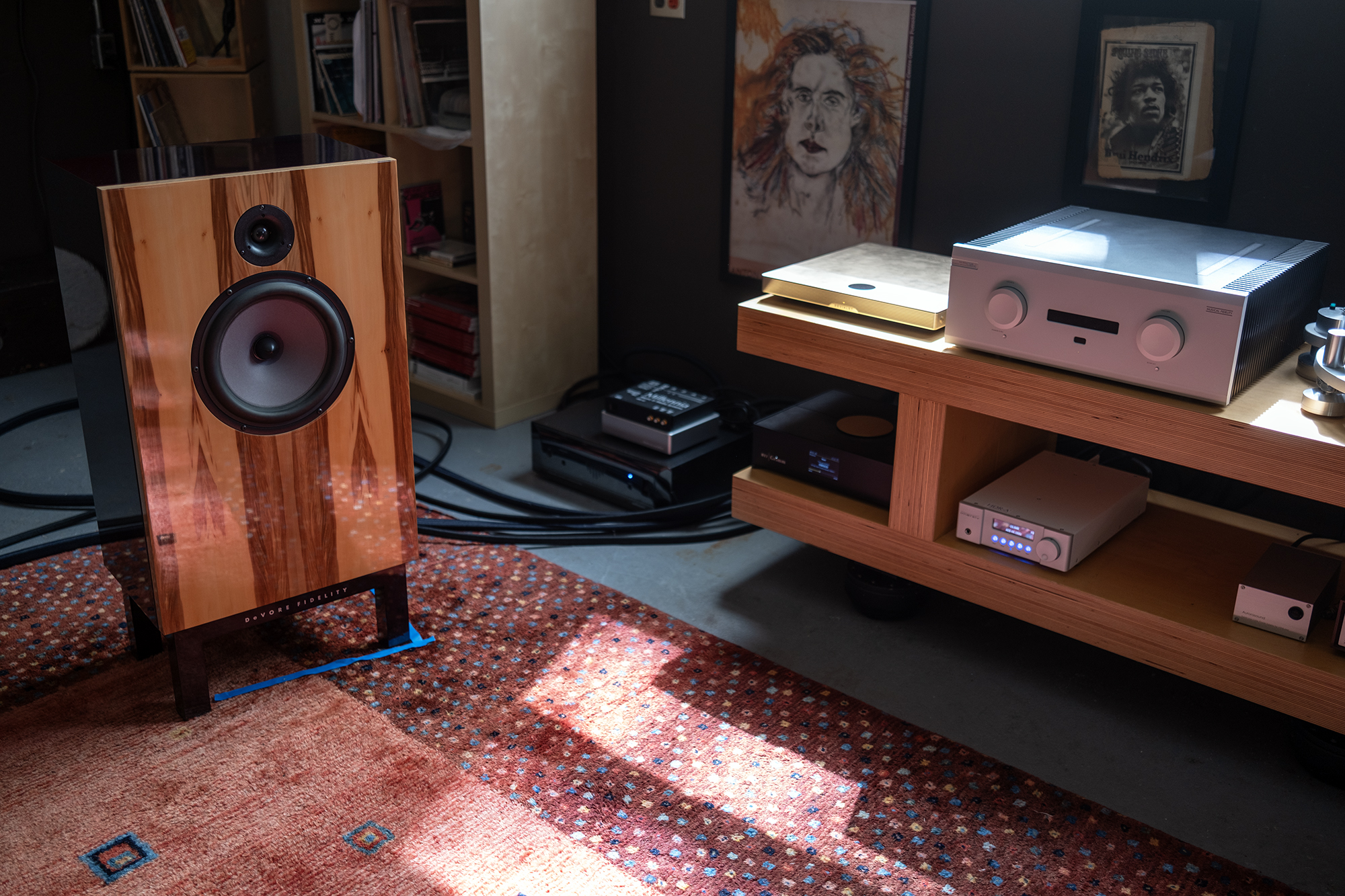
While the 150W Astra may not seem a logical choice to drive the easy-to-drive DeVores, it nevertheless did so with aplomb—superb control, refined resolution, dynamic realism, and a sense of just right richness and warmth to make things emotional. You might expect an amp with the Astra’s innards and specs to come across as cold and clinical but this is simply not the case, not even remotely.
Speaking of emotions, I’ve written about A.A. Williams Songs From Isolation before, a collection of solo covers first performed from her home on video during the COVID lockdown, and it remains high up on my repeat playlist for all its simple beauty. Williams slowly tosses, turns, and nearly embraces every word in this collection of covers turning “Creep,” “Where Is My Mind,” “Into My Arms” and more into simmering ballads to, well, isolation. With the Astra streaming the download via Roon and driving the DeVores on the Barn’s A-Side, Williams’ moving way with words and piano filled the space with quivering presence separate and apart from the O/96 and any sense of the mechanics of reproduction—effortless, controlled, and fully figured with the silent parts perfectly pitch black. Lovely.
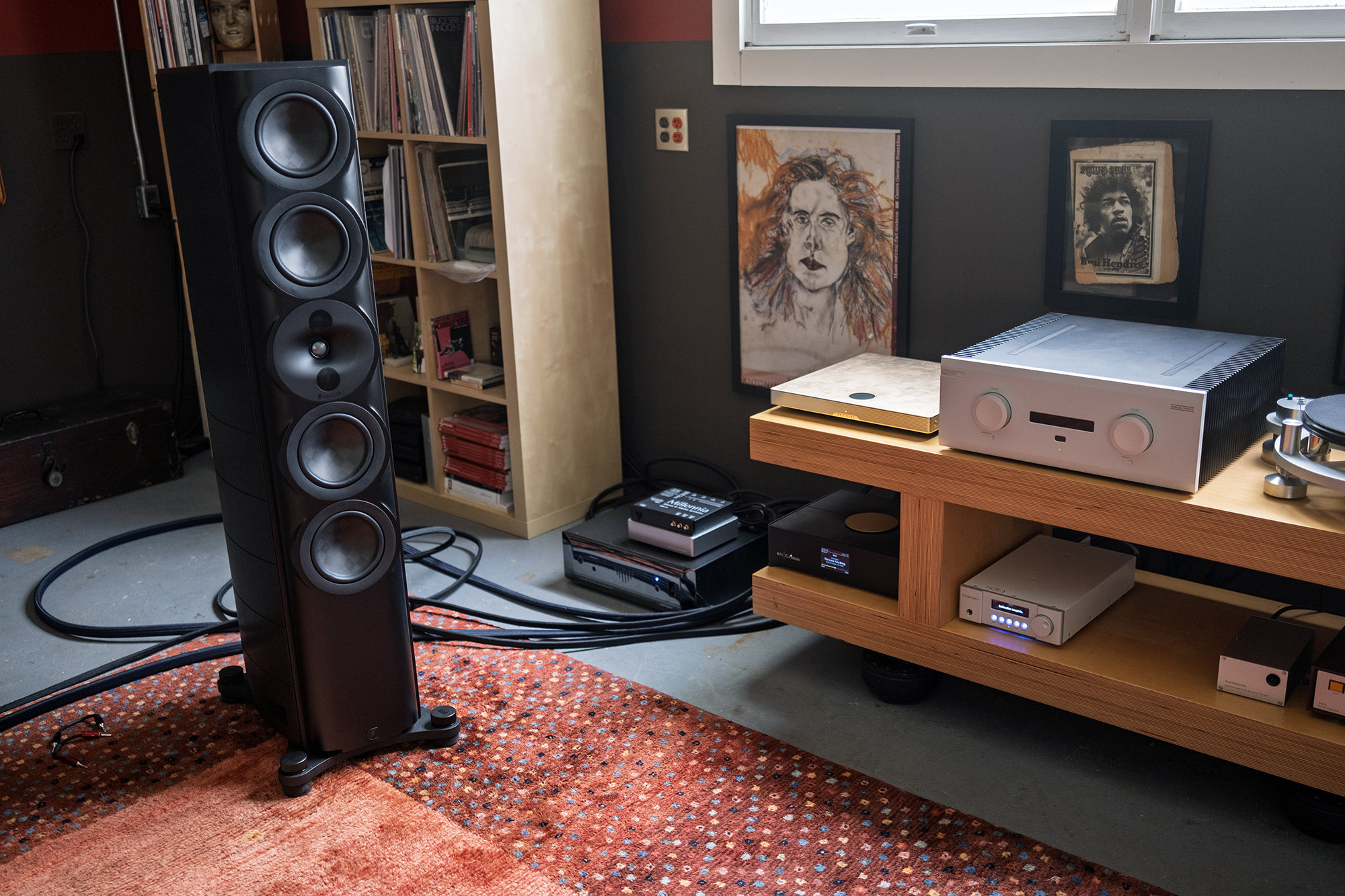
The Perlisten S7t Black Edition are full-range impressive with their own sense of superb resolution and the Astra made them shine from bottom to tippy top with silky full range refinement. Here’s what I wrote about this Astra/S7t combo in the latter’s review:
If you enjoy putting your hifi to the test, give “Skeleton Key” a whirl with a generous turn of the volume knob and see how well all those layers of abandon play out in your space. If I was a teacher, the Perlisten Black Edition would get an A+, especially when driven by the Devialet Astra that offers more resolution and nuance than the very powerful sounding Musical Fidelity M8xi integrated.
To dig into this difference between the Astra and M8xi (review) a bit more, the Musical Fidelity muscle amp sounds a bit like a blunt instrument by comparison because the Devialet offers better speed and articulation down to macro-level details giving music that spark of life feel making it more exciting and more surprising. Streaming the Barn-burner “Skeleton Key” from Circuit des Yeux’s Halo On The Inside becomes all that much more startling and unexpected through this track’s many twists and turns. The Astra also had no problem driving the S7t Black Edition to very full range sound at Barn rattling levels with superb control way down low.
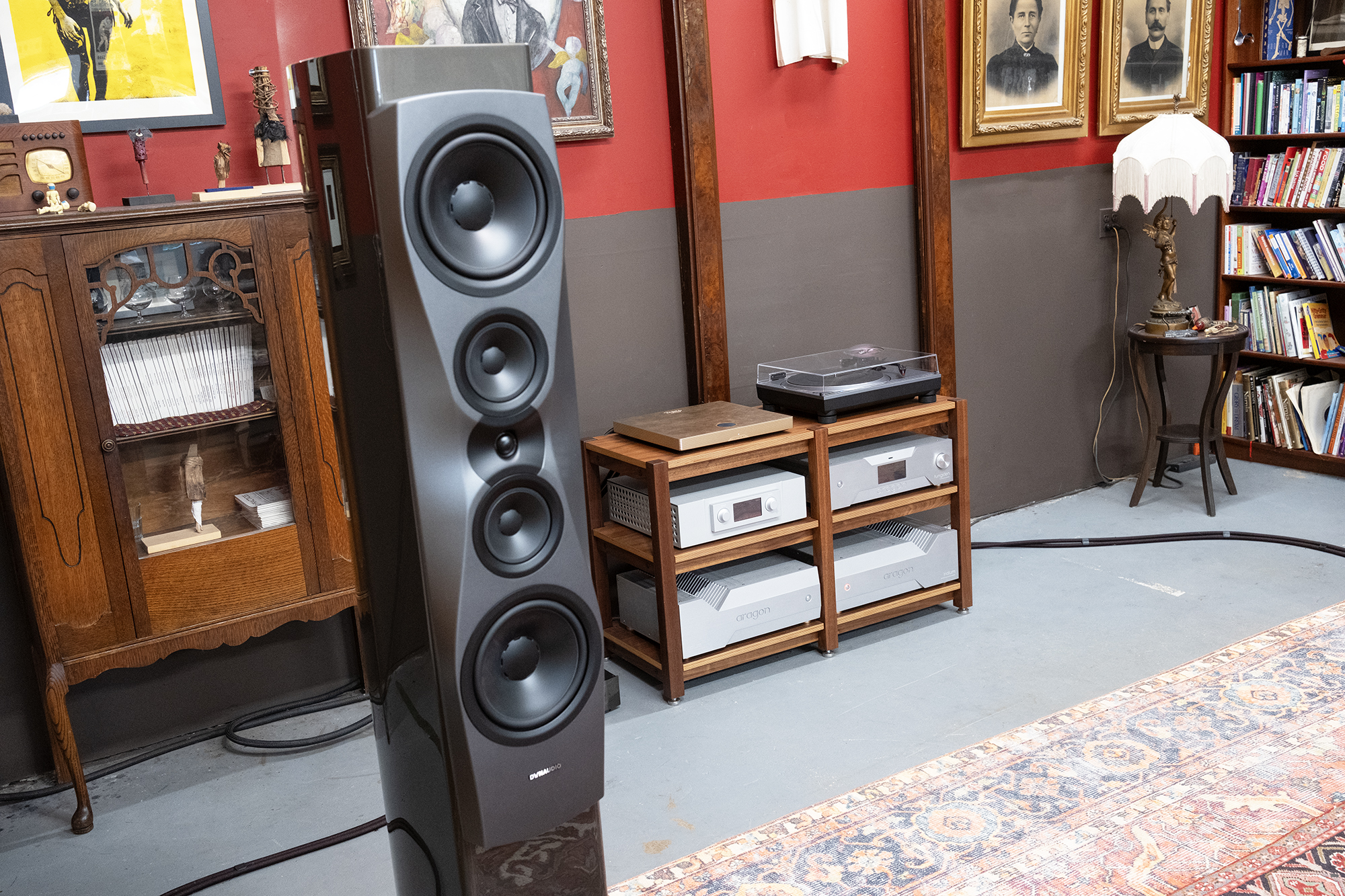
Of the three speakers, the Confidence 60 saw the most Astra time and this combination was pure exhilaration playing big, bold, and loud. The Dynaudio’s are rated at 87dB (@ 2.83V/1m) with a minimum impedance dipping below 4 Ohms with a reach down below 30Hz and my sense is they enjoy pure refined power which are all items on the Astra’s menu. Standing over 5 ft. tall, the Confidence 60 nonetheless disappear like mini-monitors when properly placed as they are on the Barn’s B-Side.
I’ve only recently come across Leaving None But Small Birds by The Body and BIG|BRAVE even though it was released in 2021 and I am very happy I did. This album lets two bands known for their heavy sound share their shared love of traditional folk music and it is pure simmering energy with enough of that kind of Wicker Man (the 1973 film) weirdness to keep things feeling dangerous. Layers of guitar and violin and a steady driving drone beat lift Robin Wattie’s vocals skyward on opener “Blackest Crow” making the entire production feel devotional. This is powerful music and when played loud through the big Dynaudios it made for a soul stirring experience thanks to the Astra’s superb grip, full range reach, just right richness, and high resolution.
All of these music notes also speak to the Astra’s streaming DAC capabilities which I found beyond reproach. To my way of thinking, there’s no reason, none whatsoever, to even mull over the idea of adding an external DAC. For a simple one-box system, just add speakers, the Astra is simply a superb choice.
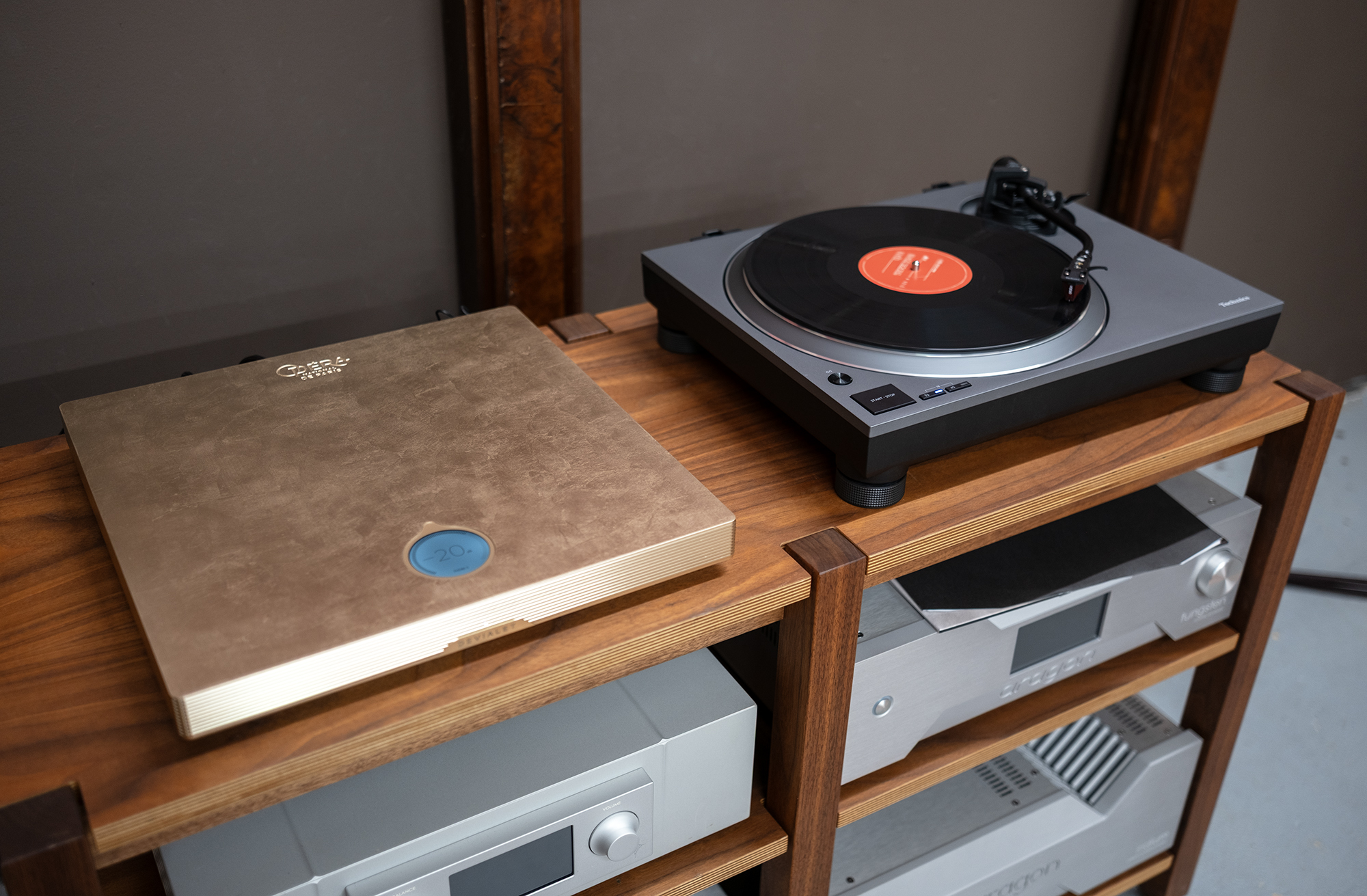
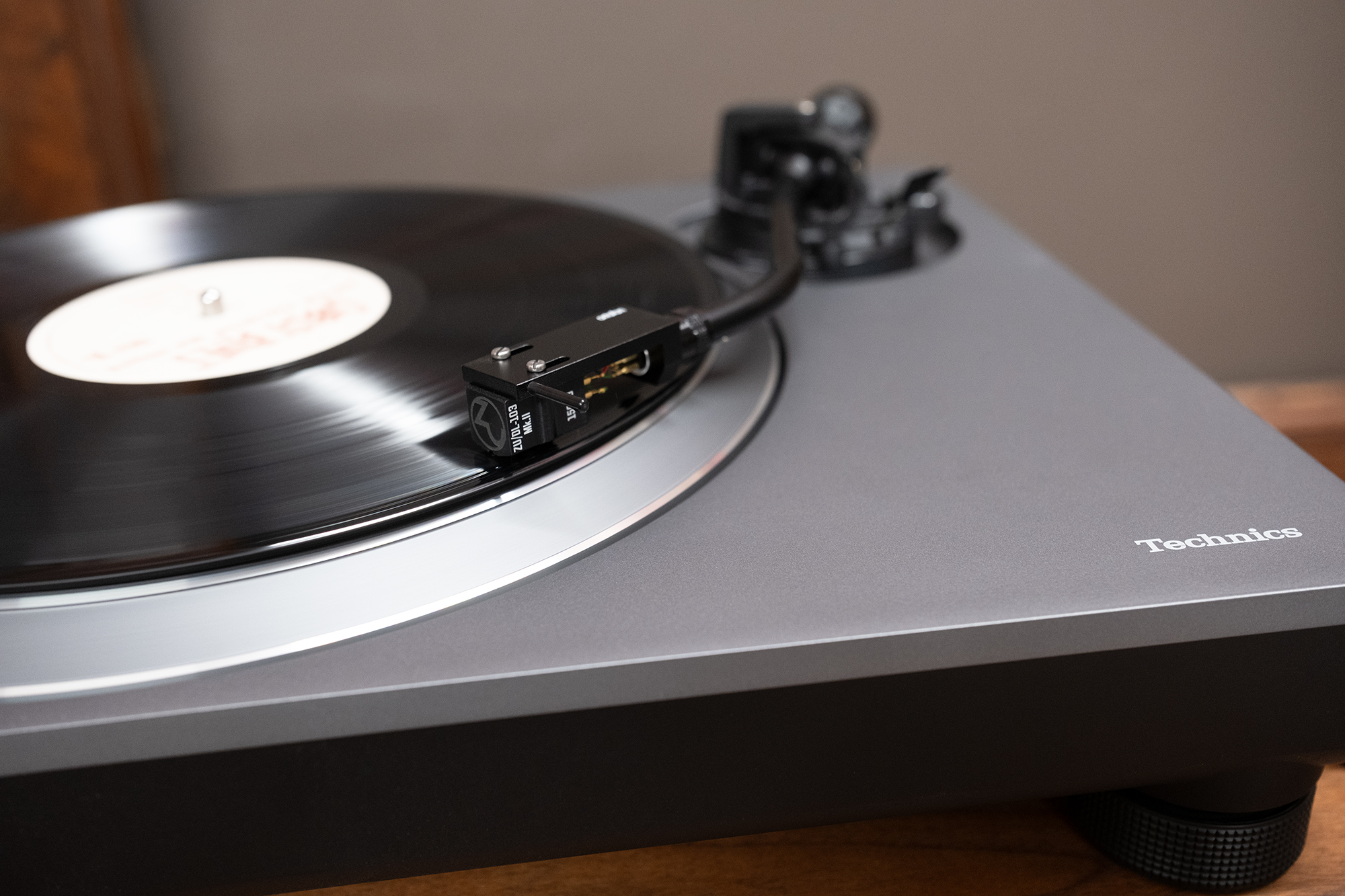
As mentioned a few hundred words back, I spun some records and some shellacs using the Astra’s phone stage using three cartridges and three ‘tables—the review Technics SL-1500CS with the included Ortofon 2M Red and the Barn resident Zu/DL-103, my 1970s Technics SP-15 with the Ortofon mono SPU (for 78s), and the Barn resident Michell Gyro SE with my EMT HSD 006 in play. Lots of analog, lots of records.
And here’s how I’ll sum things up—the nicely priced Technics SL-1500CS ($1799.99) with the Zu/DL-103 was delightful as was the Michell/EMT combo and with their respective prices in mind, I think most people could easily live with either and even love the Astra’s phono capabilities, especially seeing as it’s part of the package paid for coupled with its ability to accommodate any cartridge (and 78s).
Can you do better by adding an outboard phono stage? Of course you can—sound quality is just a question of money, how high do you want to go—to paraphrase a favorite line from the original Mad Max.
Spinning through some new and old favorites including the great compilation The Great Blues Men, Black Country, New Road Ants From Up There, Cubist Blues from Alan Vega, Alex Chilton and Ben Vaughn, and a bunch of 78s including “It Takes A Lot of Love” by Bobby Sue and Her Freeloaders and “I Know I Got Religion” by the Staples Singers I can tell you I cherished every moment without a care for better in the world. I think we, audiophiles, can get so distracted by the notion of ‘better’ that we tend to miss the riches right before our ears.

The most logical comparison I have to make is with the Bel Canto Black ACI 600 Integrated Amplifier (review $29,999) which I reviewed back in May of 2025 because it offers a similar package in many ways. I’ll ask you to read that review to get the nitty gritty Bel Canto details but in general the ACI 600 also offers an inbuilt streaming DAC, a phono stage, and a number of DSP sound shaping options including Tilt, Bass EQ, and a High Pass filter. The ACI 600 also offers 300 Watts of power into 8 Ohms and 600W into 4 and stands less than 4” high.
I wish, oh how I wish, I still had the Bel Canto here so I could offer proper and meaningful sound quality comparisons. But I don’t so I can’t. What I can offer is the words I wrote about the ACI 600’s performance are very similar to what I’ve said right here about the Astra which suggests (to me) that their differences may not be all that dramatic. But again, without a direct A/B there’s no way to say that with real certainty.
All that being said, if you can live with the Astra’s 150 Watts and without the Opéra de Paris Edition’s gold flourishes, the standard Astra at $20k in light bronze looks to be a very wise choice. And you still get that wonder of a remote.
My wife and I enjoy watching those shows where couples search for a new home, the more exotic the location the better. After buyers go through their wish list items the realtors always ask—and how much do you want to spend? In more cases than not, the budget is smaller than the wish list.
Can we really have it all in hifi—looks, style, substance, and great sound? I’ll repeat myself by saying hell ya! if your budget for an integrated amp, streaming DAC, and phono stage = a Devialet Astra.
Color me impressed.

Devialet Astra Opéra de Paris Integrated System
Price: $25,000 | $20,000 in the standard finish
Company Website: Devialet
Specifications
Range: Stereo
Streaming Services: Airplay, Google Cast, Spotify Connect, Tidal Connect, UPnP, Roon Ready (RAAT)
Daisy Chaining: Up to 8 devices
Phono Stage: Advanced (MM / MC)
Pre-amplified Output: Yes (mono / stereo)
Finishes: Opéra de Paris : 23-carat gold leaf
Power Supply
100-240Vac – 50/60Hz
Power cable supplied, adapted to the country
Power: max 750 W continuous
Casing
Machined from a single aluminum block
Anodized, laser-engraved, brushed, and shot-peened
Opéra de Paris: Covered with 23-carat gold leaf
Exclusive technologies: ADH® next-gen, SAM®, RAM®, DAC Magic Wire®
Connectivity
Wi-Fi: WiFi 6 (b/g/n/ac/ax) 2×2 WPA3
Ethernet: RJ45 Ethernet 100/1000 Mbps
USB: USB-C 2.0 (data port)
Digital coaxial inputs: Up to 4x RCA 75Ω
Digital optical inputs: 2x TOSLINK®
Analog inputs
Up to 2x RCA stereo
MM/MC phono stage with 13 equalization curves and extensive cartridge loading possibilities
Speaker output
Connectors compatible with 4mm banana plugs, spade connectors or stripped cables.
Compatible with all speakers from 8Ω to 2Ω
Short-circuit protection
Active filtering available
Performance
Distortion at 10V: 0.001% (10 Wrms, 4Ω, 1kHz) | 0.0006% (100 Wrms, 4Ω, 1kHz)
Signal-to-noise ratio: -117dB
Output Impedance: 0.004Ω (1kHz)
Damping Factor: 2000 (1kHz)
Bandwidth
+/-0.1dB (DC to 20kHz)
+/-2.3dB (DC to 80kHz)
DC to 56.9kHz (+/-1dB)
DC to 88kHz (+/-3dB)
Output Power: 2×300 Wrms under 4Ω, 2×150 Wrms under 8Ω
Peak Power: 1000 W peak (1ms)
Crosstalk: -100dB (300 Wrms, 4Ω, 1kHz)
DSP: Audio processing: 192kHz / 32-bit
Inputs
Digital: Up to 192kHz / 24-bit
Network: Up to 192kHz / 24-bit
USB: Up to 384kHz / 24-bit
Dimension: Width: 386mm | Depth: 386mm | Height: 47mm
Weight: 7,2kg