
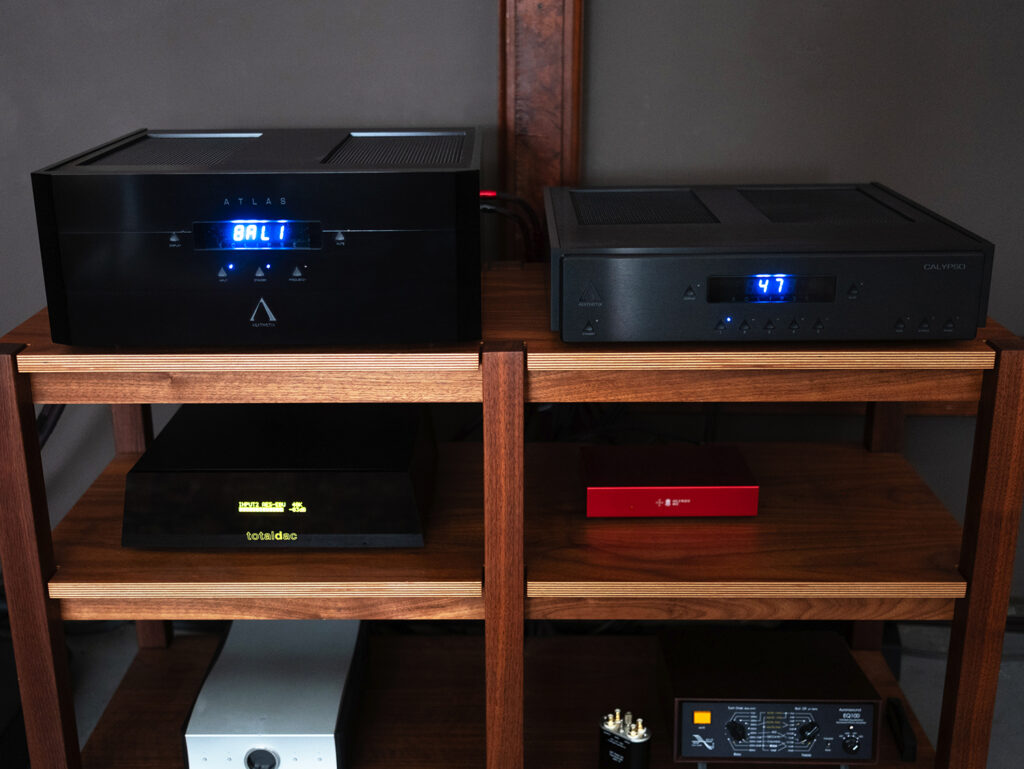
In the land of Aesthetix, the Eclipse versions of the Calypso preamp and Atlas amp are the top of the line, sitting above the Classic and Signature versions. What makes an Eclipse different?
It’s all about the parts and their sum.
Hopefully without confusing matters, Aesthetix offers two lines of gear—the flagship Jupiter series and the Saturn series which is where the gear that’s under review reside.
Regular readers may remember my review of the Aesthetix Mimas integrated amplifier from last summer about which I concluded:
It’s no wonder the Aesthetix Mimas received such glowing reviews upon its arrival and you can add my glowing review to that list. If the mark of a successful hifi design lies in longevity, the Mimas hits that mark as hard as any integrated amplifier to have graced the Barn with truly outstanding performance regardless of price.
To my mind, and I’ve been thinking about this for over a year, the Mimas is a genuine HiFi Bargain and I have to wonder why it doesn’t come up in the conversation more often when talking about great integrated amps. Then again I may just be listening to the wrong conversations or perhaps it has something to do with the Mimas’ wonderfully balanced set of sonic strengths that make it less wow-worthy than other amps that have standout qualities that really stick out, qualities that may grab ones attention in the short run that become as annoying as fleas over time.
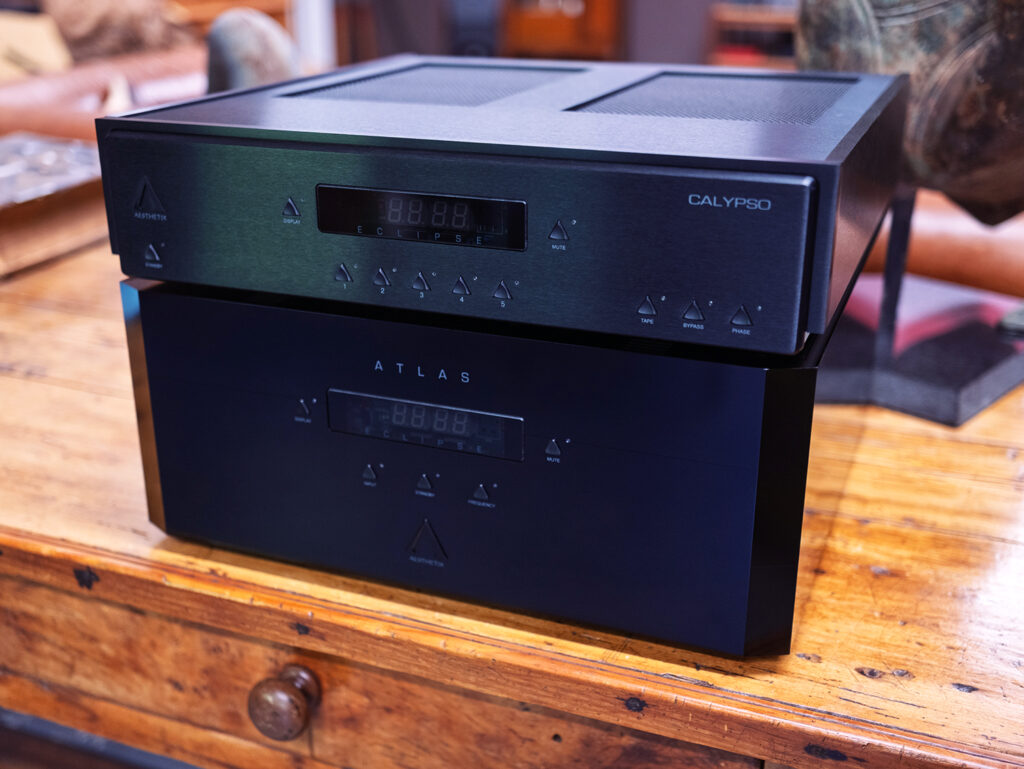
In any event and to the best of my recollection, the Calypso Eclipse Tube Linestage and Atlas Eclipse Power Amplifier take the Mimas’ strengths and essentially multiply or magnify them. I’m talking about things like low level resolution, a more distinct and solid sound image with greater specificity when it comes to defining elements within that space, better bass performance, jumpier dynamics, and an overall sense of more drama evinced by my reaction to the music in play.
Of course I’m not just talking about sound quality, seeing as sounds don’t move me to experience the full range of human emotions, I’m talking about my reaction to music. How that experience, that song, made me feel, made me think, made me wonder. Things that live on in one’s memory past the flinch from a loud noise, BANG!, a distinction that seems to be all but absent when talking about listening to music on the hifi.
Which gets me to the Calypso/Atlas combo’s other standout quality, which was also present in the Mimas, which I’d describe as a natural richness and harmonic rightness that brings music’s emotional impact further into the fore.
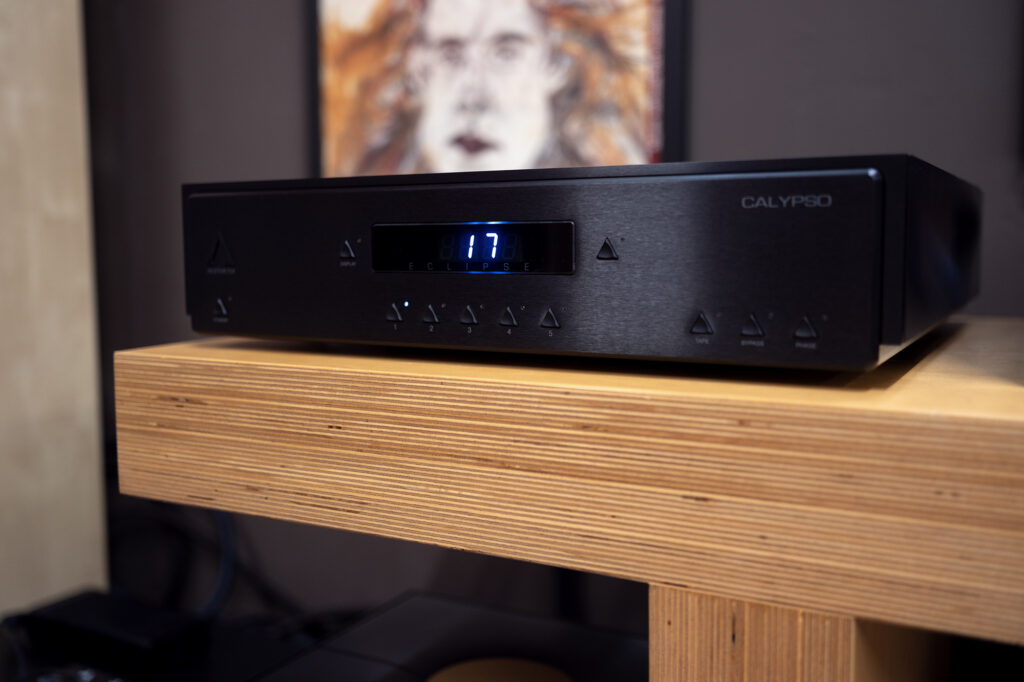
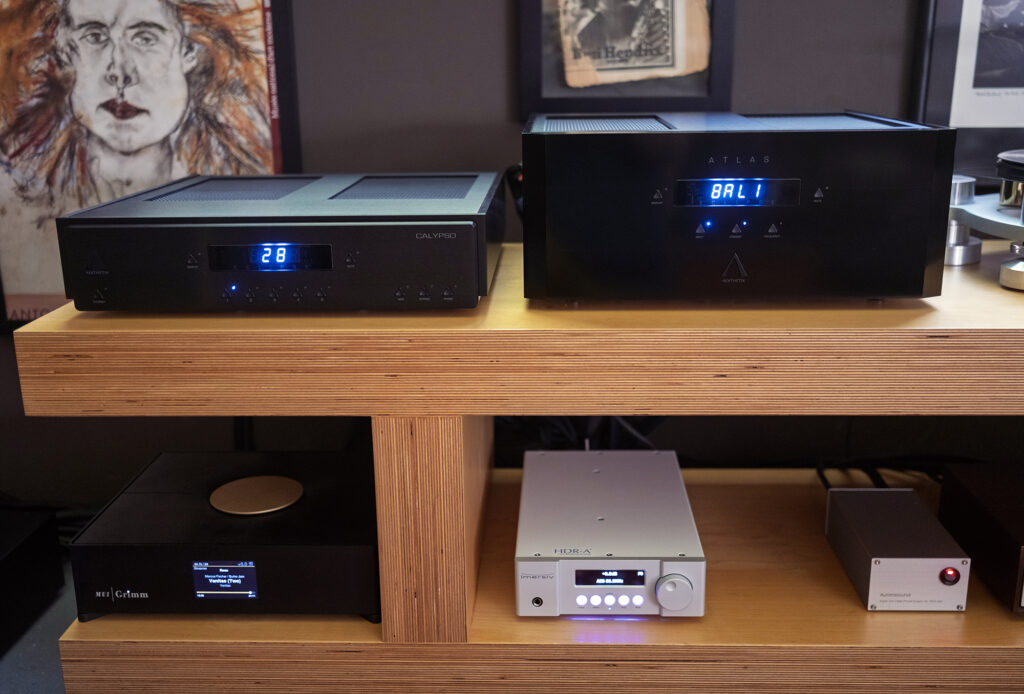
The Calypso Eclipse Tube Linestage carries on the Aesthetix aesthetic with its triangular function buttons, blue LED display, and brushed aluminum faceplate for a stealthy appearance. Those function buttons offer Standby, Display (on/off), Input selection, Mute, Bypass for use in a Home Theater, Tape, and Phase while the discrete switched resister volume can be controlled by pressing that display—left side for down or right side for up in 1dB increments. You can also perform these same functions with the included chunky matching aluminum remote which adds a Balance control to the mix.
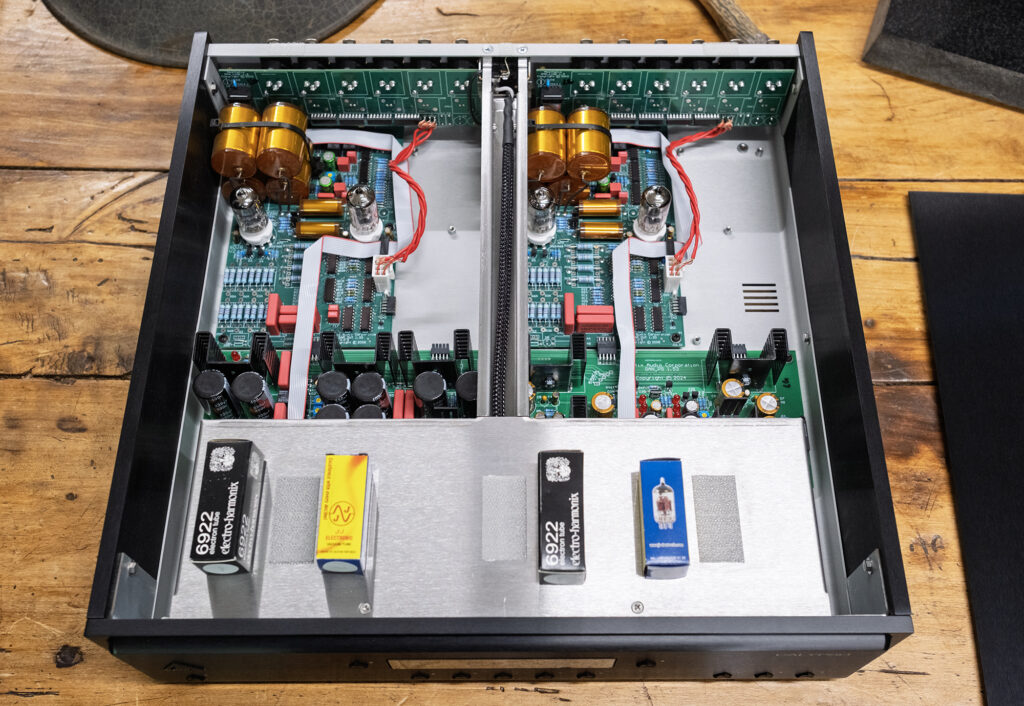
The all-tube Calypso employs pairs of 1x 12AX7 (or equivalent) and 1x 6922/6DJ8 per each channel which reside on on their own separate matching boards. The Calypso ships without the tubes installed so a quick lift of the top cover which is held on by an industrial interlocking material, i.e.. not Velcro that also acts as a vibration dampening layer, and its plug and play in a few minutes.
Aesthetix offers three versions of the Calypso preamp—Standard, Signature, and Eclipse. The Eclipse in for review differs from the others on the inside with a number of higher grade parts. I’ll let the company explain:
First phase: Internal changes to the Calypso start with .22uF / 600v Stealth coupling capacitors used between the gain stage and output stage. Four total of these exotic capacitors are used.
There are four 2uF / 400v coupling capacitors used in each channel of the output stage of the Calypso. In the Eclipse version, these are replaced with Stealth copper foil 4uF/400v, improving low frequency response.
Second phase: High frequency tuning capacitors are installed and hand-adjusted to tailor the frequency response to a tight .1dB standard (as also found on our Signature version).
Third phase: The high voltage transformer, heater transformer and high voltage choke are all re-installed on isolation mounts. Harmonic Resolutions Systems’ Nimbus Couplers specially made for Aesthetix replace the four rubber feet of standard units (as also found on our Signature version). The new power supply is installed with enhanced ventilation. Additional damping material is added to key chassis points.
Fourth phase: A single point ground system is used to ground the transformer cases as they are no longer electrically grounded to the chassis via physical contact due to their isolation mounts. All Eclipse Rhea, Calypso and Janus units receive a new power supply, which has been refined by improved trace routing to further reduce extraneous noise.
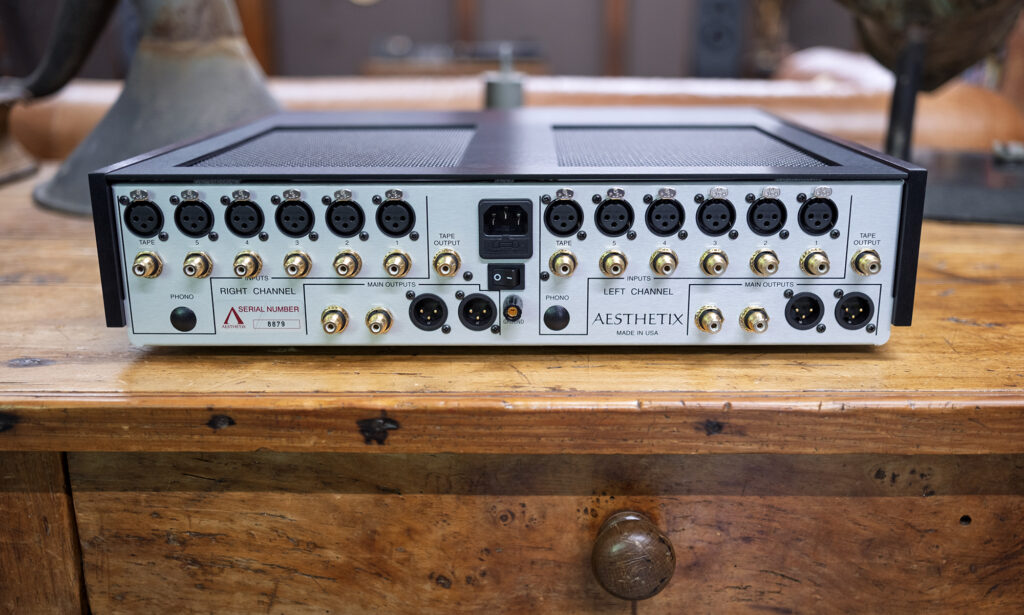
As you probably figured from the five input select buttons up front, there are 5x RCA and 5x XLR inputs around back along with RCA and XLR outputs.
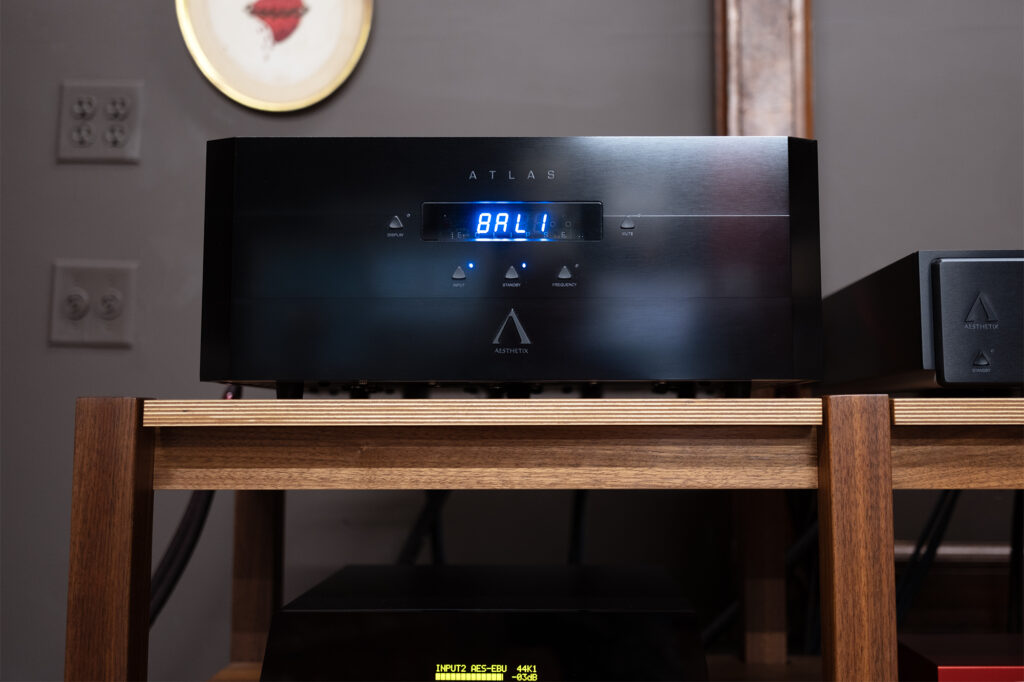
The Atlas Power Amplifier is a hybrid affair combining a bipolar output and driver stage with a vacuum tube input gain stage sporting one 6SN7 per side. The Atlas is rated at 200wpc into 8 Ohms and 400wpc into 4 and weighs in at 70 lbs which is quickly becoming the maximum limit for my body to manage without things breaking—the amp or me. Even the Barn’s old farmhouse table is showing signs of weight-related stress.
The Atlas’ front panel houses five triangular function buttons and an LED display including one button marked ‘Frequency’ which provides access to the Hi Pass crossover selection menu offering sixteen values to choose from (40 – 200Hz) when using a subwoofer(s).
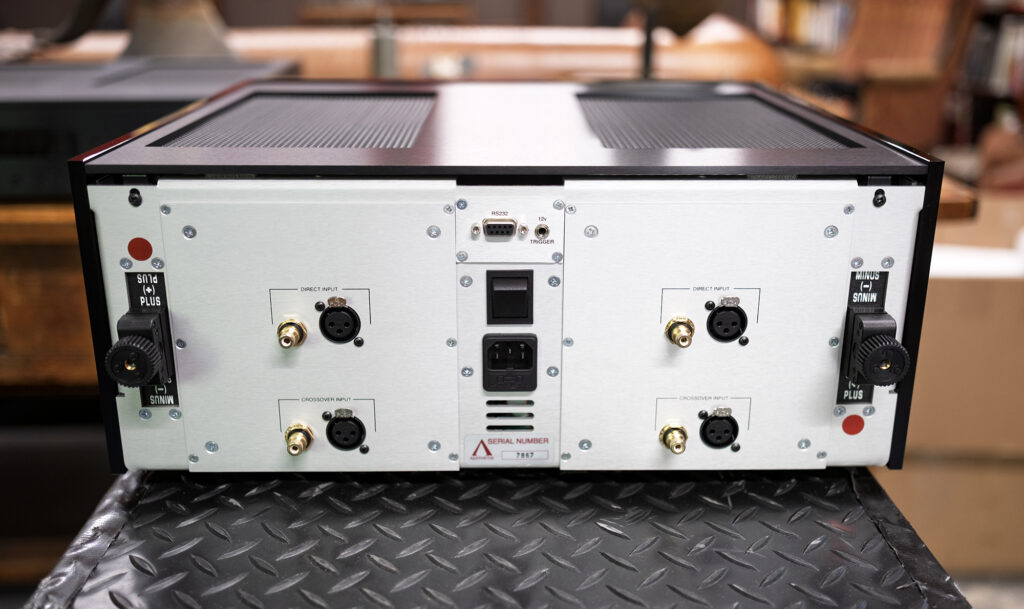
Around back we have what you’d expect to find in a stereo amp with RCA and XLR inputs, Cardas rhodium-plated binding posts, IEC inlet, power switch, and RS232 and Trigger inputs. The extra set of inputs marked Crossover are for use with the aforementioned Frequency option.
The Atlas also comes in three versions: Standard, Signature, and Eclipse and I’ll let the company explain the Eclipse difference:
First phase: The Atlas Eclipse Stereo features the Stealthcap™ capacitor, made with exotic new conductors, dielectric material, and composite resins to dramatically reduce reflections, enhancing focus and articulation with blacker backgrounds.
Second phase: The output stage of Atlas Eclipse Stereo features Super Matched Pair output devices, lowering certain output stage distortion components by as much as 40dB. In every version of the Atlas, each Bi-polar output device (16 per channel) is supplied power through a copper bus bar design, radically reducing impedance compared to standard circuit board traces. In the Eclipse version, Distributed node film capacitors are added at each output device, further reducing impedance for increased current capacity and improved transient capability.
Third phase: Critical power supply components: high voltage transformer, high voltage choke, and driver choke, are de-coupled from the chassis using specially designed isolation mounts. This dramatically reduces the amount of mechanical vibration introduced into the chassis.
Fourth phase: Since the transformers are no longer in contact to the chassis at multiple points, a single point system is used to ground the transformer cases, further reducing AC-induced noise. Power supply wiring for the high current section, already robust 14 gauge in Standard and Signature versions, is upgraded to the equivalent of 12 AWG multi conductor audiophile wiring.
Fifth phase (optional): The casework is replaced with machined aluminum pieces that are bolted together using a highly rigid joinery technique… they act as one. In black, the panels are polished to a beautiful reflective sheen. In silver, they are finished in a gorgeous matte texture.
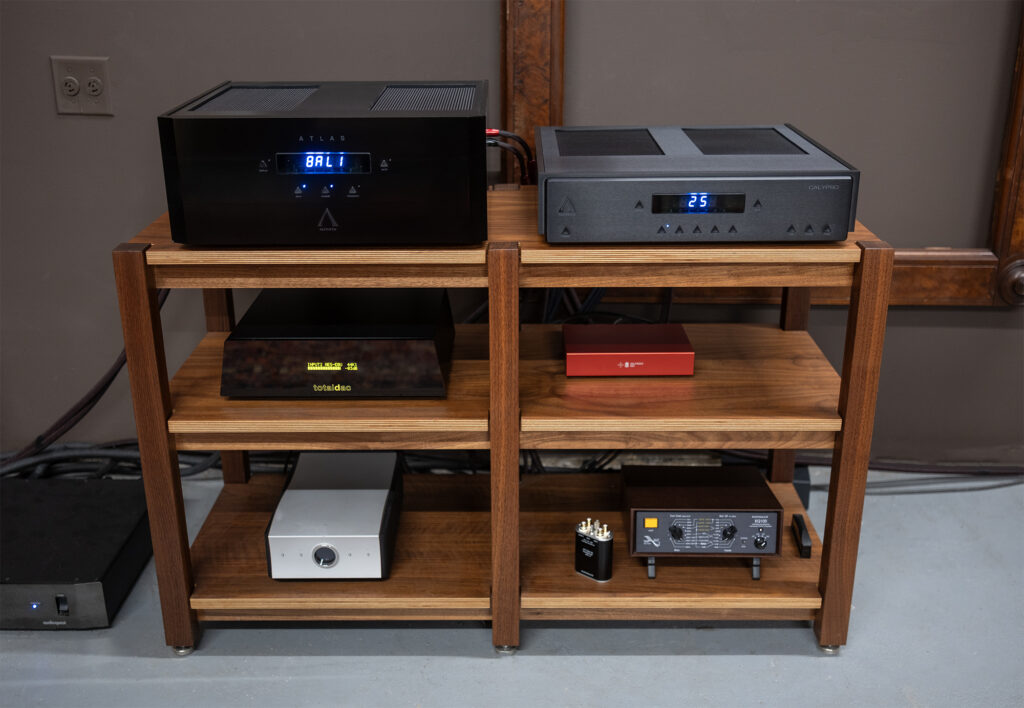
I want to clarify something about the casework—as you can see from the photos (I hope), the review samples do not match and this is because the Atlas amp is wearing that ‘Fifth phase’ facelift while the Calypso is dressed in the Classic casework. At present if you want your stack to match you have to go with Classic. Frankly I like the look of the Classic design just fine.
Getting back to my thoughts on the Mimas as compared to the Calypso/Atlas combo, the long quotes I included detailing what you get with the Eclipse versions were included for a reason as they detail how these parts improve, measurably, overall performance which tracks very nicely with what I heard. It’s also relevant to note that the Mimas borrows parts and tech from both the Calypso and Atlas offering close family ties.
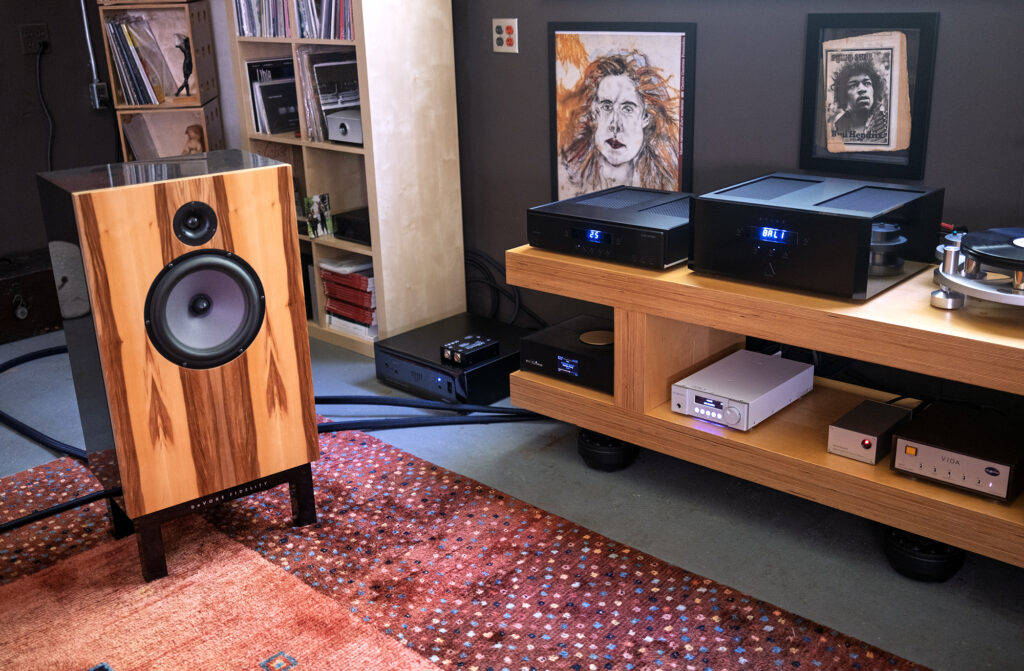
The Aesthetix stack got to play with two pair of speakers—the recently reviewed Peak Consult Sinfonia (review) and the Barn resident DeVore Fidelity O/96 (review). Digital duties were handled by the Barn resident Grimm MU1 (review)/Imersiv D-1 DAC (review) combo and the HoloAudio Red DDC & Network Streamer (review) feeding the Mola Mola Tambaqui (review) and the totaldac d1-unity (review) all tied together with cables from AudioQuest with all gear sitting on a lovely racks from Box Furniture (see full Barn and system details).
You might think that a 400W amp would be too much for the sensitive DeVore O/96 but that thought was proven incorrect a few minutes after hitting play. I’ve said this before but I’ll say it again—when people ask what kind of amplifiers do the O/96 like, my answer is good ones. Great ones even better and the Aesthetix stack had the O/96s singing sweetly with superb speed, control, delicacy, dance, drive, and timbral richness that never sounded overly ripe or too lean. Bass response, and the O/96 do bass really well, was exceptional for its force and voice. No boom boom in this room, instead I got tight and tuneful.
As you may know, I like to run every amp and stack through the DeVores because I know these speakers so well and they tell me a lot about the qualities of the upstream gear. If any system fronted by a pair of O/96 sounds boomy I know its not the speakers and the same goes for any sense of harshness or etch or overly lush midrange-forward sound. It ain’t the speakers its the room and/or the rest of the rig.
All to say the Aesthetix stack passed my O/96 test with an A+ which tells me that we’re talking about some finely balanced gear and the fact that the recently reviewed Peak Sinfonia also loved, and I mean loved, the Aesthetix stack tells me even more. Let’s let some music explain.
Kytytsi from Ukrainian avant-garde singer-songwriter Svitlana Nianio, released in 2018 on KOKA Records who specialize in Ukrainian underground and traditional music, has recently grabbed my full attention even throughout the course of its weird and wondrous 1 hour+ duration.
Straight from the heart of ancient folk songs comes the tenderness in her voice; Svitlana frames it with sounds of pure New York minimal tradition. Deeply rooted in primeval myths, her music creates a world of magic realism, in which the temporal dimension and the other world constantly move and permeate.
Somewhat reminiscent of Tori Kudo’s Maher Shalal Hash Baz and French composer Colleen (Cécile Schott), this music sounds unrehearsed and nearly naive in the best possible way with Nianio’s vocal backed her on Electric Piano [Fender Rhodes 73 Mark], Flute, Harmonium, Piano, and Synthesizer [Casio MT-200] with Serhii Hotyachuk adding Electric Guitar, Steel Guitar, Percussion and Bolesław Błaszczyk on Cello.
This music delights in the unique voice of each element creating a weird and wonderful world of magic realism, the paintings of Henri Rousseau come to mind or if you prefer moving images The Wicker Man (1973), with simple elements adding up to moods and atmospheres greater than their sum. Meditative and mesmerizing, the Aesthetix stack driving the DeVore O/96 on the Barn’s A-Side and the Peak Sinfonia on the B-Side (I let this album play through in both system contexts) brought out all the varied sounds from pure silence with the tiniest of musical elements perfectly portrayed along with the sway, movements, and riches all adding up to complete immersion.
The Aesthetix stack runs dead quiet and coupled with its as fast as music gets speed, this entrancing music startled and delighted feeling very nearly as if its unique sounds and voices were able to take form and run around, joining the Barn mice for a dance around the Maypole. Magical.
Recent Album of the Week African Family Laptop Musick by Dawuna let the Calypso/Atlas stack strut some of its bass stuff which felt physically present and powerful yet completely part of the overall mix. Think perfect control on both pair of speakers and the Peak Sinfonia have ample bass response on offer as long as you feed them with enough drive, something the Aesthetix stack offers in heaps. While I can’t speak to how well the Atlas will drive a very difficult load, the Sinfonia’s 89dB/5 Ohm load seemed like it taped into a tiny fraction of the Atlas’ reserves.
This music with its lovely and loose R&B vibe spreads out in space painting a fairly broad sound image which the Aesthetix stack materialized completely apart from the speakers and in solid relief. And solid is an appropriate word to describe the overall feel of music with the Calypso/Atlas in charge albeit without any hint, not even a whisper, of unnaturally sculpted detail or blur. When music rings out this true to life, your body responds before your thoughts have time to intrude, or so it seems to me, and African Family Laptop Music had me in its grip with my muscles twitching ready to move along with the groove.
I’m talking about a visceral response to music, to put it plainly, which is about the ideal for my way of listening and it goes hand-in-hand with reproduction that feels perfectly balanced and flawless, suspending any sense of disbelief in a phantom image because it feels so physically present. Nice.
Let’s keep things weird and wonderful with Holy Tongue’s debut full-length Deliverance And Spiritual Warfare, released on Amidah Records in 2023.
On Deliverance And Spiritual Warfare the band present their most focused work yet, fully exploring their diverse influences, from the opening Andalusian catholic march to heavyweight dub via jazz, post punk, mystical percussion tracks and techno. Featuring guest appearances from the legendary Steve Beresford on prepared piano, and Abraham Parker and David Wootton on brass.
The core band is Valentina Magaletti (Drums, Percussion, Piano, Vibraphone, Xylophone), Al Wootton (Synthesizers, Bass Guitar, Double Bass, Piano, Autoharp, Percussion), and Susumu Mukai (Bass Guitar, Percussion) and this music is drenched in dub and the deep bass you’d expect while venturing way out into deep space. And this record positively immense spatially with this sound world exploding in every dimension creating vast sense of place while each element was firmly anchored and fully voiced. Stunning.
By fully voiced, I’m getting back to the Calypso/Atlas combo’s way with timbre that feels natural and rich and when combined with seemingly unrestrained dynamics and superb bass control I got deep into the inner workings of Deliverance And Spiritual Warfare as if I’d become part of its making. To put it another way, the Aesthetix stack adds a spark of life to reproduced music that makes it feel alive.
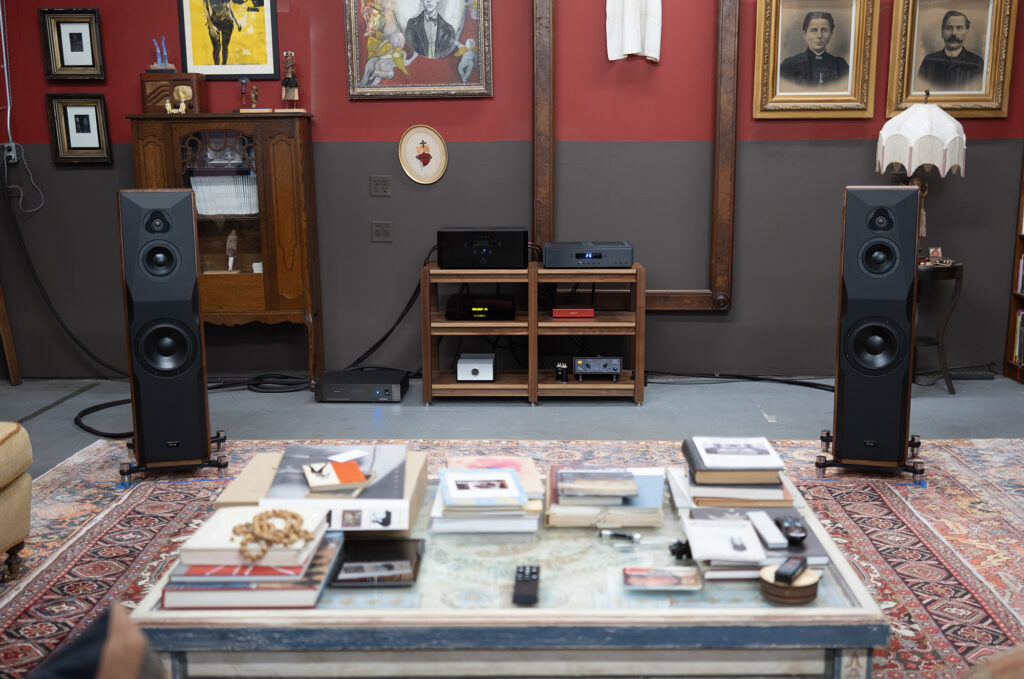
The Calypso/Atlas combo in their Eclipse attire come in at $34k for the pair which puts them into the same region, price-wise, as a number of Favorite integrated amplifiers including the overachieving Gryphon Diablo 333 ($27,800 review) and Soulution 331 ($39,975 review), very fine company indeed. Seeing as I didn’t have either on hand for direct comparisons, I’d point to their respective reviews to get a sense of how I felt about them. The Gryphon is simply stunningly good with as much power as you’ll ever need while the Soulution paints a very nicely nuanced yet powerful picture.
Unfortunately getting into comparative minutiae is only possible via direct comparisons so I’ll leave you with this thought—the Calypso/Atlas combo fits right in with these outstanding integrated amplifiers while offering a bit more natural analog bloom, a harmonic richness that sets it apart.
The Aesthetix stack arrived back in July and its been playing on both sides of the Barn ever since which means lots of lots of different kinds of music in the morning, afternoon, and well into the night some nights and my tastes in music run wide, all to say I ran the Aesthetix stack through its paces and then some with one result—always wanting more music.
After living with the Aesthetix Mimas integrated amplifier and now the Calypso Tube Linestage and Atlas Power Amplifier both in the Eclipse version I am impressed without reservation. No caveats needed to excuse some shortcoming or other because I didn’t experience any. Not a one.
The Calypso/Atlas combo offer combined strengths that surpass matters of sound quality because they get all that right while adding a touch of natural rightness, a spark of life, that allows music to flow well past your ears touching more important things deep down inside. Highly recommended.

Aesthetix Calypso Tube Linestage Eclipse Version $14,000 | Standard Version: $9950
AesthetixAtlas Power Amplifier Eclipse Version: $20,000 | Standard Version: $14,000
Company Website: Aesthetix Audio
Aesthetix Calypso Eclipse Tube Linestage Specificstions
Inputs: 5 line RCA or XLR (balanced), plus 1 tape, RCA or XLR
Outputs: 2 RCA (SE) and XLR (balanced), 1 tape RCA
Line level gain: 23 dB single ended (SE), in/out, and 29 dB balanced/out
Volume control: switched resistor network volume control with 88 1 dB steps
Front panel controls: main input, tape input select, volume, balance, phase, mute, display, and bypass
Remote controls: main input, tape input select, volume, balance, phase, mute, display, bypass and standby
Frequency response: +- 0.25 dB, 20 Hz – 20 Khz
Signal to noise: measured at 70 dB minimum, A-weighted (ref 1 mv input, 75 dB gain setting)
Line input impedance: 40 k ohms SE, 80 k ohms balanced
Maximum line input: 3.5 volts SE, 7.0 volts RMS balanced
Output impedance: 1K ohms SE, 600 ohms balanced
Recommended amplifier load: 10K ohms or greater (SE), 20K ohms or greater (Balanced)
Tubes, each channel: (line section) V1 (12AX7 or equivalent), V2 (6922/6DJ8)
Power consumption: 20 watts standby, 60 watts active
Physical dimensions: 4 3/8″ high, 17 7/8″ wide, 18″ deep including jacks
Shipping weight: 40 lbs.
Aesthetix Atlas Eclipse Power Amplifier Specifications
Power Output: 200wpc channel into 8, 400wpc into 4
Input Sensitivity: 60mV (1 watt), 2.3V (full power)
Input Impedance: 470K
Output Impedance: .25 at 1kHz
Signal to noise: 120dB
Bandwidth at full power: 4 – 150kHz
Rated THD at full power: <1%
Power consumption: 100 watts at idle
Dimensions: 18″w x 8″h x 19″d
Weight: 70 lbs
Finish: black or silver
Warranty: 3 years, non-transferable