
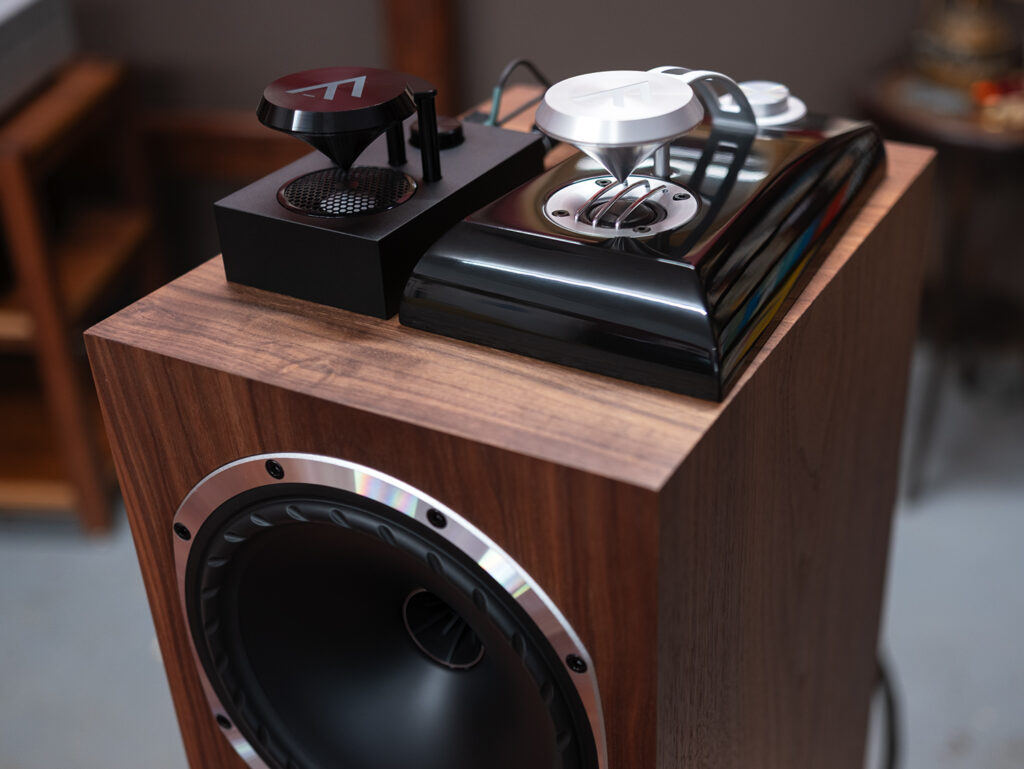
Think clarifier and enhancer. No, I’m not talking about hair care products, rather the effects of adding the Fyne super tweeters to the recently reviewed Fyne F502S speakers.
You might think that seeing as both operate from 16kHz on up their ‘sound’ would be limited to upper (upper) frequencies but that’s just not the case. I reviewed my first two super tweeters, the muRata ES103A and Tonian Acoustics TL-R2, back in 2005 and found:
While I know the Tonian TL-R2s are only reproducing sounds above 15kHz, they have a clear and distinct effect across the frequency board. Even bass response is refined and more palpable. Another odd super tweeter fact? Every review I’ve read has said basically this same thing, right down to the lower frequencies but for some reason, I just didn’t believe it until I heard it myself.
I will add that many a speaker these days offer frequency response well above 20kHz. The Fyne F502S are rated up to 34kHz, the DeVore O/Reference I recently heard at Axpona have a built in super tweeter raising their upper limit to 50kHz, the Dynaudio Contour Legacy (review) come in at 29kHz, the Rockport Atria II (review) and Wilson Benesch A.C.T. 3Zero (review) hit 30kHz, and the big YG Sonja 3.3 (review) travel up to 40kHz (all #s according to the manufacturer). All to say, there’s something going on up there above 20kHz but I’m not getting anywhere near psychoacoustics other than to point out the fact that acoustic instruments produce sounds well above 20kHz so if its fidelity to reality you’re after…

From Fyne:
…the addition of a super tweeter, time aligned to the acoustic centre of the IsoFlare, will reduce the high frequency phase error by moving the low pass roll off point much higher. So even if we ignore for now the perception of sound above 20kHz, the addition of a super tweeter will better preserve the harmonic relationship between instruments and is apparent down to low frequencies. This is a very important fact which is not intuitive.
Fyne also offers a white paper on How Super Tweeters Work.

The Fyne S-Trax is the less expensive option in Fyne’s two-deep super tweeter lineup along with the SuperTrax. Two main differences between the two, other than the obvious fit ‘n finish, are the drivers in use with the SuperTrax getting Fyne’s 25mm thin-ply carbon diaphragm (TPCD) driver and the S-Trax sporting a 25mm Magnesium dome along with claimed frequency responses of 16 kHz to 60 kHz (-6dB) and 16kHz – 50kHz (-6dB) respectively.
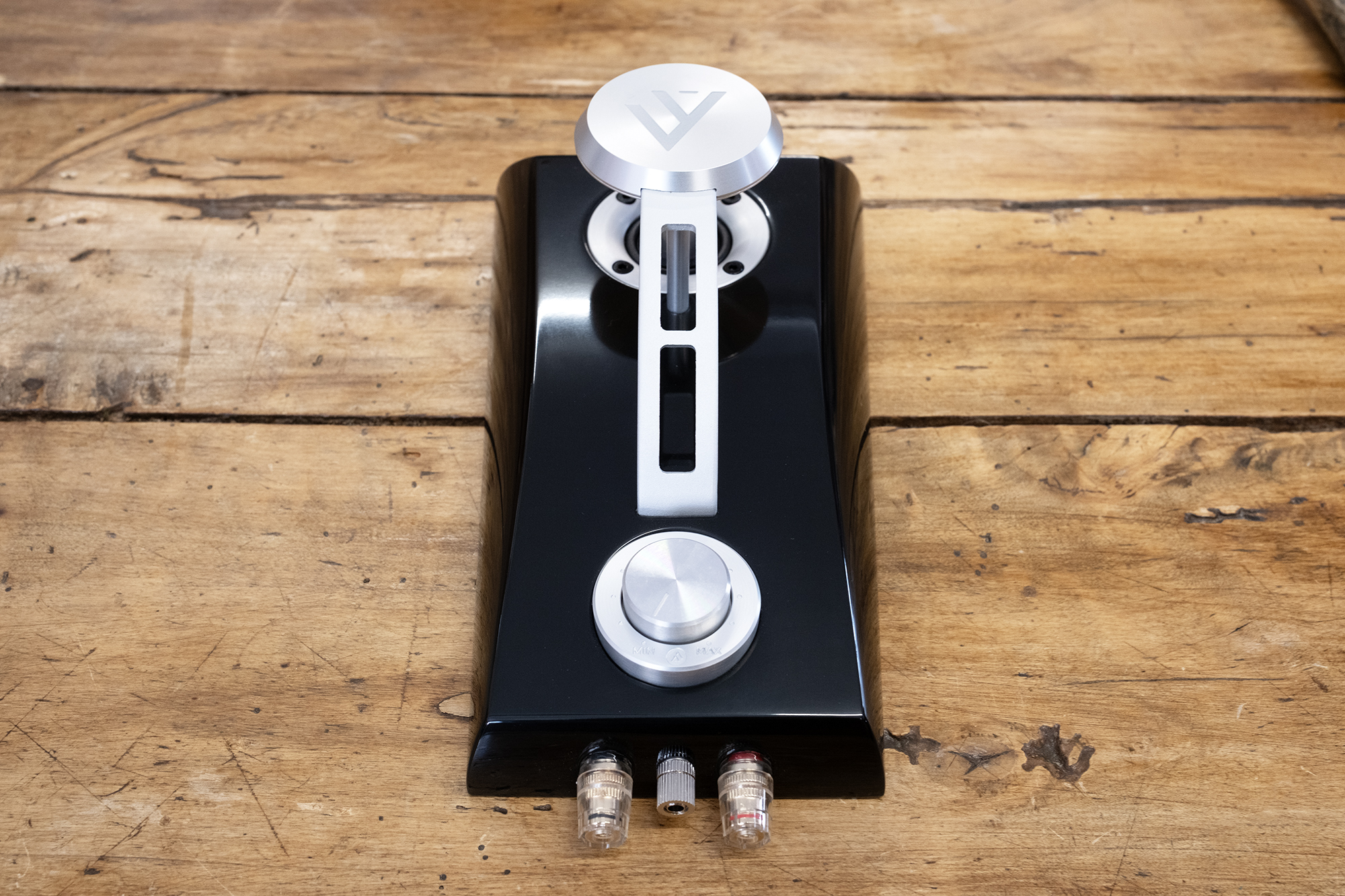
Both Fyne super tweeters have level adjustment knobs, with the S-Trax offering a +/- 4.5dB range while the SuperTrax offers +/-3 dB (from nominal setting) range allowing you to match your speakers and taste. Both super tweeters fire upward into a “tractrix radiator” (a pointed cone) for 360-degree omnidirectional dispersion (and space-age look).
From Fyne:
By using our patented time aligned omnidirectional super tweeter, reflected energy in the room has the same harmonic structure as the direct on axis energy, thus giving advantages in perceived air and space.
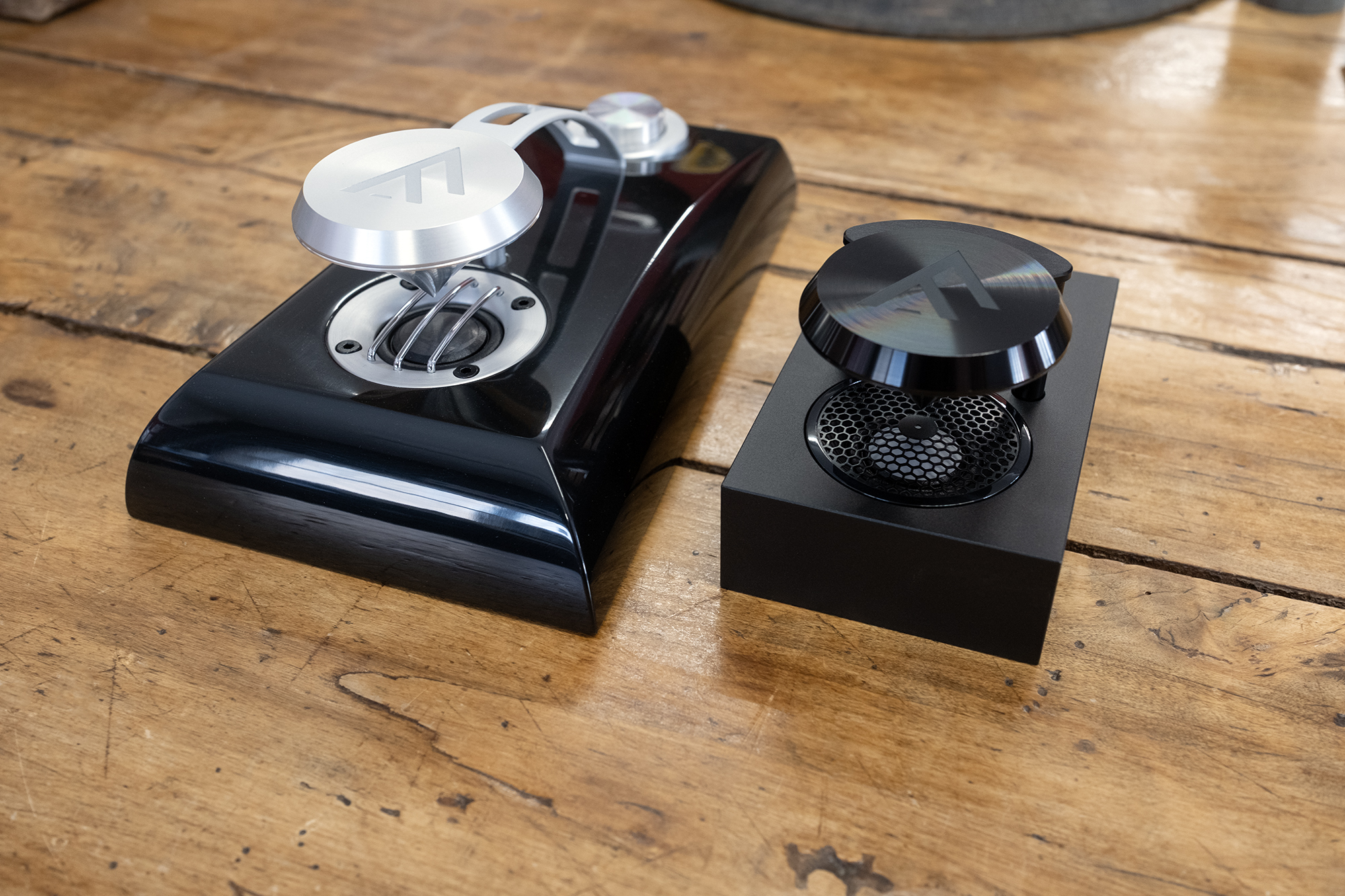
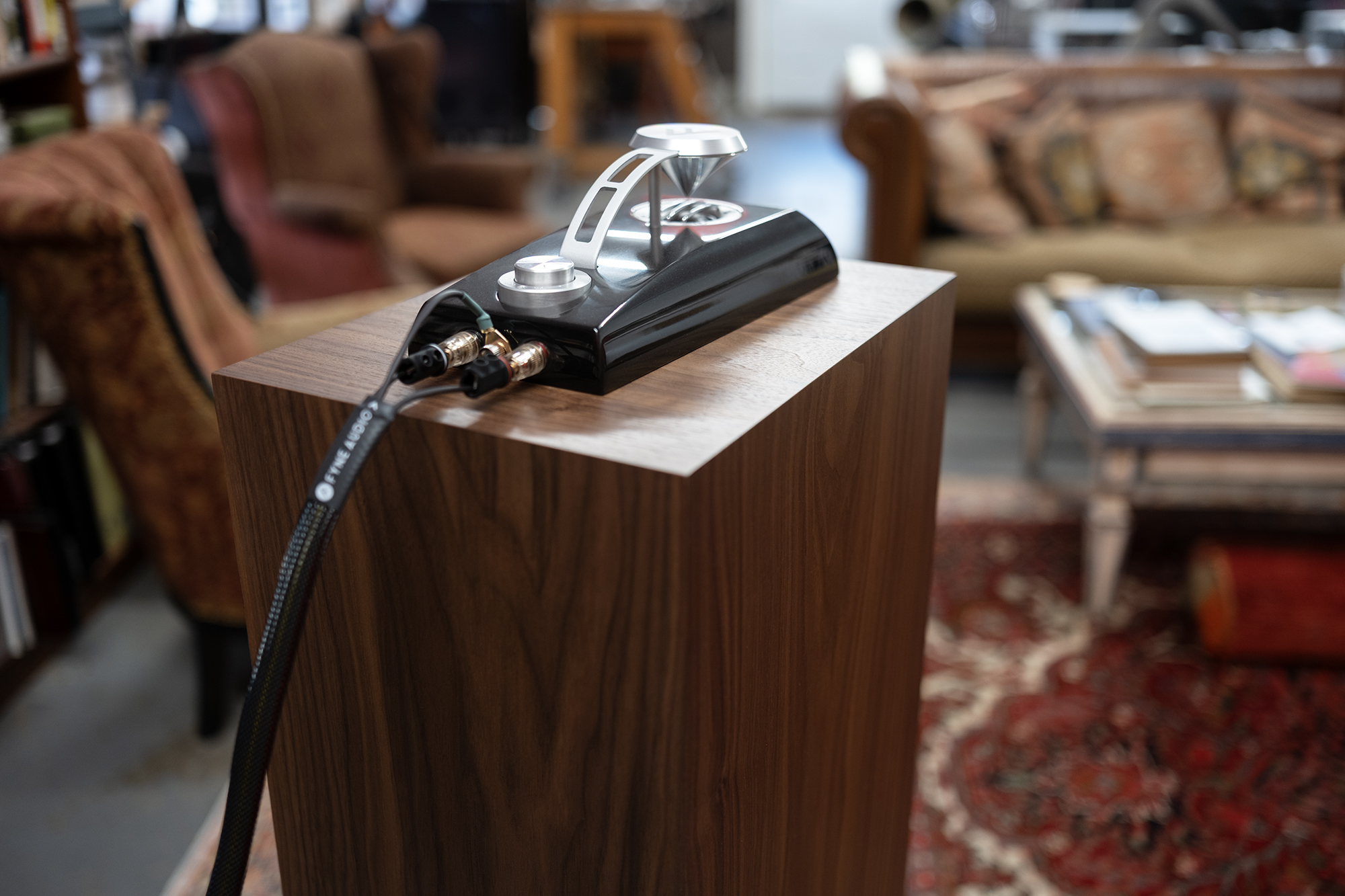
The S-Trax’s body is a nice chunk of squared off aluminum weighing 2.2 lbs while the SuperTrax offers a larger and curvier shape finished in Walnut to match Fyne’s Vintage Series of loudspeakers or Piano Gloss Black as found in the review units.

I was also sent Fyne’s optional SC1 Premium Cable Kit for SuperTrax Tweeter ($449/pair) which I used throughout this review.
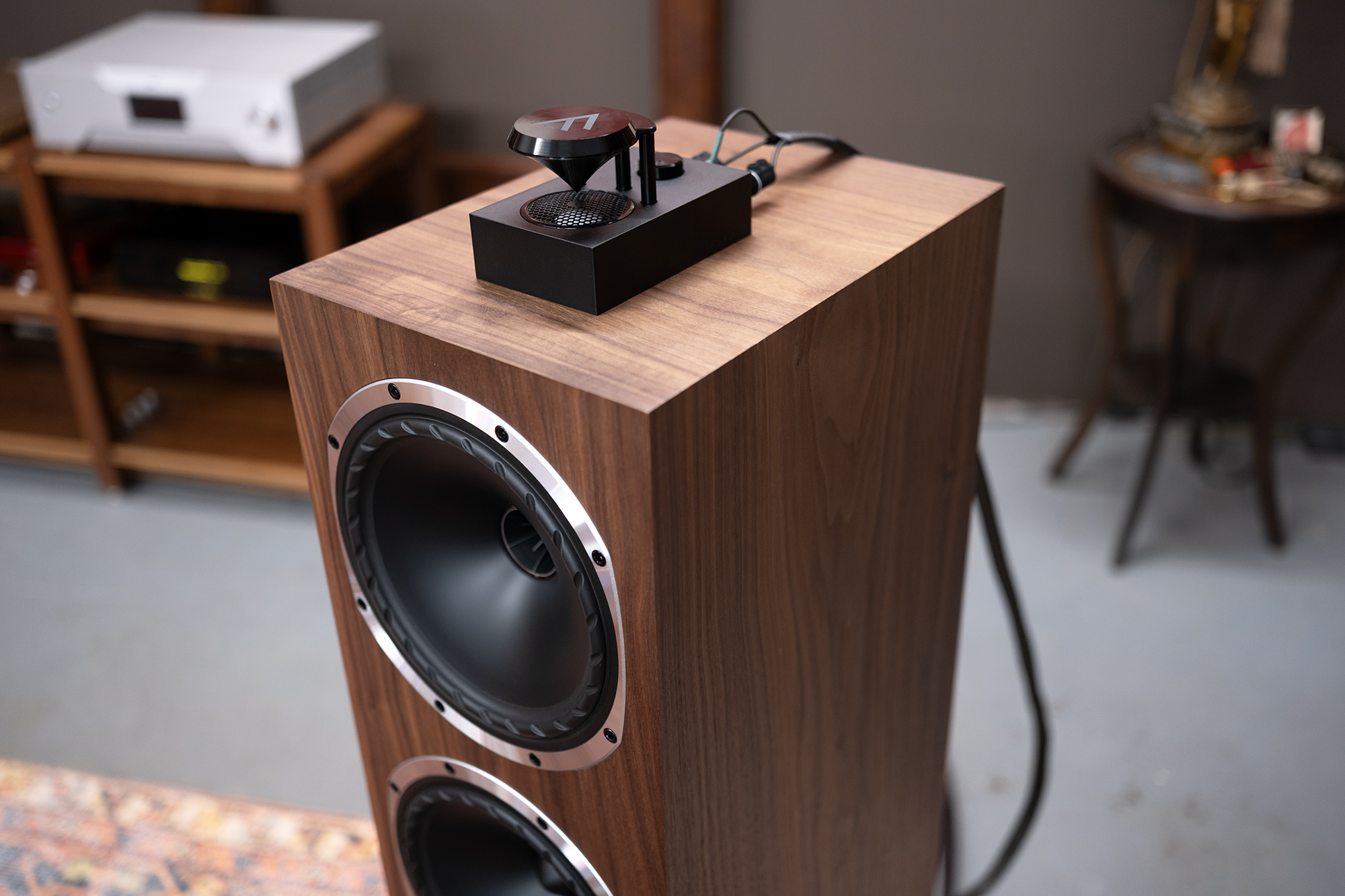
On a purely visual level it’s hard not to notice that either super tweeter is an add-on requiring exposed cables running down the backside of the speaker. This may not be an issue for you but it’s worth noting. I actually prefer the look of the less expensive S-Trax but this is a purely subjective point.
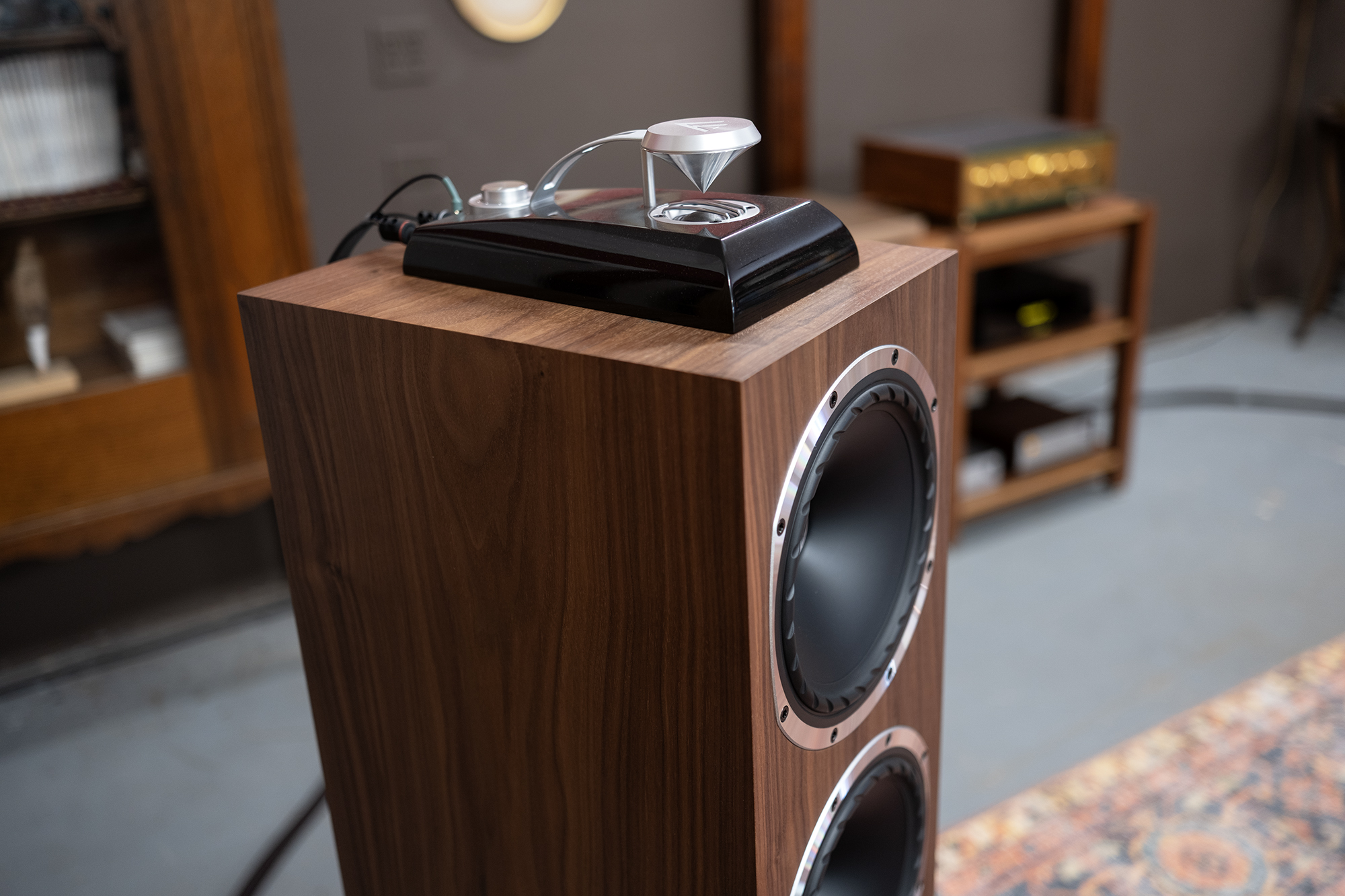
One very important detail to keep in mind—the S-Trax and SuperTrax are recommended “for loudspeakers up to 98 dB.” I used both with the Fyne F502S and did not try them with any other speakers so I cannot speak to how they will perform outside of this limited environment. My advice is to try with your speakers before you buy, if possible.
The Fyne F502S + super tweeters were paired with the Barn resident Leben CS600x integrated amp as well as the Devialet Astra Opéra de Paris Integrated Amplifier System that’s In Barn for review and the Barn resident Holo Audio Red streamer (review)/totldac d1-unity (review) combo with all AudioQuest cable.
I started out with the S-Trax in the fully maxed out position and continued listening to the same track that was playing before their addition, “I Was Young When I Left Home” by Anohni and Bryce Dessner that has acoustic guitar and of course Anohni’s heavenly vocals and the additional air, space, and clarity were readily apparent. Imagine having a knob marked “Refinement” that dials in the level of things like transient response, clarity, and spatial cues and you’ll have an idea of the changes brought by the S-Trax super tweeter. In other words, all positive improvements without any adverse side effects.
Music with obvious and important spatial information like “Bells” from These New Puritans album Crooked Wing is one good example and adding either super tweeter added an improved sense of space, air, and apparent resolution overall. I found that in my space and according to my tastes, I preferred the S-Trax run full tilt on the Max level setting. Anything lower lowered its beneficial effects.

Things were a bit different with the SuperTrax as I found its Max level position to be too much. Too much additional apparent resolution that sounded unnatural. Overcooked. Backing down to the mid-level spot solved that problem and once settled in, the positive effects noted with the S-Trax were present here as well. All pluses. I will reiterate that one difference between to two Fyne super tweeters is the drivers in use and frequency response with the S-Trax operating from 16kHz – 50kHz while the SuperTrax extends to 60kHz (according to the company).
I spent time over the course of a few weeks listening to both super tweeters moving from one to the other and once I settled on my favorite settings for each I let the music take where it or I wanted to go. And every time I removed them, running the F502S in stock form, my excitement level decreased. I missed the additional sense of air, resolution and refinement.
Bass heavy music also saw improvements down low with a sense of greater bass definition and clarity that seemed to affect music’s overall presentation. While the differences between the S-Trax and SuperTrax were subtle at best, as odd as it may seem the SuperTrax seemed to offer greater impact in the lower registers as compared to the S-Trax.
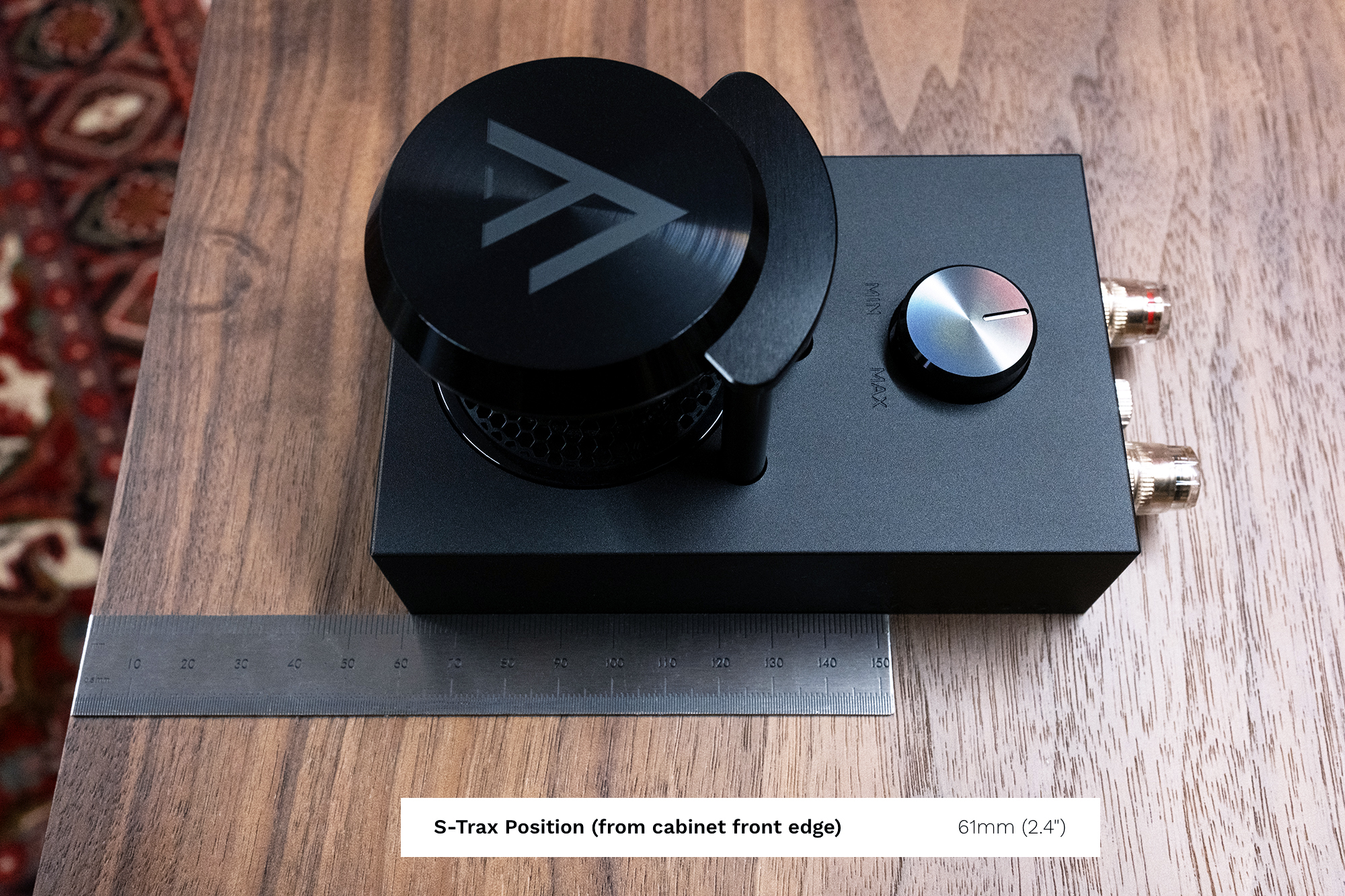
All things considered, the S-Trax would be my preferred choice for the F502S as it brought noticeable and welcome improvements for $1300 in round numbers. That being said it’s also important to consider the other end of the frequency response range as I found the F502S sounded a bit lightweight in the Barn’s large space, something a subwoofer (or two) would remedy.
Getting back to 2005, I tried a subwoofer and super tweeter with the single-driver Cain & Cain Abby speakers and in the end decided to move on to a full range multi-driver speaker seeing as my Frankenstein’d single driver++ was kinda silly. The F502S + S-Trax + SC1 Premium Cable Kit = $5250 (in round numbers) and adding one or two subwoofers would push that total over $6000 and up. All to say that at some point it may make more sense to look at a different speaker further up the Fyne line.
Adding either Fyne super tweeter offered clear and to my way of hearing welcome improvements as noted above in greater detail but if you find your system in need of a bit more air, refinement ,and perceived resolution from top to bottom, the S-Trax or SuperTrax may just do the trick.
Fyne Audio S-Trax Super Tweeter: $1299.99/pair
Fyne Audio SuperTrax Super Tweeters: $4499/pair
Fyne Audio SC1 Premium Cable Kit for SuperTrax Tweeter: $449/pair
Company Website: Fyne Audio
US Distributor Website: Harmonia Distribution
S-Trax Specifications
Maximum Recommended amplifier power (Watt RMS): 300
Sensitivity (2.83 Volt @ 1m): Suitable for loudspeakers up to 98dB typically
Nominal impedance: 8 Ohm
Frequency response (-6dB typical in room): 16kHz – 50kHz
Drive unit complement: 25mm (1”)- Magnesium dome with neodymium magnet system
Crossover type: 3rd order high pass 16kHz, CryoLite treated
System adjustments: +/- 4.5dB from nominal setting
Dimensions – HxWxD: 79 x 82 x 149mm (3.1 x 3.2 x 5.6″)
Weight: 1kg (2.2lbs)
Finishes: Black
SuperTrax Specifications
Recommended Max Amplifier Power: 400 W RMS
Sensitivity (2.83 Volt @ 1m): Suitable for loudspeakers up to 98 dB
Nominal Impedance: 8 Ohm
Frequency Response (-6 dB): 16 kHz to 60 kHz
Driver: 25 mm thin-ply carbon diaphragm (TPCD) with neodymium magnet system
Crossover: 3rd order high pass 16 kHz, Cryogenically treated
Adjustments: +/-3 dB from nominal setting
Dimensions (HWD): 3.4″ x 5.5″ x 10.1” (86 x 140 x 257 mm)