
I don’t know much about economics, but I know what I like.
Here’s the result of the new US tariffs in a nutshell—some hifi products imported into the US or made in the US are going to cost more. How much more depends on the country of origin and what each manufacturer and their importer decide to do to cover their increased costs due to higher tariffs. Of course any US-based company that uses parts sourced from anywhere else in the world, that’s every company as far as I know more or less, will also be paying more for those parts and I’d expect to see some if not all of that increased cost add up to increased prices for US-made goods within the US.
A more complete picture also has to take into account US-based companies who sell outside the US facing higher reciprocal tariffs and anti-American sentiment which may very well negatively impact international sales. Not a pretty picture no matter how you look at it.
An easy example: what used to be a $1000 DAC imported from Switzerland—which now has a 30% US tariff rate up from 2.1%—will now include a $300 tariff once it enters the US. Who pays for that extra $300? It depends on the company and their importer. Some US and North American importers have so far said they will keep rates the same and essentially eat that new additional cost. Others, like Auralic which is based in China—with its new 30% US tariff rate (until November 10, 2025) up from 2.8%—have decided to stop selling their gear in the US for now. From the Auralic website: “Due to US government tariff policy, we have temporarily suspended all shipment to US address till future notice.” Others will pass some or all of that new additional cost on to the consumer.
These tariffs are paid to the US government by importers and US manufactures and you may be wondering, where’s all that extra revenue going? In July, just last month, the US pulled in a reported $29 billion in “customs and excise taxes” compared to a total of $98 billion in all of 2024. The president and his staff have thrown out some possibilities including having tariffs replace income tax (which they can’t if you bother to do that math), reduce the national debt which is about $37 trillion not counting the additional trillions to pay for that big beautiful bill, or maybe even pass some of that newfound cash along to middle and lower-income Americans in the form of a tariff rebate check!
You may be thinking—but if we’re already paying for most or all of the new tariffs when we buy stuff at higher prices, aren’t we just getting back a tiny percentage of what we’ve already paid out? Of course that’s what it means.
Balancing trade on the backs of consumers, with much of the real burden falling on the poor, is a funny idea of fair. And higher prices overall on essentials like food, clothing, and TVs (wink) will negatively impact spending on things like hifi.
On the plus side, at least the uncertainty caused by the initial incomprehensible tariff plan, e.g. taxing islands inhabited by penguins not people, and the persistent and sometimes wild changes from week to week is becoming less uncertain. Anyone who has to budget for anything can understand how important it is to know how much the things they need to buy will cost, something the administration seems to be either ignorant of or simply does not care about. You know, budgeting for regular people, big defense contractors, toy makers, and hifi manufacturers.
On the minus side, we may see companies forced to cut back on spending and staffing while others may be unable to continue doing business with already tight budgets pushed passed their breaking point.
The rationale behind these tariffs, to use the kindest word possible, is the belief of this administration that trade deficits are inherently bad, a notion that is summarily dismissed by most trade experts, economists, and the data. For whatever that’s worth these days.
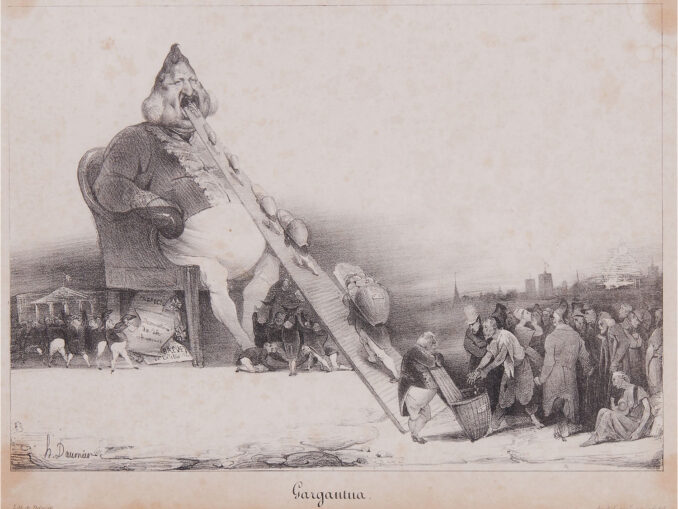
opening image: Gargantua from the journal La Caricature by Honoré Daumier (French, 1808–1879)