
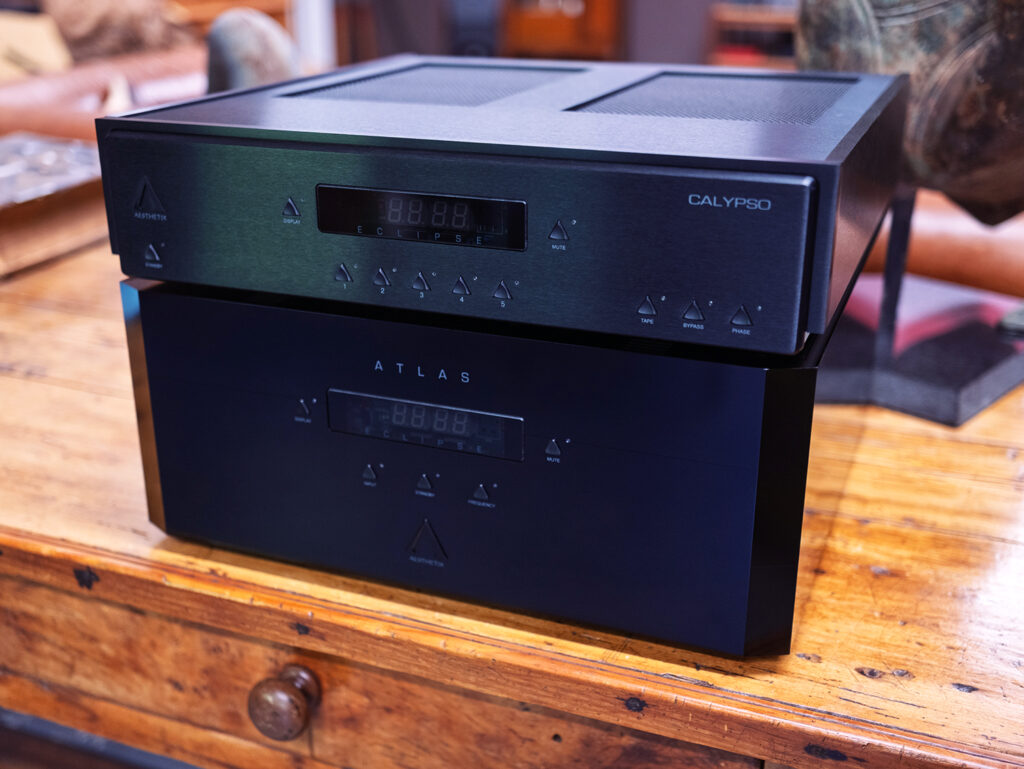
Continuing our working theme—the summer of stacks!—enter the Aesthetix Calypso/Atlas pre/power combo both dressed up in the upgraded Eclipse version.
I reviewed and glowed enthusiastically about the Aesthetix Mimas Integrated Amplifier last July (review) about which I concluded:
It’s no wonder the Aesthetix Mimas received such glowing reviews upon its arrival and you can add my glowing review to that list. If the mark of a successful hifi design lies in longevity, the Mimas hits that mark as hard as any integrated amplifier to have graced the Barn with truly outstanding performance regardless of price.
When the opportunity arose to check out some Aesthetix separates, I leapt.
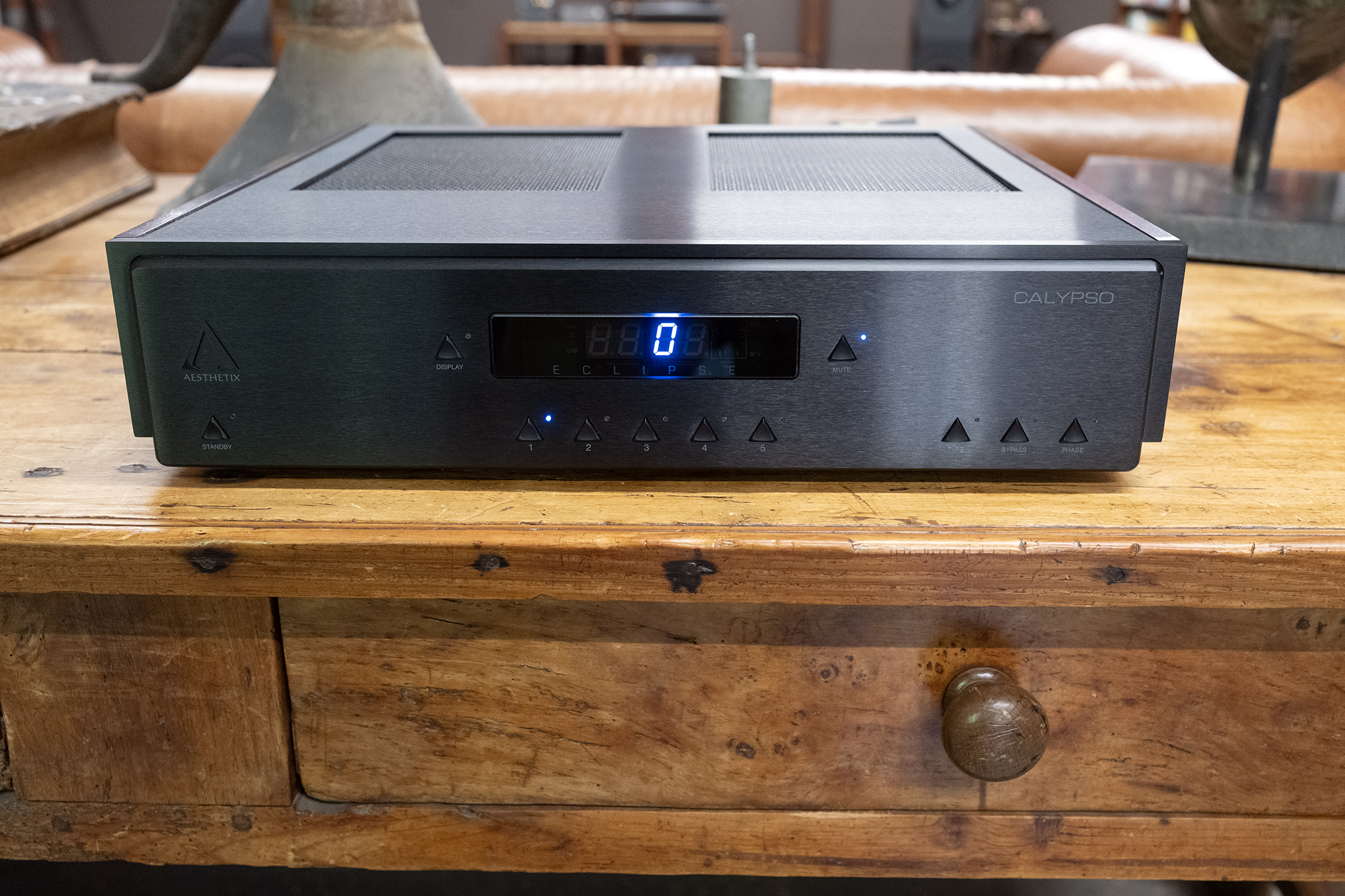
The Calypso Eclipse Tube Linestage carries on the Aesthtix aesthetic (see what I did there?) with its triangular function buttons, blue LED display, and brushed aluminum faceplate for a stealthy appearance. Those function buttons offer Standby, Display (on/off), input selection, Mute, Bypass for use in a Home Theater, Tape, and Phase while the discrete switched resister volume can be controlled by pressing that display—left side for down or right side for up in 1dB increments.
You can also perform these same functions with the included chunky matching aluminum remote which adds a Balance control to the mix.
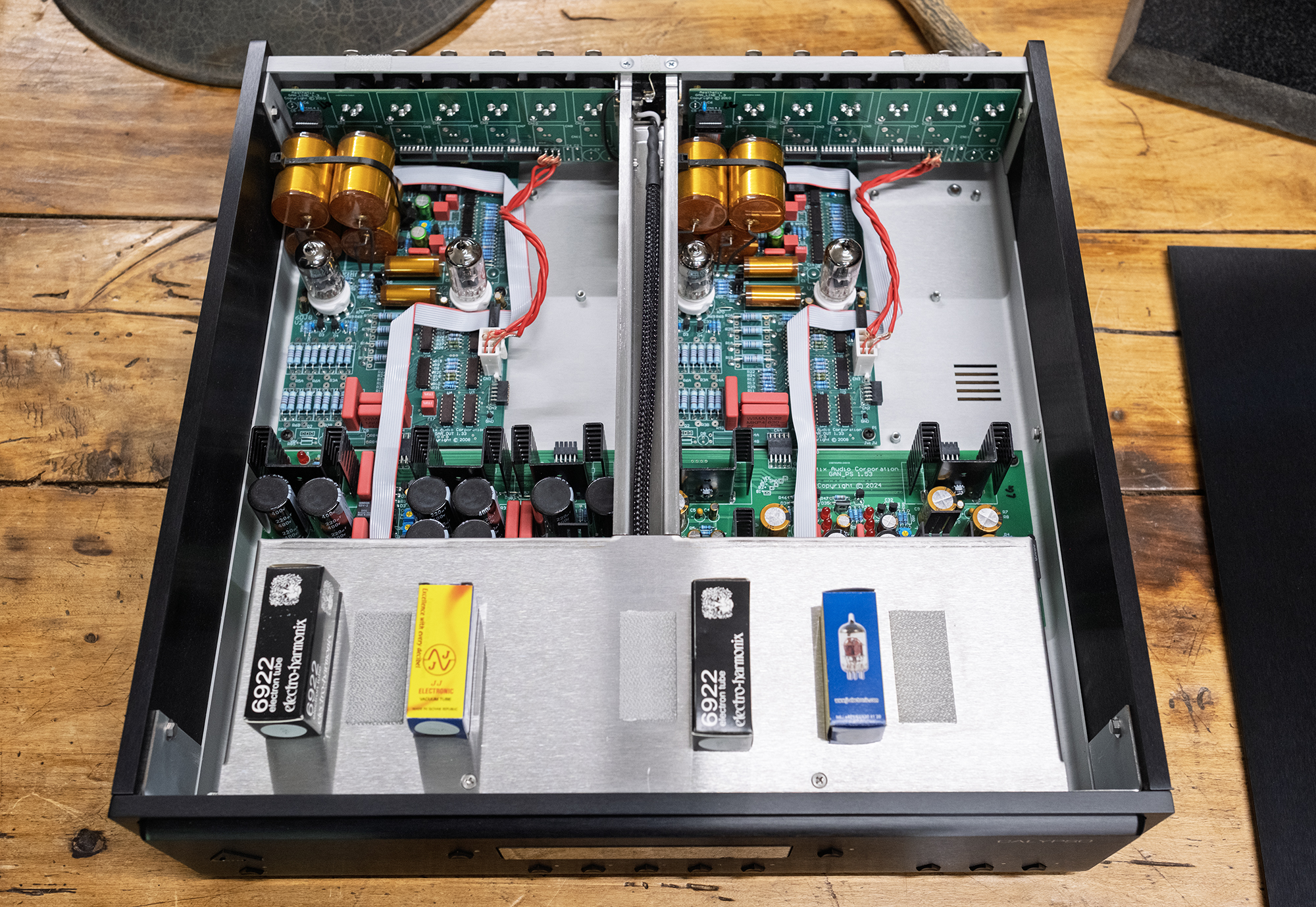
The all-tube Calypso employs pairs of 1x 12AX7 (or equivalent) and 1x 6922/6DJ8 per each channel which reside on on their own separate matching boards. The Calypso ships without the tubes installed so a quick lift of the top cover which is held on by Velcro strips (and gravity) and its plug and play in a few minutes.
Aesthetix offers three versions of the Calypso preamp—Standard, Signature and Eclipse. The Eclipse in for review differs from the others on the inside with a number of higher grade parts. I’ll let the company explain:
First phase: Internal changes to the Calypso start with .22uF / 600v Stealth coupling capacitors used between the gain stage and output stage. Four total of these exotic capacitors are used.
There are four 2uF / 400v coupling capacitors used in each channel of the output stage of the Calypso. In the Eclipse version, these are replaced with Stealth copper foil 4uF/400v, improving low frequency response.
Second phase: High frequency tuning capacitors are installed and hand-adjusted to tailor the frequency response to a tight .1dB standard (as also found on our Signature version).
Third phase: The high voltage transformer, heater transformer and high voltage choke are all re-installed on isolation mounts. Harmonic Resolutions Systems’ Nimbus Couplers specially made for Aesthetix replace the four rubber feet of standard units (as also found on our Signature version). The new power supply is installed with enhanced ventilation. Additional damping material is added to key chassis points.
Fourth phase: A single point ground system is used to ground the transformer cases as they are no longer electrically grounded to the chassis via physical contact due to their isolation mounts. All Eclipse Rhea, Calypso and Janus units receive a new power supply, which has been refined by improved trace routing to further reduce extraneous noise.
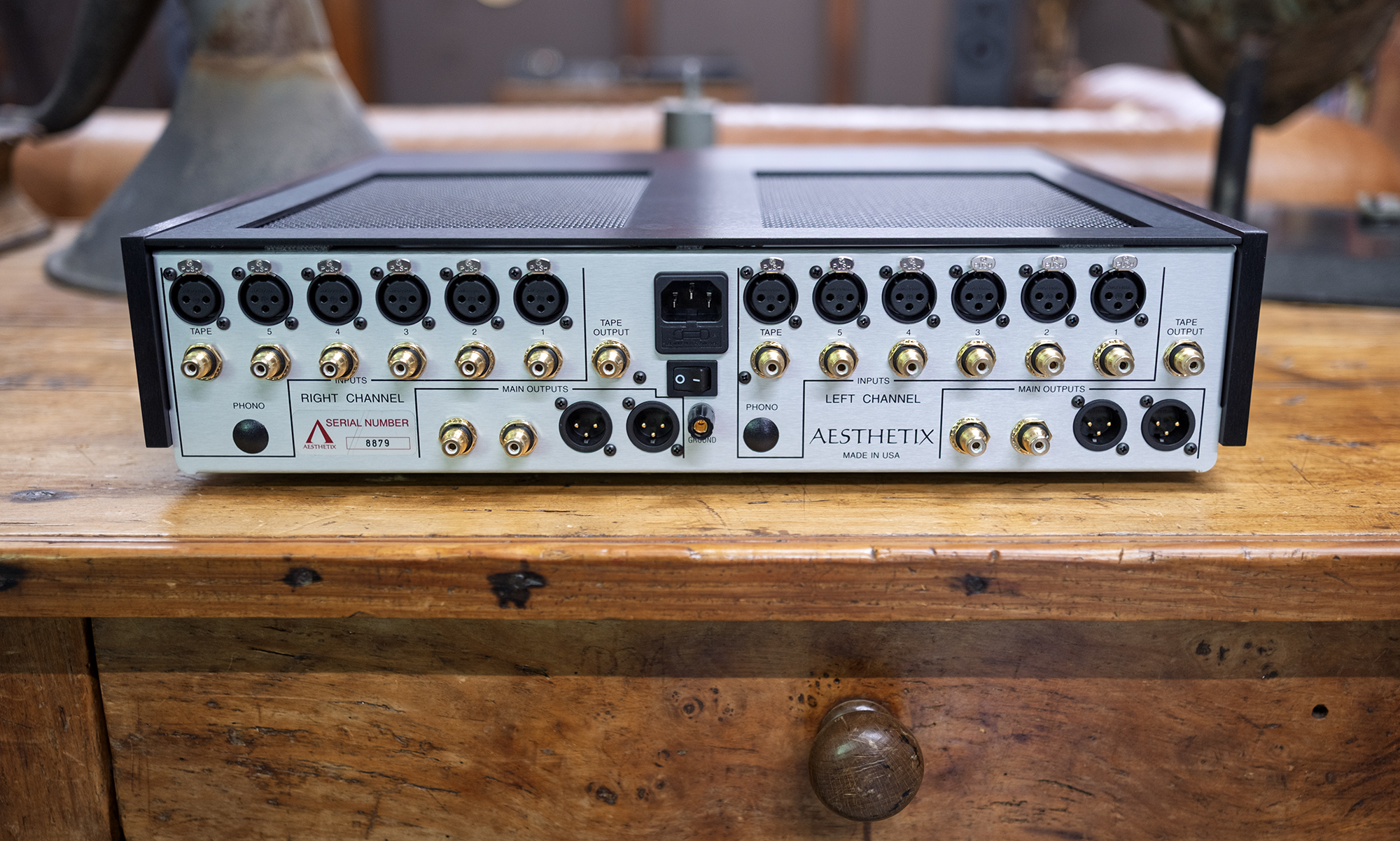
As you probably figured from the five input select buttons up front, there are 5x RCA and 5x XLR inputs around back along with RCA and XLR outputs. An optional Phono board accounts for those unused Phono inputs.
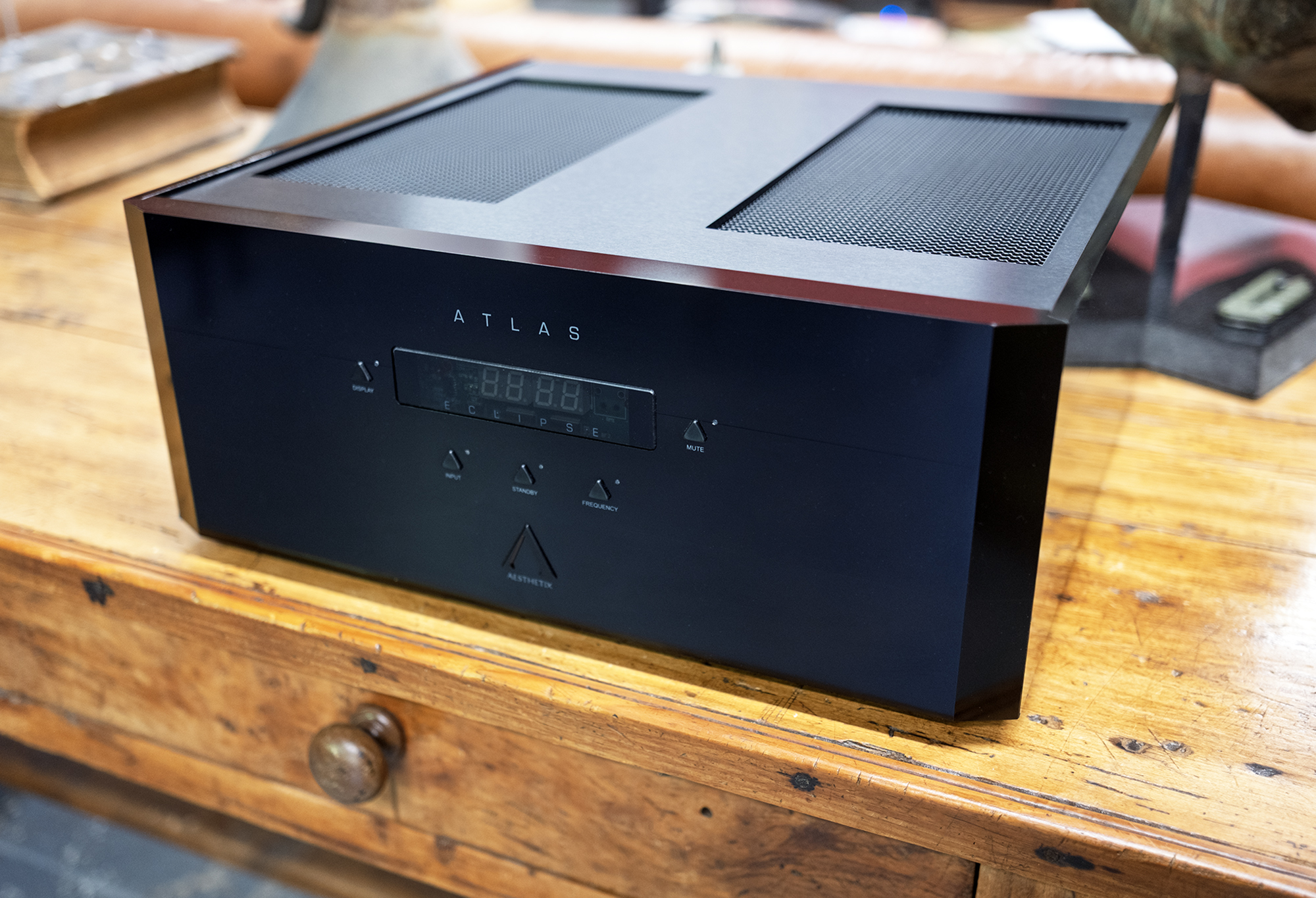
The Atlas Power Amplifier is a hybrid affair combining a bipolar output and driver stage with a vacuum tube input gain stage sporting one 6SN7 per side. The Atlas is rated at 200wpc into 8 Ohms and 400wpc into 4 and weighs in at 70 lbs which is quickly becoming the maximum limit for my body to manage without things breaking the amp or me. Even the Barn’s old farmhouse table is showing signs of weight-related stress.
The Atlas’ front panel houses five triangular function buttons and an LED display and the one button that begs the question is Frequency which provides access to the Hi Pass crossover selection menu offering sixteen values to choose from (40 – 200Hz) when using a subwoofer(s).
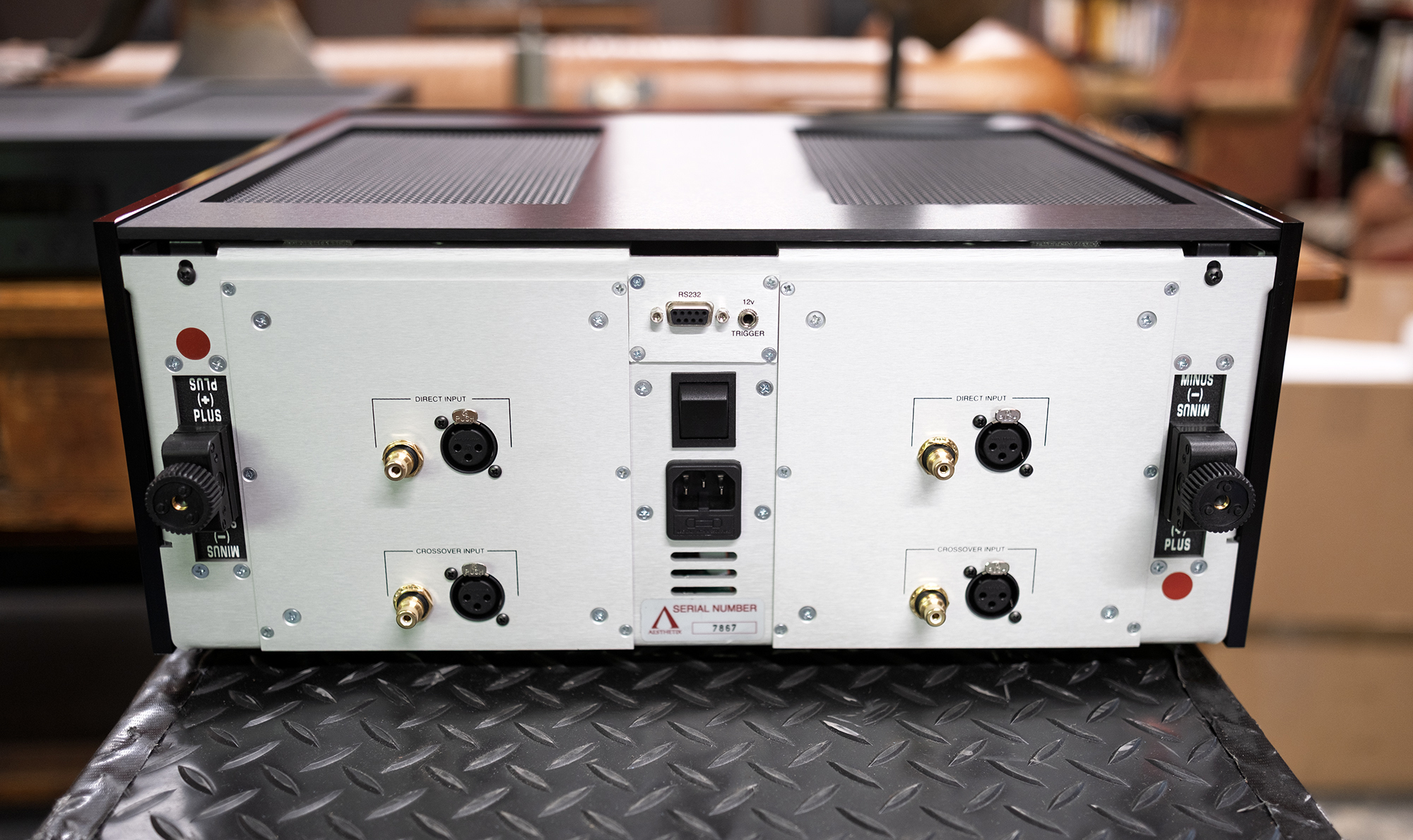
Around back we have what you’d expect to find in a stereo amp with RCA and XLR inputs, Cardas rhodium-plated binding posts, IEC inlet, power switch, and RS232 and Trigger inputs. The extra set of inputs marked Crossover are for use with aforementioned Frequency option.
The Atlas also comes in three versions: Standard, Signature, and Eclipse and I’ll let the company explain the Eclipse difference:
First phase: The Atlas Eclipse Stereo features the Stealthcap™ capacitor, made with exotic new conductors, dielectric material, and composite resins to dramatically reduce reflections, enhancing focus and articulation with blacker backgrounds.
Second phase: The output stage of Atlas Eclipse Stereo features Super Matched Pair output devices, lowering certain output stage distortion components by as much as 40dB. In every version of the Atlas, each Bi-polar output device (16 per channel) is supplied power through a copper bus bar design, radically reducing impedance compared to standard circuit board traces. In the Eclipse version, Distributed node film capacitors are added at each output device, further reducing impedance for increased current capacity and improved transient capability.
Third phase: Critical power supply components: high voltage transformer, high voltage choke, and driver choke, are de-coupled from the chassis using specially designed isolation mounts. This dramatically reduces the amount of mechanical vibration introduced into the chassis.
Fourth phase: Since the transformers are no longer in contact to the chassis at multiple points, a single point system is used to ground the transformer cases, further reducing AC-induced noise. Power supply wiring for the high current section, already robust 14 gauge in Standard and Signature versions, is upgraded to the equivalent of 12 AWG multi conductor audiophile wiring.
Fifth phase (optional): The casework is replaced with machined aluminum pieces that are bolted together using a highly rigid joinery technique… they act as one. In black, the panels are polished to a beautiful reflective sheen. In silver, they are finished in a gorgeous matte texture.
The Calypso and Atlas are very solidly built and available with a silver faceplate for a less stealthy look. I look forward to seeing how the separates separate themselves from my memories of the Mimas. Stay tuned!
Aesthetix Calypso Tube Linestage Eclipse Version $14,000 | Standard Version: $9950
AesthetixAtlas Power Amplifier Eclipse Version: $20,000 | Standard Version: $14,000
Company Website: Aesthetix Audio
Aesthetix Calypso Eclipse Tube Linestage Specificstions
Inputs: 5 line RCA or XLR (balanced), plus 1 tape, RCA or XLR
Outputs: 2 RCA (SE) and XLR (balanced), 1 tape RCA
Line level gain: 23 dB single ended (SE), in/out, and 29 dB balanced/out
Volume control: switched resistor network volume control with 88 1 dB steps
Front panel controls: main input, tape input select, volume, balance, phase, mute, display, and bypass
Remote controls: main input, tape input select, volume, balance, phase, mute, display, bypass and standby
Frequency response: +- 0.25 dB, 20 Hz – 20 Khz
Signal to noise: measured at 70 dB minimum, A-weighted (ref 1 mv input, 75 dB gain setting)
Line input impedance: 40 k ohms SE, 80 k ohms balanced
Maximum line input: 3.5 volts SE, 7.0 volts RMS balanced
Output impedance: 1K ohms SE, 600 ohms balanced
Recommended amplifier load: 10K ohms or greater (SE), 20K ohms or greater (Balanced)
Tubes, each channel: (line section) V1 (12AX7 or equivalent), V2 (6922/6DJ8)
Power consumption: 20 watts standby, 60 watts active
Physical dimensions: 4 3/8″ high, 17 7/8″ wide, 18″ deep including jacks
Shipping weight: 40 lbs.
Aesthetix Atlas Eclipse Power Amplifier Specifications
Power Output: 200wpc channel into 8, 400wpc into 4
Input Sensitivity: 60mV (1 watt), 2.3V (full power)
Input Impedance: 470K
Output Impedance: .25 at 1kHz
Signal to noise: 120dB
Bandwidth at full power: 4 – 150kHz
Rated THD at full power: <1%
Power consumption: 100 watts at idle
Dimensions: 18″w x 8″h x 19″d
Weight: 70 lbs
Finish: black or silver
Warranty: 3 years, non-transferable